The Bicycling World, Vol 7, No 23
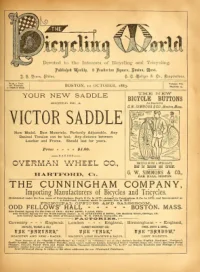
Articles in this issue
- The leader argues that a tricycle's gearing lets a rider trade power for speed to suit hills, poor roads or a weak rider, an advantage the bicycle lacks, and warns amateur trick-riders billed as "Professor" not to invite the assumption they are paid professionals. The trailing notes cover a Cyclists' Touring Club member reunited with English relatives through the club's Gazette, Cambridge's road repairs and Harvard's planned cinder track, and the disputed protest against the Eagle Club's Finley at the Brockton races.
- Henry W. Williams, solicitor of American and European patents, reports four new U.S. patents: Wm. Klahr's small-front-wheel bicycle, Harrie B. Hart's adjustable bicycle saddle, Harold Serrell's clockwork alarm bell, and Wm. Asbury's U-shaped tricycle body iron.
- Alfred Nixon rode a Sparkbrook National tricycle from London to John o' Groats, about 750 miles, in 8 days 23 hours despite windy, rainy weather — a record the paper reckons beats any prior bicycle run of the route.
- A financial post-mortem of the Springfield tournament: total receipts topped $20,000 from over 40,000 admissions and the exhibition, fireworks and races all turned a profit, but the camp and dining tent lost about $6,200, so the club is billing wheelmen for reserved-but-unused tents and selling off 1,000 leftover camp cots at seventy-five cents apiece.
- Four reader letters: Charles F. Frazier disputes the editor's Springfield race-time and foul rulings against him; E. A. Griffith, president of the Maryland Bicycle Club, denies the club ever protested R. F. Foster; John S. Prince rebuts the claim that his races with Higham were fixed; and J. R. Torrance, L.A.W. consul at Troy, gives a route from Bennington, Vermont to Albany, New York.
- Miscellaneous notes: Hill & Tolman's new automatic alarm made for the American Star, the Springfield Club voting to hold a second three-day tournament in September 1884, a planned visit by New York's Citizens' Club to Boston's Massachusetts Club, and a Massachusetts/Hawthorne Club delegation's muddy ride to the Brockton races.
- The Boston Bicycle Club's hundred-mile road race from South Natick and back is won by Thomas Midgley (Rudge) in 9h 47m, with Theodore Rothe second and L. A. Peabody third, despite falls along the way by Packard, Peabody and Wood; additional notes cover broken handle-bars, Frazier's cramp-forced retirement, and the sportsmanship among Midgley, Rothe and Frazier.
- Reports races at Brockton (Carr, Burnham, Frazier, Robinson and others), Buffalo, and Washington (Keen vs. Prince), plus notes on Binghamton, Plymouth (N.H.), the Maryland Bicycle Club's Baltimore meet, and Washington's coming hundred-mile path race, plus items on Prince's $50 challenge deposit, Ed Pettus's challenge to Pitman, and Hendee's win over Robinson as cabled to Cyclist editor Henry Sturmey.
- Club notes: the Boston Ramblers' social evening making Mr. Noon's small daughter an honorary "club baby," new officers elected at the Salem, Clinton, Lancaster and Cleveland bicycle clubs, the Trojan Wheelmen's new clubhouse in Troy, N.Y., and the Germantown Bicycle Club's resolution on the Pennsylvania Division L.A.W. parade.
- C.T.C. notices: the 1884 Harrogate meet set for the first Monday in August, details of the new C.T.C. uniform with photos available from photographer Partridge of Boston, and the 1883 club handbook obtainable from secretary E. R. Shipton in London for thirty cents.
- Upcoming events: the Newton Bicycle Club's moonlight run through Brookline and Jamaica Plain (13 October), a seventy-two-hour professional race at Madison Street Garden, Chicago (22 October), the Maryland Bicycle Club's races at Baltimore (20 October), and the Washington, D.C. hundred-mile race (26 October).