The Bicycling World, Vol 8, No 3
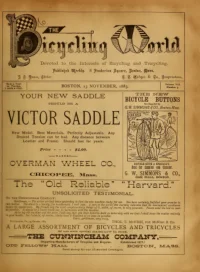
Articles in this issue
- The editor criticizes the Citizens' Club for adopting club colors too similar to the Cyclists' Touring Club's grey uniform, then adds unheaded notes rebutting a Bicycling News claim that the American Star is hard to steer (quoting Fred W. Shearing on rider Herbert S. Owen) and correcting an earlier statement about how English road records are verified.
- A column of short pen notes and a verse ('A Pensive Songlet'), including items on A. H. Overman sailing for England, the Overman Wheel Company's office moving to Chicopee, and Mr. Corson's odd load-carrying ride from Rochester to East Rochester, N.H.
- S. H. Day recounts a wheelmen's excursion, led by President Williams of the Massachusetts Bicycle Club, riding from Bar Harbor around Mount Desert Island, Maine, past Somes Sound, Seal Harbor and the 'Ovens' at Sand Point.
- Three letters: one disputing the editor's account of bicycle patents (citing manufacturer T. B. Jeffery), one from League consul N. P. Tyler defending the New Haven track's measurement via surveyor Sylvanus Butler, and short club notes from Montreal, Toronto and Wilmington, N.C.
- About twenty Star-bicycle riders, addressed by pioneer Washington rider H. C. Owen, met at Turn Hall for an informal run through the city, with drill evolutions led by Messrs. Owen and Harrison.
- Toronto Bicycle Club members led by Capt. McBride and Lieut. Ryrie rode from Toronto to Trenton, Ontario, covering 117 miles in a day, the longest one-day distance yet recorded in Canada.
- Major Thomas Knox Holmes, a 77-year-old retired hussar officer, rode a tricycle for five hours on the Crystal Palace path, covering just over fifty-three miles.
- Mr. and Mrs. T. S. Smith of the South London Tricycle Club set a ten-mile sociable-tricycle record on a Surrey Machinist Company machine, timed by G. P. Coleman of the National Cyclists' Union.
- Miscellaneous racing notes, including a discrepancy in Burnham's cyclometer reading and a call for the League of American Wheelmen to stop sanctioning races on improperly measured tracks such as those at Springfield, New Haven and Washington.
- John N. Pearsons, Frank R. Parker and Moses Sheriff of the Manchester (N.H.) Bicycle Club attempted a twenty-four-hour run from Epping; Pearsons covered 130 miles while Sheriff finished his century on foot after a fall.
- A new professional baseball ground being built at the Coliseum grounds on Dartmouth Street will include a quarter-mile cinder bicycle track with its own dressing rooms.
- Capt. B. T. Harrington of the Hawthorne Bicycle Club of Salem completed a hundred-mile road ride despite breaking his handle-bar and bending a crank en route.
- Mr. G. L. Parmelee of Boston describes a month-long, roughly 250-mile bicycle tour through Athol, Wilmington, Vt., and North Hadley to Ware and back via Worcester.
- Frank W. Westervelt and O. N. and C. E. Whipple of the Springfield Club rode a 101-mile century from Springfield to Boston's United States Hotel in twelve and a half hours.
- Race results from Rockford, Ill. (W. J. Morgan) and Cincinnati (Landy, Hodge, Hosea, Pierson, Galway), plus notes on the Harvard Bicycle Club's hare-and-hounds run, the collapsed Keen-Prince match, and W. J. Morgan's open challenge to all comers.
- Club news including Rockford's new officers, the Charlestown Bicycle Club's new uniform, a recap of the Harvard Bicycle Club's season, the Springfield Club's assessment to cover its deficit, and the Cattaraugus County 'Cyclist Club's renaming to the Randolph Bicycle Club.
- Answers to Correspondents fields readers' questions on lamps, oil cans, postage stamps and club uniforms, including a note to C. A. Hazlett on New Hampshire riders' extended century mileage.
- A note from B. B. Ayers of Chicago on which railways carry bicycles free or at reduced rates, including the New York, West Shore and Buffalo Railway and the Wisconsin Central Railroad.