L. A. W. Bulletin and Good Roads, Vol 24, No 1
Articles in this issue
- Readers' letters on cycling questions, including 'Does It Pay?' (favoring the B. & O. over the Pennsylvania Railroad for carrying wheels free), the 'Car-Track Nuisance' arguing for grooved street rails, 'Meet to the Right' on cornering, and 'A Mighty Good Thing' describing the Brooklyn 'Whirling Dervishes' club's pledge against scorching.
- Editor Sterling Elliott's leader opening the new volume of the L. A. W. Bulletin, reflecting wryly on critics, would-be editors, and the paper's role for the League of American Wheelmen.
- A Fourth of July editorial likening the League of American Wheelmen's fight for free roads and freedom of movement to the patriots' fight for liberty, and citing membership-application growth from 1894 to 1896.
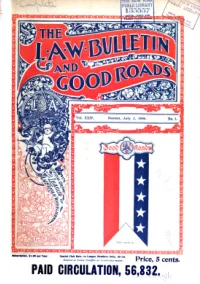
- An editorial reporting reader support for replacing the League's royal purple with a red, white and blue ribbon bearing white stars and the words 'Good Roads,' as shown on the front cover.
- An editorial on the dispute between the National Cycle Board of Trade and the manager of Madison Square Garden over hiring the hall for the cycle show, arguing the expensive shows should be wound up.
- An editorial urging League members to discourage 'sporty,' 'freaky' and exhibitionist riders from joining the League of American Wheelmen so as to preserve its good name.
- A touring department of signed route descriptions, including Richard H. Jackson's New York to New Hampshire ride through the Berkshires, a Lakes George and Champlain tour, and Harry L. Maxson's New York to Washington trip over the Maryland Division's Route 29.
- A correspondent (No. 107,104) recommends a slightly inclined riding posture between the upright and 'camel back' positions to relieve back ache, citing a doctor's advice given to a lady rider.
- F. U. Adams's feature on the emerging motor-vehicle industry in France, Germany, England and America, covering the Times-Herald Chicago contest, the planned Providence and Paris-Marseilles races, and the Kane-Pennington motocycle exhibited in London.
- Sterling Elliott describes and illustrates his unpatented baggage-car fixtures of overhead hooks and wall castings for storing bicycles without damage, exhibited at the Saratoga Springs car builders' convention.
- An editorial drawing a parallel between keeping one's bicycle in repair and keeping one's own mind and body healthy through proper food and exercise.
- A department noticing newly issued bicycle catalogues from the Remington Arms Co., the Victor Saddle Co. of Detroit, and the Hardy Cycle Co. of New York.
- Trade items including a new Morgan & Wright repair and replacement depot for Boston at the Elastic Tip Co., and Tom W. Winder's organized bicycle tour through Yellowstone Park.
- The Good Roads department, opening with 'Good Roads and Patriotism' on the wheelman's road tax, the satirical 'Wickedest Men in America' about Chicago citizens arrested for sweeping their own street, and 'Illinois for Good Roads' on the state Democratic convention's Good Roads plank.
- The League's official directory listing 1896-97 officers (President Sterling Elliott, Secretary Abbot Bassett), standing committees, the Racing Board, and division chief consuls and secretary-treasurers state by state.
- Racing Board notices listing riders transferred to the professional class, suspensions for competing in unsanctioned races (including riders at St. Louis, Fresno, Milwaukee and Paducah), National Circuit date changes, and sanctions granted for Independence Day and summer race meets.
- Per-division official notices including the Massachusetts and Minnesota League hotel lists, Pennsylvania's call for local consuls and constitution revision, the Maryland Division meet at Cambridge, and chief-consul elections for the newly established Nevada, Louisiana and Georgia consulates.
- The long state-by-state and club-by-club list of new membership applications received up to July 3, 1896, totalling 1,435 names and bringing League membership to 57,025, with renewal and new-club listings.
- A reader department answering questions such as whether the L. A. W. has a junior department (it does not; members must be at least eighteen) and the best clothing for a bicycle tour.