L. A. W. Bulletin and Good Roads, Vol 24, No 10
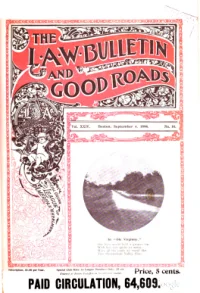
Articles in this issue
- Signed reader letters interleaved with the advertising, including G. Stanton Floyd-Jones refuting a New York World charge that wheelmen damaged his Massapequa roadside pump, D. J. O'Connell on the etymology of 'bicycle,' a plea to disqualify begging 'tramp' riders such as 'Willie J.,' and J. Lee Burbeck on California road gallantry.
- Editor Sterling Elliott answers the angry letters provoked by the Bulletin's August 14th currency-question article, defending the paper's right to discuss any subject and quoting a dismissive Salt Lake City letter as a specimen of 'the various stages of intellectual development.'
- An editorial argues the bicycle is no more inherently dangerous than a baby carriage or a hat-pin; the real hazard is the reckless person handling it, and dangerous men, not machines, should be suppressed.
- A humorous feature argues the bicycle is the supreme modern match-maker, letting courting couples escape chaperones, maiden aunts, and meddlesome little brothers as the hammock and carriage never could.
- The Missouri Division's Transportation Committee reports that the St. Louis Transfer Co. charges 50 cents to haul a bicycle about the city against 25 cents for a trunk, and names rival express companies that carry wheels at trunk rates.
- Extracts from Charles E. Vail's Salt Lake City booklet 'The Bicycle and Saddle; Their Relationship X-Rayed by Reason' prescribe a forward inclination that keeps the rider's weight in — not upon — the saddle for full control.
- Reports, quoting the Cleveland Leader, that the Erie Railroad is challenging the law requiring bicycles to be transported free as baggage, charging for inter-state service and forcing owners to personally tend their machines at every change of cars.
- A reader from Anderson, Ind. (No. 84,798) urges wheelmen of all parties to form political clubs before the November election so that a display of half a million wheelman-voters will force good-roads planks into future national platforms.
- Chief Consul Sterling Elliott describes negotiations with the New England Passenger Association that produced a voluntary reduced-rate schedule — 10 to 100 cents by ticket price — for carrying wheels, effective throughout New England on October 1st, 1896.
- George Appleton of Providence, R.I., recounts how his dour neighbour Ichabod Hansen, prematurely aged at forty-five, took up cycling after his family did and declared himself 'a boy again' for the first time in his life.
- A compilation of letters from L.A.W. members who steer their freight and passenger business to railroads that carry bicycles free, one claiming to divert at least $2,000 a year away from lines that charge extra for wheels.
- C. E. Farrington of Brooklyn gives detailed turn-by-turn cycling directions from Haines' Corners through Tannersville, Onteora Park, the Plaaterkill and Overlook Mountain Houses, Hunter, and Woodstock, with road conditions and scenic viewpoints.
- Reports the founding dinner at Louisville on August 13th of a club for members of ten or more years' standing — credited to Abbot Bassett — with James R. Dunn of Massillon, Ohio, as president, and lists all twenty-eight charter members with their L.A.W. numbers.
- Quoting the Portland Oregonian, recounts Armine Steiner and William Miller's fortnight crossing of the Cascade Mountains on a tandem from Salem to The Dalles, riding 400 of the roughly 475 miles.
- A reflective sketch reprinted from the Kansas City Star in which the narrator's companion Millicent extols the macadam road over asphalt, brick, and woodland paths, tracing her reverence to childhood memories of the Kingston Road.
- A St. Louis reader (No. 7,466) describes a Pastime Club preliminary heat in which 12 to 22 starters produced six to thirteen falls and a broken collar-bone, and proposes an L.A.W. rule limiting any race to ten starters or running it in heats.
- David Wechsler, writing in the Seattle Post, argues the bicycle vote is reshaping American citizenship — breaking New York's granite-paving ring, advancing good roads in Connecticut and New Jersey, curbing scorching, and drawing women and youth outdoors.
- The Bulletin devotes two pages to readers' currency-question letters under a fixed heading, printing arguments for free silver and remonetization (from H. Pembroke and others) alongside a Newark News report of Mercer County, N.J., failing to sell road bonds without a gold clause.
- Overseas briefs including Miss Londonderry's return to Boston from a 28,000-mile round-the-world ride with £1,600, the Prince of Naples compensating a working man whose bicycle his carriage wrecked, and British objections to motor-cycle pacing in racing.
- Will E. Ferguson (No. 73,017) explains his method of oiling each chain link individually while spinning the wheel, then cleaning and graphiting it, so the chain runs some eight hundred miles without screeching or stiffness.
- John R. Fox of Devizes, England — twelve years a parish way-warden — describes English main and parish road construction, drainage, the preference for hand-broken stone over machine-crushed, and how the old turnpike tolls gave way to maintenance by rate.
- The League's official pages list the 1896-97 officers (President Sterling Elliott, Secretary Abbot Bassett), the standing committees and Racing Board members, and the chief consuls and secretary-treasurers of every state division, followed by the membership-application and renewal forms.
- The Racing Board's official report records professionals declared, suspensions and reinstatements, a $50 fine on Thomas Cooper and E. C. Bald for misconduct at Louisville, accepted Louisville tandem records, and sanctions granted for September race meets across the country.
- Consolidated division notices, including New Jersey Chief Consul Robert Gentle's membership appeal, New York and North California hotel-discount and road-book announcements, Oregon's board meeting, Nebraska's officer nominations, Rhode Island's State Meet souvenir, and the new Ohio glass-and-tack law.
- The statutory state-by-state list of 1,093 new membership applications received up to September 4th, published under Article III of the constitution, with members invited to protest objectionable applicants within two weeks.
- The editor's reply column answers readers on a discontinued ladies' department, sprocket-wheel sizing, a half-serious physics query about whether a heavy or light rider gains against a strong wind, and (under 'Why the Rear Wheel Goes Faster') why driven and coasting wheels turn at different rates.