L. A. W. Bulletin and Good Roads, Vol 24, No 16
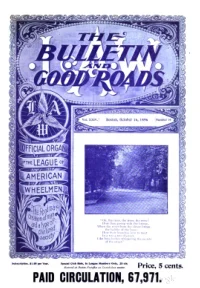
Articles in this issue
- Readers' letters argue amateurs love their wheels while professionals encourage track dishonesty (Professional vs. Amateur) and point Route 43 riders to Portsmouth, R.I.'s only good road near Cornelius Vanderbilt's Oakland Farm (The Better Way); further letters cover the Grand Trunk Railway overcharging tourist Ernest H. Rowe at Thorndale, Ontario (Not a Square Deal), J. F. Summerfield's kerosene-and-graphite chain routine (Care of Chain), and S. W. Balch's account of New York wheelmen mimicking truckmen's cargo nicknames to clear a path (The Open Sesame).
- Editor Sterling Elliott announces a reciprocal advertising scheme for the coming season whereby manufacturers who give approved L.A.W. mentions in their catalogues receive an equivalent amount of Bulletin advertising space, with relative circulation taken into account.
- An editorial argues cycling is no passing fad but a transformative distance-destroyer that brings city and country together and will continue to grow into the coming seasons.
- The National Cycle Board of Trade adopts uniform guarantee wording for 1897 pledging six-month repair or replacement of defects, and votes to leave the conduct of cycle racing entirely to the L.A.W. by discharging its own racing committee.
- Reprints the failed federal highway-commission bill and the substitute joint resolution — passed by the House in June 1896 but stalled in the Senate during the St. Louis Convention — extending the Agriculture Department's road-inquiry work to cover highway location, road-material testing, and reduced freight rates, with members urged to lobby their representatives.
- The Racing Board suspended riders who competed in an unsanctioned race after promoters falsely claimed a sanction, prompting the Bulletin to call for a new rule punishing such misrepresentation by promoters.
- A New York member proposes the L.A.W. invite manufacturer bids for an exclusive 'League bicycle' sold only to members at the agent's discount, reasoning wheelmen would join for $2 to save several times that on a wheel.
- Responding to complaints about defective tires, the North American Rubber Co. of Setauket, N.Y. explains in a letter to Sterling Elliott that its low-priced unguaranteed tires were resold as guaranteed by jobbers and wheel makers, so the dealer rather than the maker must make them good.
- President Sterling Elliott discloses that L.A.W. members insured through the American Wheelman's Protective Association of Chicago are dissatisfied after theft claims were disputed over vague 'due diligence,' and offers to refund out of pocket any premium paid by a member not properly treated by the company.
- Under the newly adopted New England railroad schedule all roads are responsible for the bicycle itself and a release is asked only for cyclometer, lamp, and tool bag, yet some baggage handlers — notably on the Fitchburg — are still wrongly refusing wheels or demanding full-machine releases.
- Two pages set apart for the gold-versus-silver debate, opening with the editorial 'Why Do We Need Money?' on the bank-and-check system and quotations from Senators Stewart and Jones for the gold standard, and continuing with reader contributions including 'Cracker Barrel Philosophy' (free silver would double bicycle prices) and a chief consul's defense of the producing class against plutocracy (No. 30,827).
- Charles Fuller Gates of Los Angeles surveys road and cycling conditions from the sandpapered roads around San Francisco Bay to the desert trails of the Southwest, describing the Los Angeles County road-sprinkling programme of wells and windmills extending toward Pomona and Riverside.
- H. G. Bradbury of Minneapolis describes the gravel cycle-path along Lake Harriet built under Park Superintendent W. M. Berry, and the first-class gravel inter-city path jointly funded by Minneapolis and St. Paul wheelmen.
- A Good Roads department editorial argues that with long-haul railroad freight rates reduced, attention has shifted to the local wagon road, and that every neighborhood must now improve its own roads to rescue farmers from the hidden cost of mud.
- F. N. Vail corrects Colonel F. V. Greene's earlier Bulletin article, citing 210,000 square yards of Alcatraz asphalt laid in Santa Barbara in 1887 and nearly a million square yards of California asphalt pavement nationwide in five years as proof of its proven worth.
- The League's official department lists the 1896–97 national officers (President Sterling Elliott, Secretary Abbot Bassett, Treasurer E. S. Hartwell), the standing committees including the Racing Board and Highway Improvement, and the state-by-state division chief consuls and secretary-treasurers, followed by the membership application and renewal blanks.
- The roll of 180 qualified League clubs listed by state, with certificates electing representatives of the Pastime Cycle Club of Green Bay and Kaukauna League Club to the Wisconsin Division board of officers.
- Consolidated division business: rival Michigan tickets (official vs. Independent-Progressive headed by Edward N. Hines), retiring Tennessee chief consul Charles J. Scherer's address, nomination and election notices for Utah, North California, Iowa, Arkansas, Massachusetts, and Indiana divisions, and Ohio local-consul appointments.
- The weekly state-by-state lists of membership applications, renewals (Renewal List No. 13), local consuls, and League hotels published under Article III of the constitution, totaling 652 applications and a paid membership of 69,879.
- The readers' Q&A column fields questions on the humped riding position, the metric system, Century Road Club rules (100 miles in 14 hours; president Wm. A. Skinkle of Cleveland), ball-bearing lubrication, and corrected Massachusetts road-book hotel listings.