L. A. W. Bulletin and Good Roads, Vol 27, No 11
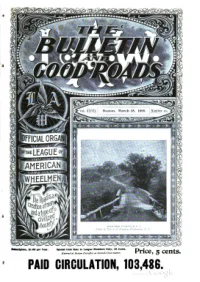
Articles in this issue
- A proposal to build a two-story elevated structure along the New York river front from the New York and New Jersey bridge terminal at 55th Street to the Battery, the upper story carrying a boulevard, bicycle path, and promenade at an estimated $1,000,000 per mile.
- A new Vineland, N.J. regulation forbids wheelmen from using sidewalks under any circumstances despite the bad streets, with the editor urging local League members to organize; followed by short Good Roads items on toll roads (member No. 188,957) and on road instruction by Ed. Lockett of the Pasadena Better Roads Society.
- Editor Sterling Elliott's lead essay argues that the bicycle conveys city-dwellers to the rural surroundings where the year's great transformation — spring blossoms, birdsong, and brook-cooled forests — can truly be witnessed.
- The editor examines circulating statistics claiming 264 cycling deaths since 1894 (versus 333 from horseback riding and 1,350 from swimming), arguing that cycling's dangers are overstated given the millions who ride and that nine-tenths of accidents could be avoided.
- The editors evaluate the revived 30-inch bicycle wheel and conclude that the 28-inch wheel is adequate for good roads, requires proportionally less weight for equal strength, and that the only argument for a larger wheel is appearance for very tall riders.
- A trade essay on the long-standing practice of taking old bicycles in trade, explaining how competitive pressure eroded dealer margins and how the steep 1898 price reductions will further depress the market value of second-hand wheels.
- An editorial on women's cycling apparel, arguing that a cycling costume demands more careful selection than any other garment — neither too dull nor too brilliant in color, and modestly cut — since a mounted cyclist is conspicuously before all observers.
- A recent English invention attaches a small horizontal guard wheel behind a pacing multicycle so that a following rider who strikes it is merely deflected sideways rather than colliding, with a proposed wind shield above it; followed by Wisconsin's Century Road Club plan to petition the Legislature for a $500,000 road appropriation.
- Theo. F. Merseles argues that the L.A.W., rather than concentrating on racing, should establish a touring department drawing on its consuls to gather and distribute current road conditions, best routes, hotels, and repair shops, making League membership more broadly valuable.
- The Maryland Division, L.A.W. is advancing bills in the State legislature for a road investigation commission, State stone-crushers, tax exemption for county road bonds, and county bond issues for roads upon petition of 200 taxpayers; with notes on a Bridgeport, Conn. Good Roads meeting and a new Kentucky baggage law.
- An enthusiastic Good Roads convention at Anniston, Alabama drew 400 delegates and organized a permanent association, adopting recommendations to amend the State constitution so that County Commissioners may issue bonds for roads and bridges.
- The thirteenth instalment traces American cycling from the 1876 Centennial Exposition through the American Star (patented Nov. 23, 1880), the American Safety of 1885, the Springfield Roadster, the Eagle, and the Broncho of 1890, describing each machine's drive mechanism and rider position.
- A notice of the New York State Museum Bulletin "Road Materials and Road-Building in New York" by Dr. F. J. H. Merrill, which includes photographs of standard road construction, a geological map of useful rock distribution, and quarry locations for road metal.
- County commissioners in Montana oppose the new State road law because it transfers highway authority to county surveyors, who would be required to define and map public roads, keep them in repair, and superintend all construction; with a note from W. A. Platt of the Colorado Springs Chamber of Commerce on its new good-roads committee.
- The recurring "Ad. Critic" department invites readers to write in evaluating five Bulletin advertisements, with a five-dollar prize awarded each week fourteen days after the issue date to which the letters refer.
- Opening the Good Roads department, Prof. W. C. Latta's Indiana survey finds improved highways raise land value an average of $6.48 per acre and that poor roads cost $76.28 annually per 100 acres; followed by "The Ravages of Narrow Tires" (quoting the Springfield News) and the drainage item "In the Wrong Place."
- The League's official roster of national officers (President Isaac B. Potter, Secretary Abbot Bassett, Racing Board chairman Albert Mott) and standing committees, followed by the state-by-state list of Division chief consuls and secretary-treasurers and the membership application and renewal blanks.
- Renewal totals by State for March 7-12 followed by consolidated Division reports: Massachusetts standing committees, the Maryland good-roads bills, Nebraska and Wisconsin consul appointments, Vermont's 1,000-member recruiting premium, Ohio and Indiana renewal drives, Michigan's Honor Medal, and the New York State Division's 1898 Honor Badge.
- Chairman Albert Mott reports suspensions and rulings (John S. Wiese of Akron, W. A. Flager of Greeley, Geo. E. Myers and H. S. Mackley of Cleveland), professional-class transfers, registrations, an extract of the 1898 Racing Rules on tracks, and approved team contracts for Henry E. Ducker and Dudley Marks; with Stolen Wheels and L.A.W. Supplies notices alongside.
- The state-by-state list, published under Article III of the constitution, of membership applications received up to the Monday preceding, together with sanctions granted for club meets at Philadelphia, Baltimore, Reading, Paterson, and Morristown.
- The reader-query department answers correspondents on gearing (No. 45,339), 30-inch wheels (No. 106,391), touring routes and English wheeling costs (No. 100,104), bicycle enameling (No. 7,797), and a Chicago-to-San Francisco route sought by John A. C. Huennekens of Milwaukee; with items on a proposed Pittston toll road and Boston street-sprinkling complaints.