L. A. W. Bulletin and Good Roads, Vol 27, No 14
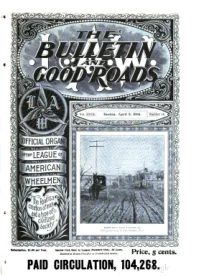
Articles in this issue
- A photograph by L.A.W. member No. 175,180 documents a badly deteriorated stretch of the Chambersburg and Bedford Turnpike in the borough of Everett, Pa., contradicting the company president's recent claim to the Bulletin that the road was kept 'the very best possible under the circumstances.'
- Member No. 66,869 endorses a proposed L.A.W. Touring Department but urges the League to retain control of racing as well, arguing that combined League management would best protect members' rights.
- Editor Sterling Elliott's leader on the contradiction between nineteen centuries of Christian teaching and the public clamor for war with Spain, noting that gamblers oppose war while many ministers advocate it, and that a nation forbidding Sunday cycling now embraces 'hundred-ton guns.'
- An L.A.W. member bought a bicycle catalogued at twenty-three pounds but found it weighed over twenty-seven; after the seller refused a refund, the buyer's attorney forced return of the purchase price.
- An editorial arguing that the League grew only when it championed Good Roads rather than racing, warning that 1897's racing controversies have again overshadowed highway reform, and calling for a Bureau of Touring Information and disentanglement from racing.
- A satirical editorial cataloguing the 'dangers' of cycling: it cures insomnia, destroys poor appetite and dyspepsia, and makes pessimists cheerful, ruining all the pet ailments of the sedentary.
- A critique of the class of bicycle inventors who, having just learned to ride, rush to patent ideas already proved worthless, contrasted with the practical, experienced men whose incremental improvements actually advance cycle design.
- The Pennsylvania Division's 1898 road book is issued in two pocket pamphlets for the eastern and western sections of the state, compiled by W. W. Randall and Carl Hering, at 25 cents to Division members and 35 cents to others.
- Francis S. Hesseltine, American representative of the Touring Club de France, corrects a March 25 Bulletin article by Joseph Pennell, explaining that membership costs only five francs and grants duty-free bicycle passage into Italy, Switzerland, Belgium, and Denmark.
- The sixteenth installment traces frame development from the 1884 Kangaroo and Rudge through the 1887 Cross Frame, the 1889 Semi-Diamond, Dunlop's pneumatic tire, and the high diamond safety that became standard by 1896.
- Member No. 127,907 photographs a wagon that collapsed on a Pennsylvania road near Forest Lake, Susquehanna County, illustrating how bad roads destroy good wagons.
- The Bulletin's standing weekly contest invites readers to critique five advertisements per issue for a $5.00 prize, the latest going to Louis E. Asher of Peoria, Ill.; submissions address the advertisements themselves, not the goods advertised.
- Member No. 121,338 forwards an American Electrician test: drops of competing oils raced down an inclined glass plate reveal body, flow, and gumming, while copper-dish tests detect acidity, finding mineral lubricating oil least active on bearing metals.
- Reports Hiram Maxim's argument that foot-powered human flight is impossible because a man needs two to three horsepower to lift his own weight — though the editor notes scientists once similarly declared Atlantic steamship crossings impossible.
- Reprinted from the new Pennsylvania road book, a guide to how clay, gravel, shale, sand, loam, and cinder surfaces respond to rain, drought, and frost, to help wheelmen anticipate riding conditions.
- Essex County, N.J., will hold an April 12 referendum on a $1,500,000 bond to finish its park system, adding thirty miles of cyclist-friendly drives with tunnel crossings at every trolley and railroad intersection.
- Civil engineer W. E. Barnes advises that permanent country roads need a level survey and profile, careful grade design to spare draft animals, complete drainage specifications with tile under springy sub-grades, and thorough rolling before any stone is laid.
- Summarises Benjamin Franklin's paper to the Engineers' Club of Philadelphia arguing against clay binders in macadam and for light stone roads of six to eight inches, citing 106 miles of successful four- and six-inch macadam in Passaic County, N.J., and endorsement by State Commissioner H. I. Budd.
- The League's official matter, listing officers for 1897-98 (President Isaac B. Potter, Secretary Abbot Bassett), standing committees, the full roster of Division chief consuls and secretary-treasurers state by state, and the membership application and renewal blanks.
- Renewal List No. 13 totals 2,489 renewals received March 28-April 2; the accompanying notice opens the spring renewal season, grants sixty days' grace, announces new numbers on renewal, and instructs members on how to remit dues.
- Consolidated division reports including Rhode Island and New Hampshire committee appointments and quarterly-meeting votes, Ohio and Michigan recruiting appeals, the Wisconsin League Hotels list and local consuls, an Ohio Cincinnati consul list, and Indiana and Kansas notices.
- Chairman Albert Mott's Baltimore notices recording professional registrations, transfers to the professional class, suspensions (including the permanent suspension of many New Orleans riders for Sunday racing and promoter A. J. Stackpole), national circuit dates, and a list of stolen wheels.
- The state-by-state list of membership applications received in accordance with Article III, running across Arizona, Colorado, Connecticut, Illinois, Massachusetts, New York, Ohio, Pennsylvania, Wisconsin and other divisions, with the procedure for protesting objectionable applicants.
- Member No. 90,925 revives the long-discussed proposal for a cycle path connecting the Jersey City ferries with Newark, N.J., noting that thousands of New Jersey wheelmen working in New York could ride daily but for the marshy, poorly-surfaced Jersey meadow roads.
- Brief replies to members' questions (a beeswax-and-graphite lubricant recipe for No. 171,362; no women's cycling paper exists for No. 76,017), followed by 'Sandy's' comic dialect letter about his father's humiliating militia drill amid the Spanish war scare.