L. A. W. Bulletin and Good Roads, Vol 27, No 22
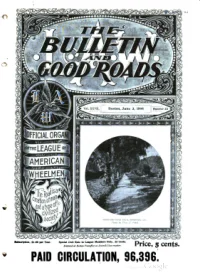
Articles in this issue
- Reports that New York cyclists remain handicapped reaching the good Long Island roads, and that Deputy Commissioner of Highways John H. Madden has submitted to the mayor a cost estimate for side-paths from the Thirty-fourth and Ninety-second street ferries through Long Island City; folds in the adjacent notes "Side-Paths Are Educational" and "Why Wait for Better Roads?" (Albany member No. 36,854 and Prof. W. R. Hoag of the Minneapolis Times).
- Lead editorial reflecting on how uncertain weather complicates cycling outings, advising wheelmen always to plan a route that allows an alternative retreat when a half-and-half morning turns into a soaker.
- Editorial defending the much-maligned scorcher as an ordinary citizen off the bicycle, illustrated by a reader's anecdote showing that drop-handlebar riders are consistently more courteous about lending tools on the road than upright-bar ("Straightback") riders.
- Reprints a Milwaukee Sentinel item describing how Engine companies No. 13 and No. 22 sank axle-deep in mud near Third Street and Meinecke Avenue while responding to a $3,500 fire at the Wisconsin Malt Extract Company plant, as evidence that impassable city streets carry real fire-loss costs.
- Answers member No. 133,711's complaint of stiff index fingers by tracing the numbness epidemic of about 1893 to extreme backward saddle positions and downward-curved handlebars, and argues that a properly fitted 1896-or-later machine should cause no such trouble.
- Quotes a writer in The Engineer on the lateral driving stresses set up by pedal pressure, explaining how the short modern head tube and horizontal top tube give far greater rigidity than long-headed designs, and how D-section rear forks best resist chain tension.
- Surveys the factors that decide coasting contests on a long hill — rider weight, wind and road surface against frame rigidity, clean well-lubricated bearings and especially a resilient tire, which efficiency tests show affects a bicycle more than any other part.
- Tabulates straightaway and standard-course bicycle and tandem road records accepted by the Century Road Club, with marks by A. W. W. Evans (355½ miles in 24 hours at New Brunswick), A. B. McDonnell (Buffalo) and Hulman-Ferguson (Terre Haute), plus J. M. Nobre's 253 centuries and J. H. George's 32,479 miles at Philadelphia.
- Drawing on a copy of Chambers' Edinburgh Journal of January 25, 1834, supplied by I. S. Kinch, shows that the principles and economic benefits of good-road construction were already understood and advocated in Great Britain more than sixty years earlier.
- A dialect verse by associate editor Joe Lincoln in which a plain man reasons that, hereafter or not, one ought to work, do good, and "make your life a light fer other men ter see."
- Divides bicycle makers into three classes by how much work they do in their own factories — those who produce every part, the older makers who buy raw stock and do the vital machining, and the "assemblers" of ready-made wheels — concluding the best machines usually come from the first two classes.
- Reprints W. N. Harris in Cycling on the telltale signs of a rental machine — mismatched tires and rims, dropping nuts, an oil-caked singing chain and a wobbling front wheel — with an editor's note that a liveryman who understands business keeps good wheels; framed by "Cyclers' Snap Shots" photographs from Arizona, Fairmount Park and Falmouth, Me.
- Opening editorial of the Good Roads department likening the dozen-year good-roads agitation to a sower scattering seed, and stressing that the gospel of better highways must be repeated "line upon line" until interest leads to investigation of construction, care and equitable apportionment of cost.
- Reports that Gen. Stone of the Road Inquiry Bureau is to accompany the invading army to Cuba with road-making machinery to build military roads, recounting his discussion with Gen. Miles on the strategic value good roads would have given the Union armies during the Civil War.
- Twenty-six numbered practical suggestions from the Municipal World on forming and maintaining gravel roads — drainage, crowning, clean gravel, tile under-drains and the organization of statute labor — closing with the claim that good roads could halve the nation's $1,000,000,000 annual carting cost.
- The League's official directory edited by Abbot Bassett, listing the 1898–99 officers (President Isaac B. Potter, Secretary Abbot Bassett), the standing committees including the Racing Board under Albert Mott, and the Chief Consuls and Secretary-Treasurers of every state division, with the membership application and renewal blanks.
- Consolidated division notices anchored at Renewal List No. 21 (342 Massachusetts renewals leading): Virginia and Colorado local-consul, hotel and repair-shop appointments; four New York State Division by-law amendments (John F. Clark, M. M. Belding Jr.) for the June 18 meeting; New Jersey's July 14 annual meeting; Michigan membership and repair-shop lists (Leo A. Caro, E. N. Hines); and recruiting appeals from Ohio's Chief Consul W. D. Kempton and Maryland's Conway W. Sams (Mt. Royal Ave. asphalt won by Sherlock Swann).
- The weekly state-by-state list of new membership applications published under Article III of the Constitution, totaling 541 (carrying the League over 131,000 members), the largest blocks being 148 from Massachusetts and 99 each from New York and Pennsylvania; the "Stolen Wheels" notices run in its margins.
- Editor's replies to correspondents F. N. T. and C. H. F. on handle-bar height and forward riding position, plus a note on the puncture-proof "steel ribbon" tire formed of a spirally coiled riveted strip.