L. A. W. Bulletin and Good Roads, Vol 27, No 23
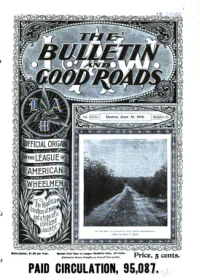
Articles in this issue
- Argues that a fair test of any new bicycle requires at least 500–1,000 miles over the same roads as the old machine, because clean bearings and fresh lubrication make any new wheel seem superior regardless of real merit.
- Editor Sterling Elliott cautions that office-seekers who suddenly discover good roads only at election time are welcome in the League of American Wheelmen, but preference should go to candidates who have been consistent friends of the cause.
- A comic editorial monologue in which a bicycle addresses its incompetent learner-rider, cataloguing the abuse it endures and warning that it will retaliate when the chance arises.
- Notes the irony that male writers who long campaigned for women's dress reform achieved nothing until the bicycle compelled women themselves to shorten and divide their skirts, only for some of those same men to now agitate for the long skirt's return.
- Traces how bicycle racing has risen from a minor footnote on county-fair programmes to the headline attraction, surpassing the baby show and the slow-mule race, and urges League members to use the crowds for good-roads missionary work.
- Citing Chief Justice Foster's ruling that reckless riding constitutes 'social malice,' argues that the confirmed scorcher who menaces pedestrians and other cyclists is criminally careless and the worst type of road-hog on the public highway.
- Examines the claim — spurred by the bicycle's cheapening of horse-flesh — that Americans may adopt hippophagy, quoting a Golden Penny writer on the horse's cleanliness and nutrition, before the editor firmly declines the prospect.
- An American correspondent to the English Cyclist describes a factory producing waterproof-cemented manila-paper rims, stronger than wood and grain-free, at up to 5,000 pairs of 28-inch rims a day, though higher cost prevented their introduction.
- A detailed survey of why brakes fell from fashion with the pneumatic-tire era, a practical demonstration that front-wheel brakes are more powerful than rear, and a classified table of brake types (tire, hub, rim, crank-axle, drum), continuing through p.13.
- Reflects that 'high-grade' has become an elastic term, settling on the definition that a high-grade bicycle is one well-designed throughout of good materials and put together by skilled mechanics — comely to look upon and strong enough for perfect safety.
- The Bulletin's recurring 'Ad. Critic' advertisement-criticism contest, naming the May 20 winners (Geo. H. Leach of Campello, A. F. Moses of Cambridge Springs, Geo. J. Gilbert of Detroit) and inviting readers to judge this issue's advertisements for $5, $3 and $2 prizes.
- Disputes the advice that the knee must remain noticeably bent at the pedal's lowest point, holding that for road speeds up to fifteen miles an hour the heel should simply rest comfortably on the pedal, and that extreme short-reach fashion gives an awkward knee action.
- Reviews 'Practical Training for Athletics, Health and Pleasure' by Randolph Faries A.M., M.D., Director of Physical Education at the University of Pennsylvania, praising its lucid coverage of general health and special athletic events; received from the Outing Publishing Company.
- Traces women's cycling dress from the dangerously long tricycle skirt of fifteen years ago through Bloomer-style experiments and Parisian divided skirts to the practical modified short-skirt costumes of 1898, illustrated by sixteen numbered figures on the preceding plate.
- Announces that Mr. Armstrong's five-part exposition of the Higbie-Armstrong Good Roads Act (signed into New York law March 24, 1898) has been reprinted as a pamphlet explaining petition forms, cost-sharing formulas, and the companion Fuller Bill, with 50,000 copies to be distributed by the State Division, L.A.W.
- Reprints G. E. Johnson of the Louisville Courier-Journal's address to the Kentucky Commercial Convention comparing good roads to the body's arteries and urging Kentucky to begin agitating for State Aid before the next General Assembly.
- League member No. 122,826 complains that the road from Ellsworth to Mt. Desert Bridge, traveled by hundreds of wheelmen bound for Bar Harbor, is now covered with loose round rocks and unrideable after dark, made worse by the work already done on it.
- The L.A.W. official department edited by Abbot Bassett, listing the 1898–99 officers (President Isaac B. Potter, Secretary Abbot Bassett), the standing committees, the full roster of state division chief consuls and secretary-treasurers, and the renewal and membership-application blanks.
- Consolidated division notices and Racing Board bulletins from Chairman Albert Mott of Baltimore — including President Potter's appeal to wartime members, Rhode Island paying enlisted members' dues, the Ohio and Kansas division meets, suspensions and registrations, and the National Championship score led by Gardiner.
- The weekly state-by-state list of applications for League membership published under Article III of the constitution, running through Colorado, Connecticut, Illinois, Massachusetts, New York, Pennsylvania and the other divisions across several pages, with the New Jersey division's notice ending free road books after July 1st.
- A register of stolen bicycles with serial numbers and owners, including a Comet, a Pierce Racer, a Western Wheel Works Special, a Columbia Chainless and a Rambler reported from Massachusetts, New York, Pennsylvania and Michigan.
- The Bulletin answers reader queries on technical points — the diameters of early cushion and pneumatic tires for S. R. E., and a description of leather-lined band brakes acting on a hub drum for No. 70,622.
- A comic phonetic-dialect letter from 'Yure Luvin Neffyu' to 'Uncle Bulatin' recounting how he and Gus, caught in a storm, sheltered in a haunted cabin and scared off the tramps who had stolen their wheels by playing ghosts, then made off with the tramps' stolen chicken and pie.