Vol 28, No 1
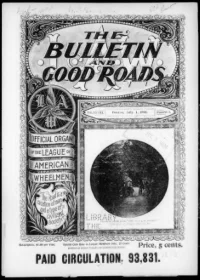
Cite this issue
Citation
L. A. W. Bulletin and Good Roads 28, no. 1 (1898). cyclearchive.com, https://cyclearchive.com/magazines/the-bulletin-and-good-roads/vol28-1/
Page numbers are pages of the PDF, which can differ from the numbers printed on the page.
Articles in this issue
- Verse wishing every scorcher a straight-away track on which to pedal until he could never get back, signed by one of their victims.
- John H. Percy praises the fifty-acre reservoir and encircling road at Highland Park, Long Island, kept by John Ballou at Ridgewood reservoir.
- A reader's account, with drawings, of a broken frame on a ride from Long Branch to Philadelphia and the tarred-rope and wood splint that got the rider home.
- Verse on a boy who must be shaken awake on school mornings but is up and dressed at 12.01 on the Fourth of July.
- The paper reprints a Cassell's Saturday Journal passage on the rattlesnake flag and the choice of the eagle as the national emblem, linked to the Stars and Stripes over newly acquired lands.
- Joe Lincoln's verse on Little Adelbert, who banged and blew himself up on the Fourth of July.
- A note on the English cyclists' pocket medicine case, with short paragraphs on a Lincolnshire rector's funeral, two Warwick pedlars jailed for abusing lady cyclists, and a Fourth of July rhyme.
- The leader argues that the Fourth of July, chosen by the forefathers for the wheelmen's midsummer outing, was set to suit the L.A.W.'s growing political weight.
- Verse teasing Washington for being first in war and peace but never first to ride a wheel.
- An editorial on why members let their membership lapse, quoting Carriage Monthly on New York liverymen who envy the League's organisation; it runs over to page 6 and ends on Cuba's freedom and the Fourth.
- Verse on a sleepless churchgoer's night before the Fourth, when the church bell is rung by a mischievous elf.
- A humorous piece by Constant Reader complaining of editors who reject good copy, cut the best of it and never explain why, and a plan to found a society for the prevention of editors.
- Verse on Proud Spain's wordy digs at the Yankee pigs, which are bristling for a fight.
- A wordless street scene, told in prose, of an end-seat hog who gives up his seat to a woman and then is displaced by another, with the moral that the same conduct is diplomacy or theft depending on who does it.
- A slow race announced for the Cottage City summer meet, July 28 to 30, in which riders must keep between chalk marks and not stop.
- Verse on a boy graduating from caps and crackers to his father's gun.
- An editorial, continued on page 10, on the call for radical change in cycle design, quoting Cyclist and Henry Sturmey and arguing for steady judicious variation over change for its own sake.
- Verse on a scorching cad and his club of ugly, drunken comrades who ruin a quiet cyclist's ride, with a note that it is from Legends of the Wheel.
- Verse by Margaret H. Scott of Philadelphia on a bicycle that never eats but needs a carpet tack to make it faint.
- The leader opening the twenty-eighth volume, thanking readers and declining to print their praise.
- An obituary of Birdsey Grant Northrop, Connecticut apostle of village improvement, Arbor Day originator and early street and highway improver.
- The paper's weekly competition for readers' criticism of its advertisements: the winners for June 10, 1898 (F. V. Hetzel of Philadelphia, Geo. A. Sturdy of New London, M. A. Craig of Terre Haute), the proposition of $5, $3 and $2 for the best letters, and the verse Relatively Speaking on a placard seen by half a score against an advertisement read by thousands.
- An editorial defending cyclists against the charge that the bicycle causes heart failure, bad manners and immorality, arguing that the public will judge it fairly.
- Nixon Waterman's verse on Deacon Pettigrew, who loved fireworks, rode off with his bombs and rockets, and was blown up by a pebble that burst his tyre at the reviewing stand.
- Advice on pedalling, with the ball rather than the hollow of the foot on the pedal and the faults of toeing in or out.
- The Iowa Supreme Court holds that a county may levy road taxes in cities and towns, rejecting a railroad's claim of double taxation.
- Argues that rollers over ten or twelve tons are often undesirable, quoting the Municipal World on which weight suits new work and which suits reconsolidation.
- Stone roads in south New Jersey are in bad condition because farmer holders neglect them, and Amador County, California, builds macadam by day labour at $2,777 a mile against $5,000 bid; quotes Portsmouth Times on good roads.
- An improvement celebration at Jamaica, Long Island, with fifteen steam rollers in the parade, and 170 miles of new macadam in Queens County.
- A wedge-shaped snow plow used in Saxony, from the English Surveyor, with its horse and push arrangement and adjustable depth and width.
- Quotes the Louisville Courier-Journal on Kentucky road taxes lost to overseers and contractors, and calls for a good roads commission at Frankfort.
- Notice of H. E. Honhorst's appointment as local consul at Bellevue, Ky., in place of Francis Miller, by order of Chief Consul Owen Lawson.
- Notice that L. B. Peeples of Portland became Chief Consul of the Oregon Division on 3 March after A. B. McAlpin resigned.
- Chief Consul Leo A. Caro writes to new Michigan members that the 1897 Road-Book is exhausted and a new set of road-maps is in preparation.
- Notice that the Board of Officers extended the time for Honor Medal applicants to 1 October 1898.
- The Big Four Railroad is made the official route through Ohio to the National Meet at Indianapolis, 9 to 13 August 1898.
- Chief Consul A. C. Miller appoints F. B. James an additional local consul at Iowa City and names the Kirkwood a League hotel there.
- The new Pennsylvania Division button, a red keystone enamelled emblem with a blue wheel, is offered to members at 25 cents by post from Philadelphia headquarters.
- Formation of a Junior Membership for sons and daughters of L.A.W. members, aged twelve to eighteen, with a sterling pin, joining fee and annual dues.
- Chief Consul Edward N. Hines chides the 537 Michigan members whose renewals are overdue and announces the Detroit State Meet of 3 to 5 September, with racing, a steamboat ride and a new road-book free to renewing members.
- Recruiting competition for 1898 offering prizes from a gold watch for 100 new members down to a stop-watch, a ring, a medal and smaller awards, with rules on counting applications, continued on page 19.
- Chief Consul W. H. Arthur invites wheelmen to the fifteenth annual Illinois State Meet at Aurora on 2 and 4 July, with fourteen race events and the Aurora Cycling Club's entertainments.
- A recruiting committee of one member in each town, with ten for Indianapolis, is appointed to work up membership, with a correction naming the first junior member as Kent Bender.
- The General Committee of the Massachusetts Division sets the annual Mid-Summer Meet at Cottage City for 28 to 30 July, with the New Bedford track race on Saturday and a steamboat excursion; Secretary Arthur K. Peck.
- Racing Board notices of clubs and riders refused sanctions and suspensions, registry numbers, and the score in the National Championship (Gardiner leading with 49, Cooper 23).
- A list of stolen League-registered machines with owners' names and towns, from Trinity and Eclipse to Gendron, each with its registry number.
- Officers and committee chairmen for the Indianapolis national meet of 9 to 13 August 1898, including accommodations, entertainment, races and transportation.
- Short answers to correspondents on motor bicycles and tricycles, wider handle-bars, and seating a lady on the rear of a tandem, with a note that letters without an address go unanswered.
- A verse of a man stuck in a well singing that man wants but little here below but wants that little long.
- The mile record from 2.20 3-5 in 1890 to 1.35 in 1898, with the riders and years that cut it.
- Verse in which Saint Peter greets a cyclist's battered soul with the old tale of no brake and lost control.
- Deer Uncle Bulatin, a comic dialect letter signed Shure Shot Sandy, about a boy who burned a minister's barn and gave a false name; the unheaded letter fills most of a column.