Vol 29, No 18
Cite this issue
Citation
L. A. W. Bulletin and Good Roads 29, no. 18 (1899). cyclearchive.com, https://cyclearchive.com/magazines/the-bulletin-and-good-roads/vol29-18/
Page numbers are pages of the PDF, which can differ from the numbers printed on the page.
Articles in this issue
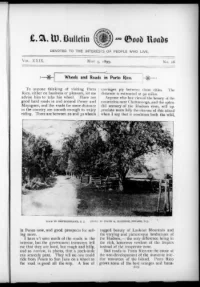
- Advice to visitors to Porto Rico to take a wheel: good hard roads round Ponce and Mayaguez, a rideable road from Ponce to San Juan, and bad interior roads holding back the island's resources. Written from Ponce and Mayaguez, with a road photograph.
- Essay signed E. J. H. on the eyes, ears, tongue and memory: the eyes are made largely not to see with, the ears not to hear with, and the tongue to be held still. Ends by wishing one could forget what one has read and heard.
- Under The Camera department: an Edinburgh Photographic Society silver medal to Miss Christian H. Curle for a paper urging flower photography out of doors. Covers lighting, long exposure, developers and printing processes, reprinted from the Philadelphia Record.
- Short paragraph on The Gatling Gun of Cleveland, Ohio, whose literary gunner Walter Hurt is held by the government, with his reply.
- Touring department notices: the National Touring Committee's new Touring Bureau at 530 Atlantic Ave (Paul I. Aldrich, chairman); Max E. Peltzer of Chicago answering road inquiries; a member seeking companions for a Haverhill to Littleton trip; the Long Island Railroad cyclists' booklet; a variation on Massachusetts route 133; thanks to correspondents.
- Information from L. A. W. No. 113,703 on the roads from Halifax through Windsor, Kentville and Middleton to Annapolis and Digby, and the Yarmouth run. Adds the trip of No. 93,624 across the peninsula, half of it by train.
- Editorial on a letter from a bicycle dealer asking a maker for bicycles at $10 each, with no care for their construction. Argues that dealers and makers are legally liable for injury to riders.
- Editorial on sociability, continuing onto page 10: the lone rider who selfishly keeps his tours to himself, against the group of cyclists that wins envy. Ends with a verse, A sorrow shared is but half a trouble.
- Editorial on Lexington Day, when thousands of wheelmen rode Massachusetts Avenue through dust clouds; the youth's advice to keep the mouth shut and breathe through the nose while cycling.
- Editorial on American bicycle supremacy, quoting a Scottish Cyclist complaint of an Easter tour in France where nothing English was seen.
- Letter from a member of the Automobile Club of England, sent to the newspapers of towns on the Easter tour, explaining that motor cars will not arrive in procession. Describes the club's pleasure tour with no racing, a twelve-mile-an-hour limit, and no motto of death to the horse.
- Verse by Nixon Waterman on the self-important man who says women should be kept in their place, and the wish that the new women will beat him.
- Letter signed D. Allen Willey, No. 139,604, urging a bicycle path between Baltimore and Washington linked to Newark or Wilmington, Del., with the cost under $500 a mile and the value of European roads cited.
- Note on the cartoon 'All Hogs Take the Road!', reproduced from the Utica Globe, on the new sidepath law.
- Verse on the office-boy who envies the boss and the boss who longs to be the office-boy.
- The new Pennsylvania act: three sidepath commissioners in each county, a tax of up to $1 per bicycle collected with the regular taxes, and the Sidepath Fund for paths beside the roads.
- Mr. William J. Wells of New York city, whose bicycle was stolen on March 17th, recovered it from a man on the street and took him to the station. Judge Hinsdale sentenced the old offender on April 10th to a year and a $250 fine.
- Verse on the elephant's trunk, which never swears.
- Verse about a man who swallowed a cent, called a doctor, and paid two dollars for the cough that followed.
- Short foreign news paragraphs: the Vienna cycle track, the Touring Club de France month-long Morocco tour from Tangiers to Fez, the death of Mr. Munro of Enfield aged ninety-three, the Scottish Retail Cycle Trade Association, Liverpool's cycle parade profit and the Canadian Wheelmen's request to Montreal aldermen for World's Championship funds.
- Profile of William Alfred Howell of Rockville, Connecticut, a League member for fifteen years, chief consul since 1898 and chairman of the National Membership Committee, with his photograph.
- Extract from Municipal Engineering in which Thomas Conyngton argues that horses' hooves and iron-tyred wagons, not only motor vehicles, wreck granite, asphalt and paving-brick roads.
- A short quoted remark, credited to a lost source, on the great mass of the people and the privileged few.
- Instalment one of a fireman's-eye story by H. I. Cleveland, first printed as a Chicago and North-Western Railway pamphlet, about the Fast Mail engines 908, 584 and 592 running to Omaha; it is concluded on page 20.
- Department of the paper conducted by the L. A. W. Press Committee, its unheaded notes covering Henry Sturmey's ruling that riders without L. A. W. endorsement may not race on European, Colonial, Canadian or Mexican tracks, the New York circuit's applications, and the problem of professional circuit-chasers with only two meets.
- Harry Gibson of Cincinnati, back from a trip to California with the outlaw riders, applies to the Racing Board for reinstatement and says he has no use for wild-cat promoters.
- Anson P. Dare of Harrisburg, Pennsylvania, reports the first commission under the new state sidepath act, with a petition of thirty-five signers delayed until the court sat.
- Wheelmen of Tioga County, New York, are building a path along the Susquehanna valley to join Broome County and the Chemung sidepath through Owego, Waverly and Apalachin, quoted from the Owegoan.
- Verse by Joe Lincoln, with a drawing of an angel, in which a husband praises his wife's first husband, now dead, and finds the late man's virtues hard to live up to.
- Verse by William D. Kempton of Cincinnati satirising a church whose choir has a monopoly on the singing and whose preacher never mentions orthodoxy.
- Gen. Roy Stone of the Office of Road Inquiry, Department of Agriculture, invites suggestions on road legislation, convict labour, road funding and steel roads, quoted from the Springfield (Mass.) Homestead.
- Mr. Meigs of Barre, Massachusetts, on using crude oil on roads, with a watering-pot for a single barrel or a tank and pierced pipe for larger trials, at $141.50 a mile.
- A central New York pathmaster who turnpiked a stretch with crushed stone, and whose successor covered it with loose sand dug from the bank, so that critics were met with profanity.
- Mayor Jones of Toledo proposes that the idle tramp and the idle millionaire should each contribute to road-building, the tramp with his time and strength and the millionaire with his money.
- A cab sinks to its body in the mud of Clara Avenue in the Cabanne district, and the St. Louis Post-Dispatch reads it as the cost of dishonest, extravagant and inefficient municipal government.
- Department conducted by Abbot Bassett: the rules for renewing membership, with no fines and no back numbers of the Bulletin, the New York Division's push for Junior Membership, and Chief Consul Belding's Local Consulates as a helping hand.
- A signed notice by Paul I. Aldrich, chairman of the National Touring Committee, Boston, 1 May 1899, urging division officers to build membership and to send the Touring Department route and road information.
- Arthur W. Robinson, member of the National Racing Board for New England, explains that amateur riders in open L. A. W. races after 30 April must register with the Racing Board, at fifty cents for members and $2.50 for others.
- S. A. Boyle, chief consul, announces a monster smoker for members at the Park Theatre, Philadelphia, on the night of Monday 5 June 1899, with tickets to be applied for at the Division headquarters, and offers a temporary ticket to men who have applied.
- Notice from Chief Consul George L. Cooke, Providence, dividing the state into ten districts, with ten district consuls appointed for Newport, Westerly, Pawtucket, Woonsocket and other towns.
- Notice from the Wisconsin Division asking members to name men to be local consuls in the listed towns not yet represented, continued on page 29 with the town list, a recruiting appeal and a Milwaukee local consulate notice signed by F. G. Cramer, secretary-treasurer.
- Chief Consul Edward N. Hines calls for one new member from every Michigan town for the Red-Letter Day, noting Detroit's 736 members, the Belle Isle wheelmen's shelter and the Board of Public Works concession.
- Weekly list of stolen machines: a white tandem Rambler No. 32,264, a Cleveland No. 143,050, a Columbia No. 760, a lady's Toledo and a Wolff-American No. 15,707, with the owners' names and addresses.
- Signed notice by Fred Gerlach, chairman of the Racing Board, Chicago, 24 April 1899, lifting the suspensions of named riders, restoring Illinois College to sanction privileges and raising the suspension of W. H. Lancton on payment of a fine.
- Dialect joke in which Farmer Meadowgrass sees a hotel sign reading Don't blow out the gas and dreads a sleepless night, ending with the burning light.
- Department of replies to readers' queries, its unheaded answers covering a puzzle department not yet feasible, city-to-city records, renewals without a fine under the new constitutional ruling, and the New York and Pennsylvania sidepath plates.
- Verse by Harry Weir Boland on a poet's song of love, with Doris, Margaret and Betty responding.
- Four-line verse on life's ladder, whose rounds grow slippery near the top.
- A radiating line drawing asking why the heavy lines appear bent, with a sketch sent in from Ithaca, New York.
- Verse on the professional musician who works when he plays and plays when he works.
- Four-line verse on the parlour lamp that went out when two was company.
- Four-line verse on the dead man and the man dead drunk, who differ only in what fills their bier.