Vol 29, No 6
Cite this issue
Citation
L. A. W. Bulletin and Good Roads 29, no. 6 (1899). cyclearchive.com, https://cyclearchive.com/magazines/the-bulletin-and-good-roads/vol29-6/
Page numbers are pages of the PDF, which can differ from the numbers printed on the page.
Articles in this issue
- Sterling Elliott's editorial on the editor's lot: a reader who wants a liquor advertisement dropped and the answer that the paper takes its advertisements where it finds them, and a rebuttal to the complaints about the Philippine annexation remarks.
- Short notes from Britain and the Continent: the French Touring Club's expected bank balance, a cycle track on a roof, the 'nickel-plated horse' (the bicycle), a motor-car service between Rosehearty and Fraserburgh, and a Campbeltown minister's remarks on Sabbath cycling, quoted from the Scottish Cyclist.
- A Camera department piece on toning and fixing prints, with a note on using a single gold bath and a Hesseltine photograph of sheep feeding at the top of the Stelvio Pass.
- Advice to amateur portrait-takers on posing the head: favouring the better side of the face (usually the left), the profile, the nose, and the eyes.
- A four-line boxed verse on the English idiom 'eaten it up' and 'swallowed it down'.
- A letter signed L. A. W. No. 600 defending brick streets against two January correspondents: Cincinnati and Columbus brick is poorly laid, and asphalt is slippery and tiring for riders.
- A column of short jokes on imperialism (the 'fringy whiskers' man and the Washington Star), Philadelphia's asphalt strips and glass ordinance, a jocular citizen run down by a cyclist, and the 'chainless' and 'motorless' bicycles, under a printed head.
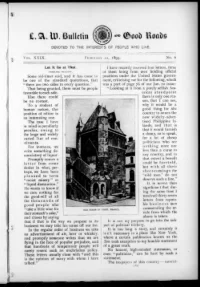
- A run of maxims drawn from Dickens on duty, simplicity, gratitude, gallantry and humanity, set beside a photograph of the Alexander Standish house at Duxbury; it runs on to the foot of the page.
- A short item on a cycle trade paper's circulation claims against two rival papers and a fourth paper's undated card.
- W. S. Mackie of Utica writes on the Wheelway League of Oneida County: its 1898 receipts of $2,965.59, over sixty miles of sidepaths built with the Rome League, and a bill to make riders who use the paths without paying buy a licence.
- C. D. Peck reports on the Erie County sidepaths built from a bicycle licence tax: about twenty miles completed in 1898, the Sandusky-Perkins-Bogert path, costs of about $200 a mile, and a ground-limestone surface.
- Unheaded news under the Cycle Paths banner: New Hampshire's proposed one-dollar bicycle licence for paths, the Detroit Wheelmen's resolutions for the Michigan path bill, and the New York Division's circular urging members to back the Ellsworth sidepath bill.
- A headed verse by E. Bradshaw, reprinted from the National Single Taxer, satirising monopolists who would reservoir the rivers, tax the breath and own the earth.
- A party of eight rides from Chittenango Station through the gorge to Cazenovia via Chittenango Falls, past the deserted White Sulphur Springs, lunching by the falls; the steep Cazenovia road is taken by train, and the instalment runs on to page 11.
- A four-line headed verse on living without poetry, ending 'We all have got a Chaucer'.
- Letters answering the 'A Pointer to Builders' correspondence on 30-inch wheels: No. 4,715 on the 28-inch wheel's adoption in 1893, J. C. Caterson of Philadelphia against 30-inch wheels and for larger tyres, and No. 11,954 of Pittsburg, who says he would not take a 30-inch machine as a gift.
- Benj. I. Cohen of Portland, Ore., writes that reading the Bulletin aloud to his wife restored his health after an attack of overwork and mental strain.
- The masthead-page leader on Congress: the Agricultural Department's road inquiry, cut this year to $8,000, set against the $25,000 voted for balloon and flying-machine experiments.
- Isaac B. Potter, instalment II, answers inquiries on local consulates: their work on roads, pumps and guideboards, how they are maintained, and how the two-dollar new-member fee and the one-dollar renewal are divided between the National body and the State Division.
- A headed verse by Nixon Waterman on Tommy Spink, the schoolboy who could wiggle his ears, and his later recollection.
- A headed comic verse on a father who finds Gussie kissing his daughter Maudie, the cold four-mile walk home, and the coat left behind.
- An extract from an address by Albert H. Tuttle, M.D., to the Gynaecological Society of Boston (12 January 1899) on exercise, dress and the bicycle as a restorer of women's health, with the bicycle age as the renaissance of exercise.
- Verse on whaling and the blubber, a pun on blubbering, recalling boyhood days when mother did the whaling and the writer did the blubbering.
- Argues that motor-vehicles will cause fewer collisions than horse-drawn ones, because they can be guided and stopped with accuracy, while the horse can only be approximately controlled; a drunk driver is likely to end in the ditch.
- A reader asks which of two riders on 70-gear and 90-gear machines is more tired after the same ride; the answer is the higher gear on smooth level road with strong riders, the lower gear on hills, headwinds or rough road.
- Answers a reader's question on whether the forward rider must turn out for one behind: in a strict sense no, though courtesy is expected and a refusal makes a road hog.
- Warns that prices of rattle-boxes and teething-rings will be affected by two New Jersey trusts, the Rubber Goods Mfg. Co. and the National Tin-plate and Stamped Ware Co.
- Reprinted from the Cleveland Plain Dealer: a small Cleveland boy's slang-laden account of a bruised side, rubbed better by a visiting gospel preacher he mistook for the new scout.
- Calendar facts from the Chicago Evening Lamp: no century can begin on Wednesday, Friday or Sunday, and the same calendar recurs every 20 years.
- Verse by Joe Lincoln parodying the sentimental poets, with lines that carry advertisements for The Bings $3.00 shoe and Guffy's Pure Old Rye, and a closing note offering the verses for sale.
- Verse by J. W. Long: a tireless man and a tired wheel change places when the rider takes the wheel into a ditch.
- By Martin Dodge, acting director of the U.S. Department of Road Inquiry: after Macadam, road-builders should pursue lighter vehicles and steel roadways, since the bicycle carries many times its own weight and inanimate power could replace animal power on roads over five miles.
- Anecdote from the Lincoln County News: a Russian, a Turk, a Frenchman, an American and an Englishman each toast their native country at a Los Angeles champagne supper, the best toast being free of charge.
- Anecdote from the New Brunswick Advertiser, told by Sir William Long: an old Scotch lady who could not abide long sermons asks a coachman whether the minister is done with his sermon.
- Anecdote: a Scotch minister's sermon on 'Except ye repent' alarms a deaf parishioner, who tells his neighbour that the dominie will make them leave the parish unless they pay.
- Four lines of cycle-cleaning advice (dip the chain, wipe outside, no noise, no wear, no dust), signed W. H. L.
- Verse by Jean Patterson of Merrill, Wis., on the year growing old, the winter's approach and the hope of spring, ending in the promise of triumph over death.
- Abstract of a paper by Dr C. A. Wheeler of Leominster, Mass., read before the Worcester North District Medical Society on 24 January; the bicycle as exercise against disease, the cow and tuberculosis, quoting Dr Oliver Wendell Holmes and Dr Oscar Jennings of Paris (continued on the next page).
- Anecdote from the Detroit News about Thomas Tall, justice of the peace at Clayton, a marrying justice who advertises in the home paper and reserves the right to kiss the bride.
- The Model Bicycle Co. of New York has closed up; its circular letter, sent to addresses taken from the official columns of the L. A. W. Bulletin, implied a full-sized machine.
- Satirical piece on the ventilation crank in cars and churches, who opens the windows and lets the wind blow letters into the waste-basket, with an umbrella cartoon.
- Replies to critics that Boston's railroad station, one block from the Bulletin office, has thirty-two tracks; St. Louis is next, then Boston's North End, with Philadelphia's Broad Street and New York's Grand Central lesser.
- Verse by Nixon Waterman, parodying Kipling's would-be imitators: it calls for a great army and armored boats, and mocks Whittier, Holmes and Longfellow as mud.
- Verse by Joe Lincoln, with a cartoon of a small boy: a baby brother bought from the doctor, who is no use compared with a dog.
- Editorial letter signed by John Bigham, Ann Arbor, 22 January 1899, urging representative colored men to elect delegates and form a brotherhood of their own, with the endorsement of L. A. W. president Potter.
- H. H. Rogers of Fairhaven, Mass., who spends ten to fifteen thousand dollars a year of his own money on roads, and who has presented about nine thousand feet of curbing to citizens who paid for it.
- Editorial under the Good Roads banner: the good roads movement has solid foundations, as Illinois local papers show roads too rough for doctors, wood-haulers and coal-haulers.
- Editorial, credited to an exchange: the horsemen and farmers, once suspicious of the good roads cranks, now work with the wheelmen, the League's cry since 1880 having won the farmers over, and a man who lays a good solid roadbed is a public benefactor.
- Discusses using prison labour to build roads, quoting Judge John Gibbons of Illinois and a proposal to use the Joliet convicts on a highway from Lake Michigan to the Mississippi (continued on the next page).
- Reprinted from The Municipal World: drainage is the first principle of road-building, through crowning, side drains, gravel on the traveled track, underdrainage with farm tile, and prompt repair of wear.
- Joseph Pennell, Foreign Marshal, on the new French rules from 1 May 1899 for cyclists' customs duty and permits, Germany's bar on cycles in express trains, Austria's deposit of 25 gulden, and the Cyclists' Touring Club tickets.
- Signed by Clarence W. Small, Chief Consul: asks members to write to their representatives about House Bill No. 10 for state aid to highways, ahead of the 21 February hearing, and calls for volunteers for the road book work.
- Signed by Edward N. Hines, Chief Consul: the division's December and January recruiting fell well below last year's, and members are urged to recruit, to tell friends about the subscription rates and to send for the cycle-path book.
- A second notice under its own head, addressed to local consuls, signed by J. B. Doncyson at Clay Center, 27 January 1899, enclosing a letter from Chas. A. Southwick, who finds that most Clay Center wheelmen have never heard of the L. A. W.
- Abbot Bassett's report to the 1899 National Assembly: membership fell from 102,810 enrolled in 1897 to 77,091 in 1898; it covers the Canadian privilege, the Periodical Department, the division membership table and the loan fund (continued on the next page).
- Signed by Nelson H. Gibbs, Secretary-Treasurer, Providence, 27 January 1899: Dr A. P. Longfellow and Joseph P. Burlingame replace Howard L. Perkins and Percy A. Harden as the Rhode Island Wheelmen's club representatives.
- Verse: a would-be critic mocks a sailor's song and is answered with 'Oakum off!'
- A Kansas Division member's letter with verses on the tete-a-tete and a tutor who tooted the flute, asking what fate suits the author of the 'Tate' verse; the reply proposes the same fate as the author of the tutor verse.
- Headed verse: a minister should not presume to teach his worldly brother unless his words can illume the matter.
- Department of short answers to readers: long cranks against short ones, a Simpson chain that was worthless, League membership numbers reshuffled every ten years, lamps and bells on German bicycles, cranks of different length for tandems, and the Kicker's Column postponed by request.
- Joke verse about a boatman full of jokes who named his craft The Cheese because it had a lively skipper in it.
- A comic sketch: Sluthe borrows two dollars because his assistant has gone ahead with the money, comes back in the night seeming drunk and sleeps in the barn, and in the morning says he only feigned intoxication to deceive a rascal.