The Cycle Age and Trade Review, Vol 20, No 16
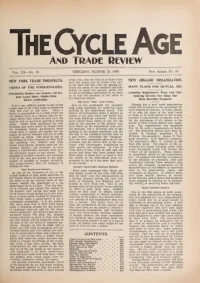
Articles in this issue
- New York wholesale dealers report December-February sales considerably above last season's levels, though a veteran Broadway dealer warns that department stores are pushing bargain bicycles aggressively and the public remains susceptible to cheap goods.
- The Associated Bicycle Dealers of Chicago is founded with thirty-six members, adopting comprehensive by-laws covering price maintenance, bicycle theft protection, and a minimum repair-rate schedule kept private from the public.
- Season-opening festivities in Providence, Buffalo, Detroit, Piqua, Ohio and Newcastle, Pa. drew average crowds of 4,000 to 6,000 visitors per store and produced solid bookings, with Detroit dealers preferring the steadier week-long format to a single crush of visitors and local Y.M.C.A. branches running the shows in the two Ohio and Pennsylvania towns.
- Stockholders of the Warwick Cycle Mfg. Co. took no action on a compromise offer to creditors, leaving insolvency proceedings to run their course; the published creditor schedule listed claims exceeding $100, including $150,000 owed to Providence financier Joseph Bannigan and $20,000 each to Springfield's Pynchon and Second National Banks, with the plant possibly relocating to Holyoke.
- A Scottish Cyclist correspondent argued that tricycles deserved a revival among riders who had neglected them for the bicycle, citing their inherent stability on greasy or slippery roads, easier mounting and dismounting, and superior luggage capacity for touring, while conceding they lag a safety bicycle's speed except on steep climbs.
- A Pittsburgh dealer signing himself 'B. M.' argued that local cycle shows are valuable advertising undercut by price-cutting, which makes buyers hold off waiting for further drops, and urged manufacturers to fix and hold a standard retail price to get the season moving.
- The Indurated Fibre Company of Lockport, N.Y. reported promising early experiments using its fiber product to manufacture bicycle saddle tops, claiming the material could revolutionize saddle making.
- Cleveland dealers reported the retail season opening earlier than ever despite poor weather, with buyers favoring higher-grade machines and trading in old mounts for allowances now capped near $30-35 versus $65-70 the previous year, while dealers agreed to date the sixty-day guarantee from April 1 regardless of purchase date.
- The collapsed Toledo department-store bicycle manufacturing scheme run by Joseph M. Murphy and George J. O'Toole ended in a formal assignment for creditors, with attorney Joseph P. Hanley named assignee and a local trust company left as the only real loser, out roughly $530, after backing the venture's unfinished run of 280 machines.
- Answering a Marysville, Cal. correspondent's question about why some bicycles jump when the rear wheel is spun free of the ground, the Cycle Age explained that an imperfectly trued wheel, an untrue front sprocket, or unbalanced cranks and pedals each produce a varying momentum that causes the frame to sway, much as a marching column's cadence can sway a bridge.
- A cycle show at Verona, Italy drew few English or American exhibitors but was judged a commercial success, with Deluca of Trevise winning first prize for Italian-made cycles and the French firm De Dion et Bouton's petroleum tricycles placing fourth among foreign entries, though exhibitors and the public accused the jury of favoritism.
- An editorial on the loosening of the old patriarchal relations between makers, dealers and riders examined why dealers financing bicycle sales on installment plans prefer a lease form over a chattel mortgage, since customers sign leases more readily, even though a lease must be properly recorded to protect the dealer's right to repossess.
- The Cycle Age published an itemized cost breakdown for three tiers of repair-shop tool outfits, from a basic general-repair kit to a fully equipped shop with labor-saving machinery, aimed at the many new repair shops opening for the season.
- A survey of distinctive English bicycle-building practices highlighted W. A. Lloyd's Cycle Fittings of Birmingham's double-spoon rim-brake shoe and underhung ladies'-frame bottom bracket, the Engineer Cycle Works' scaled chain adjuster, the Singer Cycle Co. of Coventry's clip-mounted coaster foot-rest, and the Sparkbrook Mfg. Co. of Coventry's self-releasing band brake.
- A revival of interest in puncture-healing tires centered on two similar 1893 U.S. patents, Frenchman Pierre Mercier's vaseline-expanded rubber layer between canvas strips and Frederick H. Sprang's oil-based variant, with the Larue Air-Tight Tube Company's Herbert A. Barrows now in the United States seeking to sell American manufacturing rights under the Mercier patent, which the company had also bought out Sprang's competing patent to protect.
- German trade commentary argued that the roughly three-mark import duty on American bicycles was too low to protect home manufacturers against cheaper U.S. machines, proposing bicycles be reclassified as 'vehicles' rather than 'fine ironware' to raise the duty to 6-10 percent without violating existing commercial treaties.
- The Niagara Cycle Fittings Company of Buffalo, N.Y. filed papers of general assignment to Louis G. Schoepflin, with $10,000 capital stock and debts up to $40,000, after having earlier transferred much of its property to the affiliated Niagara Pedal Company.
- The Elgin Cycle Co. of Elgin, Ill., maker of the Elgin King, added a chainless model to its line built on the Sager patent's roller-pin gearing, already adopted by several high-grade makers.
- An advertising-strategy piece argued that the most effective ads drive home a single vital selling point with force rather than crowding in many details, likening focused advertising to a rifle shot and scattershot advertising to a shotgun blast that covers more ground but hits far less effectively.
- A legal explainer on bicycle sales warranties held that advertised claims in catalogues and circulars constitute binding 'express warranties' a purchaser can rely on, and that a written guaranty signed by a dealer distributing a maker's catalogue can make the dealer personally responsible unless he is acting purely as the maker's agent.
- Quoting Hiram S. Maxim in Engineering Magazine, the Cycle Age argued that cheap production and high wages go hand in hand in modern industry, noting that a bicycle that took six months to a year to make by hand at the start of the century could now be produced in a fraction of the time, letting workmen's pay rise even as prices fell.
- The patent-office column described W. H. Sparks of Camden, N.J.'s vibration-damping rubber steering-head bearings, a front-sprocket coaster brake, W. J. Tanner of London's space-saving folding pedal, Louis Baecker of Detroit's compressed-fiber 'upholstered tire' substitute for pneumatics, and a helical chain-disk mechanism for the 'Swedish chainless' bicycle.
- A trade-club discussion features a general manager recounting how a dismissed employee threatened to leak damaging inside information through a lawyer but was talked out of it, and a well-traveled salesman recalling a young clerk who carelessly gossiped his firm's purchase costs and profit margins to a stranger on a streetcar.
- The standing new-products department featured the Eldredge and Belvidere cycles made by the National Sewing Machine Co. of Belvidere, Ill., the Manhattan Brass Co.'s four bicycle lamp patterns, the Julius Andrae & Sons Co.'s new 32-tooth front sprocket for its 1898 Andrae line, and the M. D. Stebbins Mfg. Co.'s Chilion wood-frame bicycles.
- Professional wheelmen protested being taxed by the League of American Wheelmen to fund its control of racing while denied any vote in racing affairs, with the Cycle Age noting the National Assembly's contradictory stance of refusing professionals League membership while still taxing them, and exempting amateurs, who cause far more trouble, from any fee at all.
- With the League of American Wheelmen poised to relinquish control of racing, the Cycle Age weighed successor candidates, dismissing the already-overburdened Amateur Athletic Union and profit-driven racing associations as unsuitable and arguing that local bicycle clubs, amalgamated into one central body as in Europe, were racing's natural governing heirs.
- A brief race report noted that McCarthy defeated Eaton in straight heats.
- Leading members of the National Cycle Track Association formed a professional 'racing syndicate team' at a Springfield, Mass. meeting, signing McDuffee, Linton, Barnaby, the Butler brothers, Cooper and Coulter under managers Henry E. Ducker, Charles R. Culver and Dixie Hines, and noted in the same notes column that Detroit's $7,000 cycle track had just been auctioned off for a mere $250.
- Philadelphia professional racers renewed complaints about the League of American Wheelmen taxing them for racing-management costs without giving them a vote, drawing a parallel to the Amateur Athletic Union's new $1 basketball registration fee, which the League matched at twice the rate for its own amateur wheelmen, and arguing that voting amateur racing men should be taxed too.
- After a three-month fight, the Pennsylvania Division and the Associated Cycling Clubs of Philadelphia secured passage of a city ordinance requiring all vehicles on Philadelphia streets after dark to carry lighted lamps, with Mayor Warwick signing the measure and handing the pen to Chief Consul Boyle of the Pennsylvania Division as a memento.
- A. G. Batchelder and I. B. Potter traded public accusations after Batchelder was replaced on the L.A.W. Racing Board by a Colorado appointee following the National Assembly in St. Louis, with Batchelder blaming 'peanut politics' and Potter's influence, while a separate track dispute saw Gardiner challenge A. I. Brown to a $500-a-side race after a disqualification.
- Gossip items included rumors that champion Eddie Bald was eyeing the stage, ex-racer John Lawson ("the Terrible Swede") earning over $5,000 touring Scandinavian communities with a home-trainer act, a Galveston, Texas man sentenced to seven years for bicycle theft, and a New Jersey bill requiring municipalities to post bicycle-regulation signs at their limits.