The Cycle Age and Trade Review, Vol 21, No 34
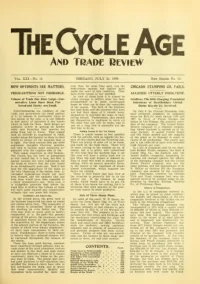
Articles in this issue
- Leading eastern manufacturers and dealers argued that although the 1898 season fell short of its exceptional early promise, business had been conducted on sound conservative lines with small stocks and no serious price-cutting, leaving conditions better than in recent years.
- The Chicago Stamping Company confessed judgment on $244,000 in notes to the company president's father, with creditors including major parts manufacturers filing bills charging fraudulent stock transfers and alleging the associated United States Bicycle Company was merely a conduit for the parent firm.
- Pennsylvania dealers and manufacturers reported satisfactory business for the season, with Reading and other regional centers showing steady sales and manufacturers working to export orders while retail trade wound down for the year.
- Bureau of Statistics data for the fiscal year ending in 1898 shows that over three-quarters of U.S. exports went to Europe—nearly half to the United Kingdom alone—while significant trade deficits with South America ($31M exports against $86M imports), Asia, and Oceanica are noted alongside a marked year-over-year improvement in European and North American trade balances.
- Firms that had invested in labor-saving machinery and rationalized their production processes were found to have outperformed competitors during a season of compressed margins, demonstrating the long-run value of manufacturing efficiency over price competition.
- A series of retail sales vignettes illustrated effective approaches for converting uncertain buyers, with particular attention to how dealers could use conversation about quality and long-term value to justify higher-priced machines.
- The editorial argues that the newly enacted Torrey national bankruptcy law will clarify the cycle trade by compelling creditors and debtors to settle accounts and force incompetent concerns into receivership; an extended analogy with the barb-wire industry—which consolidated from a dozen Joliet factories to three robust survivors—is used to predict that competitive pressure will ultimately strengthen firms that have practiced genuine economies.
- The passage of a new federal bankruptcy statute was examined for its likely impact on the bicycle trade, with particular attention to how it would affect the large number of receiverships and assignments that had marked the 1898 season.
- A practical technical article addressed the standardization problem in pedal thread specifications, documenting the range of incompatible threading conventions used by different makers and arguing for adoption of a common standard.
- The article addresses profitability of bicycle frame repairs in the era of cheap machines, explaining that repairing broken tubes, cracked lugs, and loose brazed joints yields legitimate income only when the repairman possesses genuine technical knowledge; it describes methods for rebrazing seat clusters and inserting solid iron backing pieces into broken lug branches to restore structural integrity.
- The first of a series on wood bicycle rim manufacture described the timber selection, bending, and finishing processes used by leading American rim factories, and assessed where wood held advantages over steel rim construction.
- New bicycle-related patents reviewed include a spring-actuated brake released when back-pedaling pressure is removed (J. M. Downer, Toronto), a double-lens lamp that distributes light obliquely for broader road illumination, a concave vulcanizing bed by G. W. Slater of Philadelphia adaptable to gas heating, and a reissue of the 1893 John F. Palmer patent covering the fundamental construction of the Palmer pneumatic tire.
- Examines the long-run economics of storage batteries for electric vehicles, noting that while manufacturers guarantee a five-year battery life, real-world replacement costs average about $150 annually under the irregular and demanding conditions of motocycle use, with battery cost at first hands running about 66 cents per pound—making running costs substantially higher than commonly assumed.
- Product descriptions for two new accessories: the Graham double-tube clincher tire from Toronto (a cemented-on tire fitting any crescent rim, manipulated entirely by hand without tools, with a heavy flap preventing inner-tube pinching) and Green's puncture clamp from Chicago (a temporary repair device that prevents a loose tire from creeping on the rim and cutting the valve stem).
- Brief trade items include Wilson Bros. Woodenware & Toy Co. of New York assigning to a trustee with $27,000 in liabilities and only $10,000 in actual assets; Cable Cycle Co. of Boston purchasing a 175×70-foot Avon, Mass. factory to manufacture bicycles and a ball-bearing wire wheel under new patents; and a stolen Iver Johnson Model 39 semi-racer reported missing in Baltimore.
- The "Pastime and Sport" racing column reports that Cissac, one of Tom Eck's much-promoted French imports from the Morgan syndicate, has failed to beat American riders including Church in Philadelphia—demonstrating that newspaper reputations cannot substitute for racing ability—and predicts Eck will return to the national circuit with Johnny Johnson.