The Cycle Age and Trade Review, Vol 21, No 40
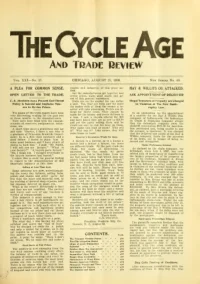
Articles in this issue
- Dr. C. S. Stockton of the Stockton Mfg. Co. published an open letter to the bicycle parts trade urging manufacturers to stop selling hubs for a dollar and pedals for thirty cents at a loss, arguing that good hubs and pedals could sustain decent prices and that the cut-throat policy was bankrupting everyone in the business.
- The Indianapolis Chain and Stamping Co. applied for a receiver for Hay and Willits Mfg. Co., alleging the Indianapolis bicycle maker had transferred its largest assets to two creditors in violation of the new federal bankruptcy law in an effort to prefer them over more than 100 other claimants.
- Charles H. Sieg invited creditors of his Kenosha bicycle factory to a September meeting, offering to represent smaller creditors at no charge and expressing confidence that a settlement satisfactory to all parties could be reached.
- A technical review described the Triumph flexible frame bicycle's engineering approach to absorbing road vibration, and posed questions about how the frame's intentional flexibility could be reconciled with the need for precise alignment and consistent handling.
- Cleveland jobbers were competing aggressively for retail dealer accounts, while the Shelby Steel Tube Co. and A. L. Moore company announced plans to jointly supply all parts for complete three-crown frame machines, and new lightweight wood rims were under development at the Kundtz bending works.
- A survey of the lack of standardization in bicycle dimensions found that frame sizes, wheel diameters, handlebar configurations, and seat tube angles varied so widely between manufacturers that parts were almost never interchangeable, creating serious difficulties for repairmen and buyers alike.
- The Cycle Age editorial condemned the National Board of Trade directorate's meeting as a failure, faulting the directors for continuing the sixty-day guarantee policy, declining to endorse a trade show, and refusing to call a manufacturer's convention despite widespread pressure from the trade.
- A detailed report on the National Board of Trade directorate's decisions described the board's refusal to sanction trade shows or conventions, its continuation of the sixty-day guarantee policy, and the strong dissatisfaction this caused among parts manufacturers and dealers who wanted organized industry action.
- Assembly room workers described the systematic errors in manufactured parts they were forced to compensate for on the spot, including cups too shallow for the bearings, misaligned fork sockets, and tube-end imperfections, all resulting from cost-cutting in the factory production stages.
- The repair shop economics series examined the profitable repair opportunities created by the season's epidemic of broken handlebars and seat-post stems on low-frame bicycles, with practical instruction on using anvil-and-tube methods to open notches and straighten damaged components.
- The fifth installment of the wood rim manufacturing series addressed the problem of strip buckling during bending, explaining the physics of compression in bent wood strips and proposing remedies for the bender to prevent uncontrolled buckling from producing uneven rims.
- The Haynes-Apperson Company of Kokomo, Indiana presented its latest gas motor carriage design, featuring a modified Otto cycle engine that allowed the manufacturers to eliminate the speed-change gearing of previous models, reducing mechanical complexity and weight.
- An evaluation of wheel and tire designs for motor vehicles found that bicycle-type suspension wheels broke down rapidly under motor vehicle loads, and that the small-diameter pneumatic tires then in use lacked the durability needed for commercial service, with experiments using five-inch pneumatics described.
- The most-discussed novelty at the Indianapolis LAW meet was the Davis Sewing Machine Company's spherical crank hanger and hub design, which offered self-aligning bearings claimed to eliminate the binding and adjustment problems common in conventional cone-and-cup designs.
- Race results and cycling club news from the preceding week were reported, covering track and road events across the country and riders' forms heading into the remaining championship contests of the season.
- E. C. Bald won the main race at Asbury Park while Jimmy Michael defeated another leading American rider in the same program, Michael's victory adding to his season total in a campaign that had seen him become a dominant force on the American professional circuit.