The Cycle Age and Trade Review, Vol 24, No 102
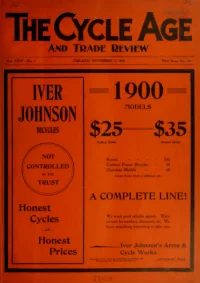
Articles in this issue
- Three senior officers of the Hartford Rubber Works were abruptly dismissed for conduct unbecoming to the company, with Colonel George Pope taking immediate charge amid speculation about negotiations to sell the plant to the rubber trust.
- Financial writers reported that Charles Flint had reached a preliminary agreement for the Rubber Goods Manufacturing Company to acquire the Hartford Rubber Works plant, though company officers declined to confirm or deny the story.
- The Cycle Age confirmed that Flint had concluded negotiations to sell the Hartford Rubber Works to the Rubber Goods Manufacturing Company, with the deal presumed to cover all rubber properties of the American Bicycle Company.
- Final cash payments under the American Bicycle Company agreement were made, with makers visibly relieved and Colonel Pope taking bonds well in excess of his cash entitlement, while about four million dollars in bonds were subscribed by makers overall.
- A.B.C. company secretary Dickerson refused to provide information about scheduled payments to members, while rumors circulated that Flint had manipulated trading in the company's stock and bonds on the curb market.
- A roundup of A.B.C. trade gossip and legal notes: independent dealers vowed never to sell trust bicycles exclusively, the Owen v. Pope bottom-bracket patent suit was withdrawn after both parties came under common ownership, and Colonel Pope reportedly gave orders to buy A.B.C. stock and bonds at any price.
- The Canada Cycle & Motor Co. appointed Joseph N. Shenstone (formerly of Massey-Harris) general manager and W. H. Shapley (formerly of the Goold Bicycle Company) general superintendent, and reported cable orders for hundreds of bicycles from Australia plus new business from Japan and India.
- August Reuter of Franklin, La., found northern bicycle models had hangers set too low for southern roads and switched to Cactus and G. & J. tires, while R. S. Plummer of the Hyde Park (Mass.) Cycle Company complained that local assemblers mixed parts from too many different makers.
- Buenos Aires had grown to some 14,000-15,000 wheelmen and the year-old Argentina Touring Club already claimed 1,000 members lobbying for road improvements, while U.S. bicycle exports to Argentina rose from $1,863 to $26,000 in a single August.
- A Buffalo dealer's manager was arrested for larceny after repossessing a telegraph messenger's bicycle over a missed installment payment, and Judge King fined him $35 before the dealer agreed to return the machine.
- Editorial reporting that the American Bicycle Company had settled its differences with the rubber trust and paid all interested manufacturers, while independent makers prepared to complete organization of the Cycle Trades Protective Association at Buffalo to guard against A.B.C. patent-infringement claims.
- A lengthy editorial essay on why perfect mechanical accuracy is unattainable, citing the British mint's twelve-grain coining tolerance and the astronomer's "personal equation" as measures of the practical limits of precision workmanship, and predicting that chemical frame cleaning would soon replace filing.
- Trade briefs including the Hunt Saddle Co. of Westboro, Mass. increasing its force from 130 to 250 hands, the Shelby company's Greenville, Pa. mill adding 800 hands, and the Rudge-Whitworth company of Coventry denying plans for a $42 medium-grade machine.
- The Rochester Cycle Manufacturing Company was among the first to release 1900 models; Al Newhouse sued former Shepard Wheel Company officers, including Congressman Brewster, for $357.82 in back pay and expenses; and the Spinroller Gear Company reported a strong eastern sales trip.
- A nationwide roundup of dealer changes, including the ownership transfer of Blank & Royds to the British Columbian Cyclery and Supply Company of Victoria, several retirements, and a $45,000 fire loss at the Biddle Bicycle Company of Knoxville, Tenn.
- Repairers recounted comic home repairs, including an elderly customer who plugged M. & W. tire lacing holes with wax-sealed wooden pegs, alongside notes on a steam-blast abrasive compound for resharpening files and a freakish double-bladed front fork built by an English assembler.
- John P. Hayes of Meriden, Conn. warned that case-hardened worm gears wear through and self-sharpen into destructive cutting edges unless hardened all the way through, while two shop contributors described improvising a beeswax jig to grind a broach and a homemade boring-tool holder built in an Ohio turret-lathe shop.
- New patents covered J. C. Daigneau's back-pedaling automatic spoon brake, F. L. White's lamp bracket brace for the George H. Clowes Calcium King acetylene lamp, and a two-part threadless seat-post expander clamp.
- Described J. D. Roots' new kerosene-fueled R. & V. Petro-Car, built by the Birmingham Small Arms Company for Roots & Venables of London, and Julius M. Walters' patented detachable motor wheel for delivery wagons, alongside notes on New York testing automobile access to Central Park.
- Pope Mfg. Co. announced it would market the Acme-built Stormer line alongside its Columbia and Hartford bicycles for 1900, in a buyers' column that also covered the Whiteley Mfg. Co.'s new Duplex Adjustable handlebar and the Bown Machine Works' simplified ball-check tire valve.
- Motor-paced record attempts pitted McDuffee's Columbia against Major Taylor's Stearns on Chicago's Garfield Park track, while Lord Wolseley declared his faith in bicycles for military use in the Transvaal and New York wheelmen pressed for a cycle path across the Brooklyn Bridge.
- Frost on the Salt Lake City track put the motor tandems out of action, so Iver Lawson narrowly beat Downing in an unpaced two-mile race before a crowd of only 700, most of them rooting for the home riders Julius, Lawson and Turville.
- Eaton split a two-heat motor-paced series with Walthour in Birmingham, Ala., while at the Grand Prix de Roubaix exploding tires let Broka take the prize as Tommaselli and Jacquelin, the race's real contenders, dueled to a photo finish behind him.
- Edouard Taylor lapped a poorly-conditioned Tom Linton twice before 8,000 Paris spectators, finishing the motor-paced hour four and a half laps ahead after covering 33 miles 590 yards.