The Cycle Age and Trade Review, Vol 24, No 113
Articles in this issue
- The American Bicycle Company formally served legal papers on the Eagle Bicycle Mfg. Co. in Hartford, seeking an injunction against manufacture, an accounting of profits, and triple damages for alleged willful infringement of the Smith-Owen bottom bracket patent, with the case expected to take at least a year to reach a decision.
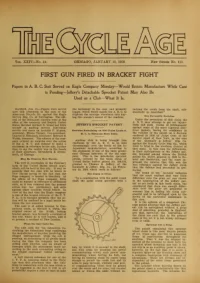
- The American Bicycle Company was preparing to use the Jeffery detachable sprocket patent as an additional legal weapon against independent makers, though a Chicago patent attorney noted the claim could likely be anticipated by prior art and its narrow language meant it was not widely infringed in current bicycle designs.
- Utica bicycle dealers reported that strong anti-trust feeling among working-class customers had created unrest, while dealers were finding better results by concentrating on fewer lines rather than attempting to carry a broad range of competing brands.
- Reports of growing Siberian cycling clubs and bicycle races in German illustrated papers were cited as evidence that the Trans-Siberian Railroad's completion was creating a new market that American manufacturers should investigate before European competitors moved in, given Russian preference for American machinery over British or German alternatives.
- The Chicago Handle Bar Co., George Spencer's fixed bar business, and the League Handle Bar Co. combined under a single management, giving the new concern control of nearly all large fixed bar interests in the country and a capacity of 700,000 seat posts annually, with George Spencer to open a New York depot for eastern and foreign trade.
- Buffalo retail dealers were relieved when a Philadelphia buyer appeared and purchased their entire stock of unsalable second-hand machines at a fair price, removing a significant storage burden and providing unexpected cash that was quickly reinvested in 1900 stock.
- The editors observed that independent bicycle manufacturers were in no hurry to pay the A.B.C.'s bottom bracket royalty, with the great majority resolving to await the outcome of the Eagle suit before making any decision, on the well-founded expectation that the patent would be found invalid.
- A Christchurch correspondent reported a generally satisfactory mid-season in New Zealand, with dealers selling regularly at firm prices and free-wheel coaster brake machines expected to arrive from English agents in time for the hilly districts of Auckland, Wellington, and Dunedin.
- The U.S. Attorney General refused to seek an injunction against the railroads' new freight classification system, ruling that however unreasonable or discriminatory rate increases might be, they did not constitute the contract or conspiracy in restraint of trade required to trigger the anti-trust statute.
- The Wilmot and Hobbs Mfg. Co. of Bridgeport, Connecticut, acquired the machinery of a Pennsylvania seamless tube plant to begin producing brass-lined seamless tubing, which handle bar makers preferred over Clincher tubing for its easier bending, and announced plans to license its brass-lining process to other tube makers on nominal royalty terms.
- Trade items reported the H.H. Marvin receiver paying a 20 percent dividend on the Badger Cycle Co., bicycle material from the Peoria Rubber plant being sold off, the forthcoming publication of Modern Cycle Repairs by the Cycle Age Co., and various other short items from across the industry.
- Technical guidance for shop mechanics covered the construction and use of a purpose-built drawing board with a hollowed frame for instrument storage, together with tips on using a band saw for rapid and economical saddle base preparation that allowed one man to cut stock for over three thousand saddle bases in a day.
- Recent bicycle patent allowances were assessed, including a double-plug tire repair device by P.B. Parks of Grand Rapids intended to make large hole repairs easier in single tube tires, along with a handle bar adjustment that cleverly avoided infringing a well-known competitor's patent through a novel locking bar arrangement.
- A detailed cost comparison between trolley and motor-omnibus lines for small towns showed that motor vehicles could operate profitably on routes where passenger traffic was too light to justify the capital expense of laying tracks, with one authority admitting that motor omnibuses were entirely practical in many cases where trolleys could not pay.
- The Eagle Bicycle Mfg. Co. of Torrington issued two well-produced catalogues for 1900, one covering its Eagle line and the other the new Torrington, with both featuring distinctive design elements including the Nile drop-forged fork crown exclusive to Eagle, and all saddle adjustments, seat posts, and crank hangers available in stock at the Chicago office.
- The L.A.W. national assembly in Philadelphia was widely expected to abandon all further pretense of controlling professional bicycle racing, given the I.C.A.'s postponement of its special meeting to consider N.C.A. recognition until after the league convention in February.
- The second day of the Melbourne Bicycle Club's Austral carnival was held under ideal conditions before 30,000 spectators with champion Beauchamp winning the main $1,500 event in record time, defeating a large field in what was described as the finest programme of professional racing yet seen in Australasia.
- A northern cyclist described a tour of Jacksonville and St. Augustine by bicycle, praising the good shell roads of Florida's east coast and a remarkable moonlight ride under tall coconut palms along the Lake Worth shore to Anastasia light, whose height offered a beautiful view encompassing the old grey fort and towers of St. Augustine.