The Cycle Age and Trade Review, Vol 25, No 146
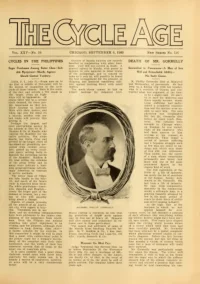
Articles in this issue
- A correspondent from Iloilo reported that the bicycle trade in the Philippines was active among the white population and better-class Filipinos, with M.T. Hashim & Co. of Manila controlling the Rambler franchise across the archipelago, and advised that heavy crating and oil protection against rust were essential for shipments, and that a single Manila agency with sub-agent rights would be the most practical distribution arrangement.
- Richard Phillip Gormully, co-founder of Gormully & Jeffery and one of the most prominent figures in the American bicycle trade, died in Montreal of pneumonia following five years of serious spinal illness that he had endured with exceptional willpower while continuing to direct the affairs of the G.&J. company, the Shelby Cycle Co., and other enterprises; his estate was valued at approximately $1,000,000, with the bulk left to his widow.
- Manson filed a voluntary bankruptcy petition and was reported working to arrange a settlement with creditors; the Clipper Chilled Plow Co. also faced financial difficulties, and the Chicago Tube Co. was reorganizing to restart its operations.
- The Cycle Age editorialized that cycle shows — whether local or national — were vital tools for educating and stimulating the trade, arguing the bicycle business was unkillable as long as no cheaper transportation alternative existed and that pessimists lacked the energy or vision to appreciate the industry's continuing prospects.
- Members of an informal inventors' club swapped stories about freak patentees seeking endorsements, with one account focusing on a country inventor who had devised an automatic air pump built into the bicycle tire valve to keep tires perpetually inflated without rider effort.
- A.J. Holmes, a veteran bicycle salesman since 1882 who managed the bicycle department at the large St. Louis jobbing house of Farwell, Ozmun, Kirk & Co., described the nature of the jobbing trade in the Lake States territory and his long career in the industry.
- Eastern New York's cycle path system, supported by one-dollar annual memberships, offered riders excellent paths and picturesque roads through the Mohawk Valley, from Herkimer through Little Falls — home of bicycle-manufacturer Snyder — and on toward Amsterdam, with the writer describing a memorable encounter with local scorchers on the road.
- The article took readers inside a drop forge factory to show how the frame connections advertised as 'solid drop forged connections throughout' were actually produced, describing the noise, heat, and dramatic process of forming steel billets under drop hammers into finished bicycle frame lugs.
- Four recently patented bicycle devices were described: a back-pedaling coaster brake, a tapered-diameter frame tube system to be manufactured by Wilmot & Hobbs for 1901, a brazeless tube joint, and an adjustable handle bar engineered to avoid the American Bicycle Company's existing patent claims.
- The sports column drew a comparison between A.A. Zimmermann, champion of cycling's White City heyday, and Major Taylor, whose performances at the Paris Exposition were then receiving international attention as the sport's current leading figure.
- Jimmy Michael demonstrated his claim to the 1900 middle-distance championship before 4,500 spectators at Woodside Park, Philadelphia, defeating John Nelson decisively in a paced race of fierce exchanges, with Champion and other riders also featuring prominently on the program and several records broken.