The Cycle Age and Trade Review, Vol 25, No 149
Articles in this issue
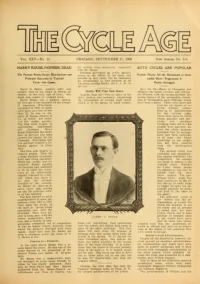
- Harry G. Rouse of Peoria, one of the founders of the League of American Wheelmen in 1878 and promoter of the famous Peoria racing meets, died of typhoid fever at age forty; he had been a pioneer Columbia and Crescent dealer and manufacturer of the Sylph and Overland bicycles before business complications forced a suspension in the late 1890s.
- A detailed review of the Inter-Ocean automobile show at Washington Park found its racing program chaotically organized and poorly managed, but acknowledged that the performances of Alexander Winton and motorcyclists Champion and Skinner provided spectacular entertainment, with Champion repeatedly furnishing most of the genuine racing action and beating Winton's time in a disputed fifty-mile event.
- Following Manson's voluntary bankruptcy petition, the sale of his plant was announced, but any purchaser would have to wait two years for possession because of a lease executed in July that gave the current occupant continued rights over the property.
- The Cycle Age editorialized that the Inter-Ocean automobile show at Washington Park proved the trade willing to support such events, but its program failures demonstrated that a great daily newspaper could not impose such an enterprise on the trade without adequate preparation or prior investigation of what the industry was capable of delivering.
- Two back-pedaling band brake designs were described and illustrated, along with a novel bicycle rack distinguished from the Calkins pattern and a strip device for altering rim dimensions; the column noted the generally low commercial value of the recent crop of cycle inventions.
- Chicago trade visitors shared cautionary stories about retail cycle credit, describing how accounts that seemed small at the outset grew to threaten the dealer's entire profit margin once store running costs, incidental expenses, and outright credit losses were all taken into account.
- Brief trade notes covered dealer relocations and a fire loss in the Midwest, the Nicolet Bicycle Co. of Champaign arranging to move to new premises, and various short business items of interest to manufacturers, dealers, jobbers, and exporters across the country.
- The sports column considered the satirical attacks on Major Taylor for refusing to race on Sundays, arguing that whatever one's views on his religious principles, Taylor deserved credit for his racing achievements rather than mockery for his personal convictions about Sabbath observance.
- Harry Elkes administered his second decisive defeat to John Nelson in a fifty-mile paced race at Charles River Park on September 22, winning by eight and a half laps and consolidating his position as middle-distance champion for the 1900 season.
- A detailed account described the sprint final of the Grand Prize of the Paris Exposition, in which champion Jacquelin was defeated by Myers and Tom Cooper from an original field of forty-nine of the world's best professional short-distance riders — a result described as the greatest race yet run.