The Cycle, Vol 1, No 1
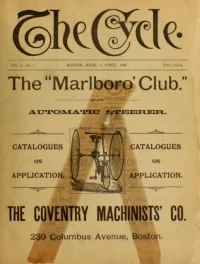
Articles in this issue
- Editor Abbot Bassett introduces The Cycle, pledging fair and impartial reporting, then moves immediately into the League of American Wheelmen's Racing Board controversy over so-called makers' amateurs, surveying three camps — strict enforcement, a new intermediate class, and abolition of the amateur law — before reporting the Board's 1886 rule changes, including a new class-race definition, a $50 championship prize cap, revised championship distances, and front-wheel timing.
- Writing as 'Jam Satis,' the author traces American cycling from the bone-shaker of 1869 through the 1876 Philadelphia Centennial, credits James Starley as the true inventor of the modern high-wheeler, and compares a top-grade 1882 roadster with its 1886 equivalent to find only six points of difference — arguing the ordinary bicycle is now essentially as good as materials allow.
- A columnist urges wheelmen to promote cycling actively rather than by fair-weather example alone, arguing that riding in bad weather and for everyday errands demonstrates the bicycle's practical value; a second plea calls on clubs to welcome women as full members, noting that ladies who ride strengthen the sport and that separate 'ladies' tricycle clubs' are a symptom of unnecessary exclusion.
- Signed 'Daisie,' this column welcomes The Cycle's launch, describes a new low-axle bar-steerer tricycle designed for ladies, raises the question of an appropriate League uniform for women riders, and anticipates a large showing of lady cyclists at the upcoming Boston League Meet.
- A correspondent reports that several Detroit Bicycle Club members will join the Big Four tour, that Chief Consul Johnson is compiling a Michigan road book, and that the club has formed a stock company to build a bicycle track expected to be among the fastest in the world; a bicycle race circuit linking St. Louis, Chicago, Detroit, and Cleveland is also being organised.
- Boston wheelmen are petitioning against the proposed Beacon Street cable-car line, which would destroy the city's best cycling road; remonstrance petitions are placed in every local bicycle warehouse and a blank is available at The Cycle's office.
- Reprinted from the St. Louis Post-Dispatch, this piece describes Charles E. Duryea's prototype spokeless and hubless bicycle — a 52-inch wheel driven by rim-mounted gearing and small idle-wheels — which has already been ridden successfully over granite and sidewalks and is notable as the first single-track cycle a lady could mount as easily as a man.
- Three reader contributions occupy this section: Karl Kron of New York addresses verses from Professor H. A. Beers's 'The Thankless Muse' to Thomas Stevens, then cycling across Asia, and supplies Stevens's postal address for fans to write; C. E. Hawley of Washington forwards a technical note on steel tempering from Dingier's Polytechnic, suggesting it may help bicycle ball-bearing manufacturers; and 'Hudson' asks fellow readers for practical advice on choosing the best tandem bicycle.
- A brief miscellany column opens with 'Wheel Ethics,' a poem by Charles Richards Dodge depicting a Sunday cycle ride as a form of open-air worship, followed by editorial notes acknowledging a large post-launch mail, commenting on the Racing Board controversy, reporting on Massachusetts League representation, and quoting the H. B. Smith Machine Company's position on the makers' amateur question.
- Editor Bassett gives the inside account of the injunction placed by the Overman Wheel Company on undelivered copies of the Springfield Wheelmen's Gazette over disputed front-page advertising rights, explaining how Col. Pope eventually released publisher Ducker from his contract but the partnership dissolved regardless, with Ducker announcing a new paper to be called The Wheelmen's Gazette.
- Reports the formation of the New York and New Jersey Team Road Racing Association at a meeting of twelve clubs, setting 25-mile races on Decoration and Election Days for a perpetual challenge cup worth at least $250; the full adopted constitution, covering membership, officers, race rules, scoring, and trophy conditions, is printed in full.
- John S. Prince and R. A. Neilson have agreed on a $300-a-side series of professional championship races, with the first at five miles likely at the new Lynn track around 30 May; H. O. Duncan's European racing schedule is also outlined, taking in the twenty-mile and fifty-mile championships in England before returning to France for spring events.
- A round-up of club news covers reorganisations and new officers at Gloucester, Waltham, Stoneham, Newton, Chelsea, Atalanta Wheelmen (Newark), Buffalo Bicycle Club, Roselle Ramblers, Syracuse Cycling Club, Wilmington Wheel Club, Northampton Wheel Club, Orange Wanderers, the Philadelphia Club's new house, and the newly formed Albany Wheelmen's Club.
- Trade notes cover strong demand for the Royal Mail bicycle's new ball-bearing head and Fox grip rim, record March sales at Pope Manufacturing, brisk sales of Singer's straight-steerer tricycle at Everett & Co., the Ranelagh Club tricycle from Coventry Machinists, Murray's new stock of Gormully & Jeffery wheels, the lightened 1886 Star, and Samuel T. Clark & Co.'s New Rapid bicycle fresh from its gold medal at the London Inventions Exhibition.