The Cycle, Vol 1, No 12
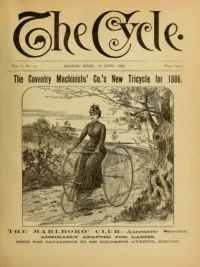
Articles in this issue
- A letter signed "Hawkshaw" recounts how an enthusiastic tandem rider and his wife were brought to a standstill by an alarming clicking noise on a hill; two hours of dismantling the central-geared Springfield tandem revealed nothing wrong, and the culprit turned out to be a displaced mud-guard whose spokes grazed the guard with every revolution.
- A letter signed "Captain" reports that the writer has refused a position as official at a race meeting held under A.C.U. rules, calling on wheelmen to stand by the League and warning that any association that lets professionals race as amateurs will be short-lived.
- The column's unnamed female correspondent counsels a country lady against expecting much pleasure from tricycling on sandy, rutted roads, and laments how few places in America offer the smooth surfaces English women enjoy; she closes with an anecdote about her friend Maud, whose dress wound into the chain on a hire machine, trapping her on a lonely hill until a farmer's wagon freed her.
- Two notices from the L.A.W. Racing Board, dated 13 June 1886, declare John Illston of Hartford a professional for competing with professionals at New Haven, and suspend fifteen named riders for thirty days for competing under rules other than those of the League at the same meeting.
- New York correspondent "Jenkins" gently mocks Boston cyclists for mistaking the Latin name of a thumb-muscle injury, then gives a detailed account of the first New York and New Jersey Team Road Race at Irvington — won by E. M. Valentine of the Kings County Wheelmen in 1h 41m 5s over 25 miles — with the full finishing order of all sixteen riders.
- Reports the definition of amateur and professional adopted by the American Cyclists' Union at a meeting at the Commonwealth Hotel, noting that temporary officers chosen at the League Meet were formally placed in nomination.
- United States Chief Consul Frank W. Weston warns C.T.C. members that, while they may join other organisations, the N.C.U. and L.A.W. definition of an amateur has not changed and members who intend to violate it should resign from the C.T.C. first.
- An anonymous letter from one of the suspended "makers' amateurs" admits he was wrong to dismiss the Racing Board's action, acknowledges the League rules are backed by the N.A.A.A. and N.C.U., and suggests reforms: allow actual travelling expenses, create a third class for manufacturer-backed riders, and return entry fees to finishers.
- Describes the reception dinner held at Aslredo's, West End, New Orleans, on 9 June 1886, welcoming home Capts. Hill and Fairchild after their Boston-to-New Orleans ride; Chief Consul Ed. A. Shields presented gold medals bearing the inscription "From Boston to New Orleans in thirty days" and speechmaking continued until the last train.
- A series of brief satirical fables — cast as scenes at "the Cycleries" — mocking a rival publisher who cut his price to undercut The Cycle, a mudslinger whose dirt rebounds as lost revenue, and other allegorical figures, each ending with an ironic moral.
- Describes two novel machines under development in Springfield: J. H. Bullard's kerosene-fuelled steam tricycle — already tested, capable of 20 mph, and being prepared for patent in several countries — and Rev. Homer A. King's lever-driven safety bicycle with variable gearing, anti-friction bearings, and a rear small wheel for steering.
- Reprinted from the Providence Journal, an outside observer argues that while the Racing Board's expulsion of manufacturer-backed "amateurs" was justified, the formation of the A.C.U. threatens to introduce semi-professionalism and the money element into a sport whose appeal rests on the public's belief that every racer competes solely to win.
- Notes that Low's Almanac of 1820 contains a woodcut of a "velocipede, or walking machine" closely resembling a modern bicycle, with a description crediting inventor Charles Davis and suggesting the device could accelerate the marches of armies — sourced from the Salem Telegram.
- A column of short cycling paragraphs covering: confirmation that English riders will not race under A.C.U. rules at the risk of their N.C.U. standing; Massachusetts Division's race profit share of $22.90; California's three-mile League championship plans; notes on the Royal Mail tricycle's new ratchet brake; Missouri Club mileage totals; a report that The Mirror of American Sports will suspend publication; and various other club, trade, and racing snippets.
- A humorous poem narrating a wheelman's revenge on a vicious dog ("Tooth-inserter") that bit his calf: the cyclist visits an armourer, returns with a three-foot fencing foil, dispatches the dog in a dramatic roadside duel, and is celebrated by his fellow wheelmen as a liberator.
- Tour-master Burley B. Ayers announces the L.A.W. annual tour route for September 1886: starting from Canandaigua, N.Y., the party will ride through Watkins' Glen, Elmira, Port Jervis, and the Delaware Water Gap before steaming to Old Point Comfort, Va., and finishing with a four-day ride down the Shenandoah Valley to Harper's Ferry.
- Describes a complete suit of cycling clothing made by the firm of Goy that converts between ordinary street dress and cycling kit without removal: trousers with concealed hooks that become knickerbockers, a jacket with a built-in waistcoat front, and a cricket cap with a fold-out rear flap that forms a two-peaked soft helmet — reprinted from Wheel World.
- Publishes in full the Northern District of Illinois decree in Pope Manufacturing Co. v. Owsley et al.: the court finds the defendants violated their cycle-patent licence agreements, orders payment of $8,707.91 in royalties and interest, enjoins further unlicensed manufacture, and refers the question of additional unreported machines to a master.
- Full race reports from the Yale Bicycle Club's two-day meeting at Hamilton Park, New Haven, 11–12 June 1886 — covering the one-mile open won by W. A. Rowe in 3.0¾, George Hendee's three-mile record of 8.52, the twenty-mile Pope Cup won by A. B. Rich, and all other events — followed by results from Lawrence, Boston, Montreal, Philadelphia, Staten Island, St. Paul, and Cleveland.
- Brief club-news paragraphs: the Roxbury Club's formation with eighteen members and its first officers; Frank J. Schwartz's election to fill the vacancy at the Ariel Wheel Club, Poughkeepsie; and the South End Girls' Tricycle Club of Hartford electing officers and planning Saturday rides on the Capitol grounds.
- Calendar of forthcoming cycling fixtures for June and July 1886, including the second Prince-Neilson race at Lynn, the Michigan Division L.A.W. annual meet and national ten-mile championship at Detroit, the C.W.A. annual meeting at Montreal, and race meetings at Binghamton, Cleveland, Chelsea, Boston, and East Saginaw.