The Cycle, Vol 1, No 18
Articles in this issue
- The Racing Board votes to approve the amateur rules of the American Cyclists' Union, ending the conflict between the two organisations, on the basis that the A.C.U. has agreed to admit only amateurs to amateur races — all the League ever asked.
- The Cycle defends the Orange Wanderers against an intemperate attack by Karl Kron (Lyman H. Bagg) in the Bulletin, arguing that the New Jersey club acted fairly in supporting lantern-and-bell ordinances; Luther H. Porter, club president, replies directly, noting there was no dissenting voice when the motion was passed.
- English cycling writer A. Kennedy-Child, who first cast doubt on Springfield track times, arrives in America intending to stay at least a year in Hartford, speaks well of the League's principled stand on the amateur question, and is not in sympathy with the N.C.U.'s recent backdown.
- The Racing Board formally disclaims jurisdiction over road racing, citing its conflict with law; the Providence Journal argues that road racing is essentially an amateur pastime that can continue wherever arrangements with authorities allow, without antagonising the Board's position.
- The Providence Journal warns that Pope Manufacturing's control of Rowe, Hendee, Knapp, and Burnham — the four fastest men in America — will doom the promateur class unless a second-rate rider unexpectedly develops the speed to beat them.
- Luther H. Porter, President of the Orange Wanderers, writes a detailed letter explaining why his club advocated for the Orange lantern-and-bell cycling ordinance, arguing that noiselessly moving cycles pose genuine dangers to pedestrians and other road users at night and that fair play requires wheelmen to respect others' rights as well as their own.
- A newly patented combination bicycle stand and camp stool by A. W. Gump of Dayton, Ohio, is described: it holds the bicycle upright or inverted for cleaning, converts instantly into a camp stool, weighs five and a half pounds, and is adjustable to different-sized machines.
- G. P. Mills of the Anfield Bicycle Club rode 861 miles from Land's End to John O'Groats in five days, one hour, and forty-five minutes on a 53-inch Humber, beating the previous record by one day, six hours and forty minutes despite a heavy headwind from Perth to the finish.
- E. H. Wilcox of Indianapolis reports covering twenty miles in 1:15, twenty-five miles in 1:42.2, and fifty-one miles in 3:52 on a heavy roadster over a hilly road with a head wind, and completing one hundred miles in 9 hours 10 minutes.
- The Bicycling News reprints G. Lacy Hillier's praise for Abbot Bassett and The Cycle as the only American paper standing firmly against the "makers' amateur," expressing sympathy for Bassett's difficult position and noting that his list of suspensions continues to grow.
- A regular column covering equipment observations and miscellaneous road notes: the writer reviews the new Rover's improved rigidity, assesses the new Regent light roadster from Trigwell, Watson & Co., and endorses spade or T-handles as a major improvement for handlebar comfort.
- Lists cycling patents granted 21 July 1886, including H. J. Lawson of Coventry for a velocipede, F. H. Stevens of Gloucester, Mass., for an oil can, and A. Vick of Mount Carmel, Conn., for a velocipede.
- A column of brief cycling news items covering the forthcoming Pacific Wheelman paper in San Francisco, the New Orleans tourists' letter of thanks, the Citizens' Club of New York monthly meeting, the somnambulist wheelman of Morrisonville, Jo Pennell's release from French prison, various road trips, and miscellaneous racing gossip.
- Full results of the Southern bicycle tournament held at Columbus, Georgia, 15–17 July, including amateur, professional, and state championship races across three days; P. W. Stone of St. Louis took the Southern mile record at 2:56½, and T. L. Ingram won the five-mile state championship.
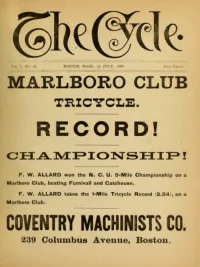
- Results from British and Irish cycling events in early July: F. W. Allard won the five-mile tricycle championship of Scotland at Glasgow; A. E. Langley won the Irving Challenge Cup at Lillie Bridge; and R. J. Mecredy won three Irish championships at Dublin.
- Brief trade items noting strong demand for the American Champion from Gormully & Jeffery, Rudge's world one-mile championship win and record of over a hundred prizes on Rudge machines this season, and Charles Ware's six prizes at Montreal and Boston Common on a 55-inch Rudge Racer.
- Calendar of upcoming cycling races and meets through October 1886, including the Chicago Bicycle Club races on 31 July, the New York division meet at Buffalo in September with the five-mile L.A.W. championship, the Springfield tournament 14–17 September, and the interstate illuminated parade and meet at St. Louis on 1–2 October.