The Cycle, Vol 1, No 3
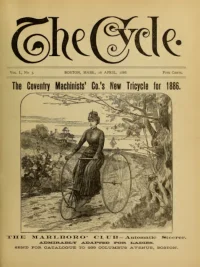
Articles in this issue
- Part III of Jamsatis's history series examines tricycle driving and steering mechanisms, tracing the transition from lever-and-rod systems to rotary chain drive, the role of Starley's differential balance gear, and the merits of various steering designs including the rack-and-pinion.
- Daisie evaluates the L.A.W. ladies' uniform cloth sent by 'Polly,' finding it durable but likely too costly for general adoption, and recounts an amusing roadside episode when a loose pedal stranded her miles from home.
- A poem by L.H. in which a cyclist weighs up the rival merits of the Victor, Rudge, Royal Mail, Sanspareil, Expert, Star, Kangaroo, and Facile, ending in cheerful indecision about which wheel to choose for the season.
- A sequel poem by L.H.P. reflecting on a season's riding and concluding that, after months of debate, the Light Roadster Rudge stands above all others for strong riders.
- Pope Manufacturing Co. announces its new ladies' two-track tricycle for 1886, describing the lighter tubular frame, lock steering mechanism, Ewart detachable-link chain, and a price of $175.
- A brief notice introduces the Columbia Safety bicycle built on Kangaroo lines with 42- and 20-inch wheels geared to 52½ inches, ball bearings throughout, and an adjustable lower sprocket bracket, priced at $140.
- Correspondent 'Spokes' reports on cycling enthusiasm in Chicago: J. O. Blake's prospects for State consul, Major Durell's success managing Columbia's warerooms, Van Sicklen's training plans for Springfield, and the unsettled finances of the Bicycle Track Association.
- A profile of the Boston bicycle house at 152 Congress Street, tracing their start in 1878 importing cycles, their agency for Singer and later Rudge machines, and their growth into the foremost Rudge dealer in America.
- Correspondent 'Stamford' reports on wet-weather riding in Connecticut: the Solitary Club's near-continuous winter riding, a Star-fever outbreak among Stamford Wheel Club members, and plans for a May trip to Boston for the League Meet.
- Detailed description of the planned three-story clubhouse for Washington D.C.'s Capital Club, covering the tiled vestibule, wheel room for thirty to forty bicycles, locker and bath facilities, drawing room, meeting room, billiard room, and steam heating.
- A humorous letter signed J. Parke Street describes gearing up a 40-inch tricycle to 48, lengthening the cranks, and raising the handles, only to find the freshly painted joints stiff and the hills as steep as ever.
- A letter signed 'Polly' provides details of the L.A.W. ladies' uniform cloth — a dark mixed-brown worsted, a yard and a half wide at $1.00 per yard — and asks whether a prescribed uniform cut exists for lady members.
- A miscellany section opening with the comic poem 'The Cycler's Love' by Arthur Young (reprinted from the Spectator), followed by short news items on club runs, the Canadian Wheelman's uniform, a Hartford cyclist's cross-country ride, and the Massachusetts Club's new librarian.
- Directory of recently elected officers for cycling clubs across the United States and Canada, including the Lawrence, Macon, Cleveland Star, Atlanta, Montreal, Waterbury, Brooklyn, and Troy clubs, together with a standing request for secretaries to submit their officer lists.
- Racing results from Minneapolis (Prince defeats Woodside in a ten-mile rink race), Rochester (Elsa Von Blumen wins a 27-hour endurance event), and Louisville (Macaulay takes a two-mile race at the Eureka rink).
- Trade notes covering Geo. D. Gideon's promotion of Invincible machines in Philadelphia, the dissolution of Zacharias & Smith and formation of Howard A. Smith & Co. in Newark, and A. W. Gump's expansion of the largest bicycle establishment in Ohio at Dayton.