The Cycle, Vol 1, No 6
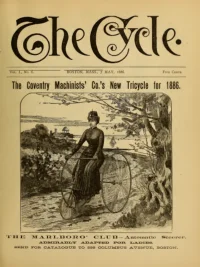
Articles in this issue
- The editor argues that even if the case for a new intermediate racing class were won, it could not be enacted at the May Boston meeting, because the L.A.W. constitution requires a separately called constitutional convention with at least one month's notice. He also notes that changes to the by-laws (including the amateur rule) require prior notice to every board officer.
- Readers respond to a brain-teaser posed in an earlier issue: a bicycle is sold for $50, bought back for $45, then sold again for $65 — how much profit was made? Several correspondents offer competing analyses, ranging from $20 to $25 net gain, with one club giving up entirely after six arguments.
- The New York correspondent 'Cyclos' mocks the florid literary pretensions of 'S. H. M.' — author of 'Bermudian Rambles on a Tricycle' in the L.A.W. Bulletin — who objects to discussions of wheel construction in the official organ while filling its columns with quotations and French phrases. Cyclos argues that technical discussion is precisely what a cycling paper should offer, and praises New York's incoming chief consul Bidwell.
- A correspondent signing as 'Lord Dolphin' rebuts a claim in the Bicycling World that rear-steering tandems have never become a leading type, citing the Surrey Machinists' Company 'Invincible' as a pronounced success in England. He quotes Bicycling News extensively on the Invincible's light frame, hollow rims, and new front-steering variant due in 1886.
- Reprinted from the Philadelphia Press of 25 April 1886, this piece argues that the L.A.W.'s mass disqualification of leading riders into the professional ranks will ultimately benefit the sport by clearing the amateur field and encouraging new competitors. A Philadelphia reader endorses the view, adding that the Racing Board's action is so evidently correct it requires no formal club endorsement.
- A correspondent styling himself 'Dealer' defends the planned parade at the Boston League Meet against a rival paper's attacks, arguing that a thousand wheelmen in line would educate the public and give sponsors the visibility that justifies their financial support of the event.
- A meeting of bicyclists in Omaha on 27 April organised a Nebraska state branch of the L.A.W., electing W. S. Rogers as chief consul and state representative and B. F. Fell as secretary-treasurer, with an active founding membership of fifty-two.
- Three members of the New Orleans Bicycle Club — A. M. Hill, C. M. Fairchild, and H. W. Fairfax — set out from New Orleans on 25 April on a 1,500-mile ride to Boston in time for the L.A.W. Meet, travelling through Alabama, Georgia, the Carolinas, Virginia, and up the Eastern Seaboard despite bad weather.
- The correspondent 'N. J.' examines contradictory public statements about where and when the New York and New Jersey Touring and Road Race Association will hold its first race, concluding that the event will not be in Boston nor on the constitutionally mandated Decoration Day, but somewhere in New Jersey in June — and that none of the proposed Irvington-to-Milburn courses actually measures 12½ rideable miles.
- Lists the 1886 time standards and current holders for each English championship distance (one to fifty miles, bicycle and tricycle), together with the schedule of championship venues from May to August.
- B. B. Ayers, chairman of the transportation committee, outlines the League trunk-line railway network for wheelmen travelling to Boston from across the country, identifying the Michigan Central, Lake Shore, Baltimore and Ohio, West Shore, Fitchburg, and other roads, and naming local agents who can arrange passage from each region.
- Reports on preparations for the Boston L.A.W. Meet, covering entertainment committee arrangements (minstrel show at Music Hall, Cadet Band, fifty-man first part), reception committee plans including ushers, baggage barges, and tasteful metal badges, and the full schedule of tours and runs across the five days from 27 to 31 May.
- William M. North, agent of the British Telegraph Company at Teheran, reports that globe-circling wheelman Thomas Stevens arrived at Meshed on 29 March after a brutal journey through two feet of snow, and is uncertain whether he will be permitted to pass through Siberia or Afghanistan on the next leg.
- At an N.C.U. meeting on 13 April, riders suspended for racing as 'makers' amateurs' were given a one-week reprieve rather than permanent disqualification, with a formal warning that any further infraction will result in permanent barring from N.C.U. contests. Honorary secretary Todd's circular narrating the affair ab initio is quoted at length.
- A conversion table translating metric racing distances (200 metres to 4,000 metres) into their American equivalents in rods and fractions of a mile, provided as a reference for comparing French and American racing records.
- The regular column 'Daisie' discusses the new L.A.W. touring colors (royal purple with divisional tints), quotes 'Merrie Wheeler' and 'Violet Lorne' on practical lady cyclists' dress, and addresses a reader's inquiry about arrangements for women attending the Boston League Meet, inviting all ladies planning to attend to write with their travel and riding details.
- A long promotional notice (marked 'Adv.') for the American Rudge imported by Stoddard, Lovering & Co., describing its crescent-steel rims, gun-metal hubs, Humber-pattern head, elliptical hollow forks, and Rudge 'Unequalled' ball bearings as offering first-class construction at a price accessible to riders who cannot afford the most expensive mounts.
- The columnist '5678' recounts two attempts to ride a 'Rover' safety bicycle — initial ignominious failure followed by a successful if ungainly second try — and offers a measured impression: real safety and pleasant motion, but sensitive steering and questionable durability compared to an ordinary high-wheeler. He also argues that handle-bars beyond 28 inches cause an ugly stoop and that 26–28 inches suits most road riders.
- Miscellaneous short items: a poem titled 'The Test' by 'P.' praising a faithful bicycle; notice that T. J. Kirkpatrick declines to stand for L.A.W. president; verse lampooning 'promateurs' barred from League racing; Arthur Young's hill-climbing victory at Clarksville; tandem-road-record from Washington to Cabin John's Bridge; W. M. Woodside's admirer telegram anecdote; and numerous club and trade snippets including the death of W. C. Marvin, founder of the Western Cyclist.
- Racing news covering the Hartford Wheel Club spring race programme for 22 May (nine events including club championship, handicaps, and open mile), the Yale Bicycle Club's spring races planned for 11–12 June, the Woodstock Bicycle Club annual meeting on 24–25 May, and the professional championship at Leicester won by Howell, plus Speechly's narrow win over Furnival at the Surrey B.C. meeting.
- Club news listing recently elected officers for the Newburg Wheelmen, Kennebec Wheelmen (Augusta, Me.), Elizabeth Wheelmen, St. Louis Star Club, Wheeling Wheelmen (W. Va.), and Cleveland Star Club, plus a report on the Hoosac Wheelmen of Hoosac Falls, N.Y., moving into furnished new club rooms with fifty-two members, and the Cambridge Bicycle Club's season run schedule.
- Short trade notes: Murray at 100 Sudbury Street has taken in Gormully & Jeffery Champion bicycles (the machine on which Schock set his record); Ardill's Liquid Enamel praised for easy application; the King of the Road lamp and Stoddard, Lovering & Co. sundries recommended; and a correction noting that seventy (not seventeen) per cent of Expert Columbias are sold nickel-plated.
- Calendar of upcoming cycling races and meetings from May through July 1886, including the Hudson County road race, Madison Square Garden bicycle races, Hartford Wheel Club races, two days at Woodstock (Canada), the full Boston League Meet programme (27–31 May), Yale College Club races, Capital Club races in Washington, N.A.A.A.A. championships in New York, and the C.W.A. annual meeting in Montreal.
- Official notice of the L.A.W. races to be held at Union Grounds, Dartmouth Street, Boston, on 30 May 1886 at 3 p.m., listing seven events: the national amateur bicycle and tricycle championships, the Massachusetts state bicycle championship, a novice mile, a handicap mile, and two invitation races at one and three miles.