Vol 12, No 16
Cite this issue
Citation
The Referee 12, no. 16 (1894). cyclearchive.com, https://cyclearchive.com/magazines/the-referee-cycle-trade-review/vol12-16/
Page numbers are pages of the PDF, which can differ from the numbers printed on the page.
Articles in this issue
- The Asbury Park Wheelmen and citizens pledge money to win the L.A.W. meet for 1894, and a committee goes to the Louisville assembly to press the claim; Charles E. Zacharias's stationery reads 'we want the meet and nothing more'.
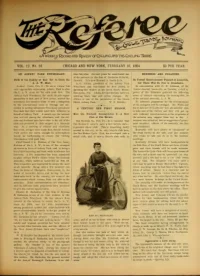
- A rumoured new riders' club at Des Moines, and Miss Ida Pritchard, the first lady in Iowa to make the century run, with her portrait.
- G. E. Johnson's notes on the Louisville L.A.W. meeting: no formal entertainment, the Kentucky headquarters at the Gault House, the Louisville Cycle Club's open house, and New Jersey's delegation of twenty.
- A quoted Sporting Life notice praising the Referee's cartoon of the libel-suit monkeys, with a joke about ready-made suits.
- A feature on the Associated Cyclers Club House Company, which houses the Century, Porkopolis, Cincinnati and Athletic clubs, with the Brighton and Crescent racing teams, the Comet and Independents, and the Queen and Corey ladies' clubs.
- The Referee's four-page colour supplement of premiums, with more than 20,000 copies sent out, and a liberal commission offered to boys and others who secure subscribers.
- The Capital City Cycling Club of Lincoln plans a building with an indoor track, costing between $3,000 and $4,000, to be financed by subscriptions and by race and rental income.
- The Zanesville (O.) Cycling Club resolves that manufacturers and dealers should support the L.A.W. good roads bureau, and the resolutions go to the national assembly; a good roads society for Muskingum County is discussed.
- A column on women riders: the bloomer costume taking up at the cycling schools, the Mowbray House Lady Cyclists' Association under Lady Henry Somerset, which discussed dress reform, Mrs. H. S. Lloyd of Emporium, Pa., and the Line Wheelmen's Club badge.
- Mr. Jeffery of Gormully & Jeffery may go to England in the coming summer and may go over with the Referee's tourists, and Mr. Yost says that either he or Mr. Dewey will surely go abroad with the party.
- Vice Consul Black of Illinois proposes a relay ride from Washington to Denver, carrying a message from President Cleveland to Chief Consul McGuire at Denver, by way of Wheeling, Columbus, Indianapolis, Springfield, Kansas City and Pueblo.
- Charley Price says he intends to race in Europe in the coming season in the interest of an American firm, and expects to beat Harry Wheeler in 1894.
- Before the league's Louisville assembly the paper examines the Potter contract story, Burdett's class B proposal to admit all wheelmen, and the presidency candidates, with Luscomb's position on Asbury Park as the meet.
- The paper reminds the league's Louisville voters that its own vote of 727 to 489 favoured admitting professionals, and argues that refusing admission solely for professional status is unjust.
- The paper argues that the trade should have one national show, wherever held, because two shows would divide patronage, and it rejects New York's demand for a show every year.
- The paper answers a New York rival who says it misrepresented him: it says he carries an advertisement at fifteen per cent below its usual rates, and it tells how a Bulletin advertisement, never printed in the Referee, led an advertiser to say he had seen it there.
- A Denver meeting at Coliseum Hall on the 5th, addressed by cyclists' union officers, urges securing the L.A.W. meet for Denver, signs up new members for the Colorado division, and plans a protest against a proposed bicycle license ordinance.
- A staff man tells of a noisy night at the Philadelphia show, sharing a bedroom with Dai Lewis and Senator Morgan, that brought the night watchman, and says the paper's representative will take a room to himself at future meetings.
- Benjamin E. Dakin, the bicycle detective, recovered two stolen Columbia safeties and won the $50 reward offered by the Pope Manufacturing Company in each case, the thieves being jailed for thirty and 180 days.
- Frank T. Fowler apologises in a letter to the Referee for his language about the Hill Cycle Manufacturing Company, and the paper recounts the Moffat Cycle Company's failure and the conspiracy suit that followed.
- A New Orleans letter blames the admission of Black riders to the L.A.W. for hurting cycling in the South, and reports talk of a southern league, a five-rider century by the Pelican Cyclists on Jan. 21, and a Spanish Fort run.
- A three-lap wood-surfaced track is planned at Nantasket beach, with cork layers allowing for expansion, a grand stand with dressing rooms beneath, and a base ball ground and cinder path inside.
- An exchange reports an Ohio horse that attacks bicycles, chasing a young lady rider who abandoned her wheel, and then smashing the machine.
- A full-page drawing of costumed riders at the New Orleans Mardi Gras wheelmen's carnival, with a note that visitors from across the United States attend and that southern riders stage fantastic displays each year.
- J. E. Poorman, who will manage the fourth annual Cincinnati road race in person, has sent out forty-three letters for prizes and has had fifteen favourable replies; the race runs from Hamilton to Chester Park on July 4.
- Albert C. Stevens, New Jersey state representative, proposes amending the L.A.W. constitution at Louisville so that ex-presidents and ex-vice presidents sit in the national assembly, to keep the league's accumulated experience, and the paper supports the suggestion.
- The Ohio state meet at Cincinnati on July 2 to 4 is run by a committee of ten league club members, with a $500, $300 and $200 invitation race, prize orders on Cincinnati tradesmen instead of medals, and a guarantee fund of $5,000.
- The Referee's planned tour of Great Britain from about July 15, for twenty to thirty wheelmen and women, landing at Queenstown and touring Killarney, Dublin, Belfast, Glasgow, Edinburgh, Coventry, Birmingham, Bristol and London over about six weeks; Walford of Bristol and Fred Bradbury of London will help with the routes in England.
- British Sport argues that good ankle action is now less appreciated than it was, when high-bicycle riders had to attend to style; an old racing man says that practising it for a couple of years keeps style, saves energy and guards against side slipping.
- A cartoon for the National Assembly meeting in which Mr. Perkins, who last year opposed excluding Black members, now stands for an exclusion ticket and may not control all his state's delegates.
- Two Chicago clubs will hold cycle shows at their club houses this month, with makers invited to show two machines each free of charge, and the paper says Chicago has set the lead for other cities.
- A short request that F. Ed Spooner send his address to the Referee's New York office at 21 Park Row.
- The New York Tire Company's self-sealing air tube, shown at the New York cycle show, is said to have held air through more than a hundred punctures, with a bicycle that ran 3,700 miles on it, and the company will supply it to users of other tires.
- A patent column on reissues: the courts compare a reissue with the old patent, and will hold a reissue void if it secures another invention with no accident or mistake shown.
- Judge Putnam of the United States circuit court holds that touching patents raise no special mystery: plain specifications and claims are construed by common-law rules, not by the opinions of mechanical experts.
- The circuit court holds that abandoning an invention gives it to the public and cannot be undone, whereas abandoning a patent application may be renewed while the invention itself is not abandoned.
- The circuit court holds that a charge of infringement is not defeated by substituting a well-known equivalent for one element of a patented combination, where the result is only an inferior device.
- Stillman G. Whittaker, returning from the Philadelphia show with wood rim patents, tries to sell the idea to a Pennsylvania Railroad conductor, who demands his ticket, and the sales talk leaves the car laughing.
- A Referee visit to the Peerless Manufacturing Company's Cleveland factory, shown by superintendent Harry Chapman, covering the testing, frame, enamelling and plating rooms, and the racer, road racer and ladies' Triangle models for '94.
- Notes on trade advertising: the makers who put a man who knows the business in charge of their ads get the best results, while some waste half their appropriation on a man who knows little or nothing about advertising.
- The Overman Wheel Company's Mr. Powell, one of the brightest advertising men in the trade and a prizewinner in Printer's Ink, and the advertiser's need to learn the agent's business before tackling the rider.
- Mr. Formhals of the Gormully & Jeffery office keeps books recording almost everything in the bicycle world and uses them to advantage, and the paper urges every office to do the same.
- The paper says the Eastern Rubber Company's advertising has brought it great prominence, that its attacks on the alleged trusts must fall flat, and that the ads would never have appeared had a proposed cycling press association existed.
- Billy Herrick, whose advertising for Morgan & Wright has not earned the full benefit of the money spent, will now pose as an advertising expert, and the paper predicts his first ad will say 'M. & W. tires are good tires'.
- A letter to the editor from J. A. Barnes, manager of the Eastern Rubber Company, saying the riders and makers who used its tires are thanked, that the firm will enlarge its works and equip them with its best machinery, and that it is flattered by the call on its goods.
- Mr. Lozier wants cycle shows run by the trade, open to the whole public with certain days reserved for agents, to educate the public and sell wheels; the paper doubts clubs will take on that much work for little more than glory.
- The paper corrects a Bearings statement that Chicago trade is bad, pointing out that dealers have time to spare for callers and that early-season inquiries after wheels suggest business will be good.
- Three of Kansas City's four last-year cycle jobbers remain in business: the Avery Planter Company takes Sterling, Kingman & Co. the Road King wheel at $100, and Stutz & Walker the Ariel line.
- A list of recent American patents reported for the Referee by a Washington patent agent, covering bicycle gearing, a tire-tightener, a wind harp, a bicycle tire and a wheel rim design.
- When Smith, Whitmore & Maloney failed owing Mr. Lozier a large sum, Maloney gave his house, worth $16,000, to Lozier, who returned it to Maloney's wife.
- The Racine Hardware Manufacturing Company's plant at Racine Junction was sold at public auction for the assignee, A. C. Frank, and bought in for $29,000 in all by M. W. Sherman of Milwaukee, for parties he would not name, with creditors to receive 20 cents on the dollar.
- Two Chicago trade voices praise the Referee for policing trade puffs and for its article on the proposed cycle press association, and one calls the Bearings' silence about its own part in that matter reprehensible.
- The Hickory Wheel Company has sued W. S. Frazer & Co. of Aurora, Ill., and the Michigan Wheel Company of Lansing, Mich., for infringing its sulky patents, and also a user of an infringing sulky in the east, and will press the suits for an early ruling on the patents' validity.
- A show-floor quarrel at Philadelphia between two rival tire makers, one calling the other's tire a direct infringement and a pirate, and the reply that the other had stolen the Para & Co. patents.
- W. C. Overman, with C. H. Walker, is fitting out the new store at 23 Warren street, New York, where the Victor wheel will be on show within days, followed by an 'at home', and the Chicago store will be ready to receive company in a few days.
- E. J. Day, of the Western Wheel Works, is appointed manager of the New York branch in Barclay street by the board of directors.
- Short trade notes: the Roulette Cycle Company moves to 136 Liberty street, the Ferris-Wheeler Company has good demand for repair outfits, Sieg & Walpole move to 285 Wabash avenue, Charles Murphy joins the Warwick Cycle Company, and the North British Rubber Company brings a patent suit against Charles Macintosh & Co. in England.
- The paper wonders what became of the southern circuit talked of earlier, and reports that Edward Manlove of the Graham Cycle Company, Chattanooga, thinks something will surely be done soon but has no plan of action.
- A humorous anecdote sent in by Captain H. A. Smith of the Middletown Wheelmen from the Daily Press: a bicycle drummer helps a fashionable young woman who fell on the ice on East Main street, and the joke turns on his mistake about who she is, credited to H. B. Gleason of the Stearns travelers.
- The Minnette Cycling Club's house on Monroe street opens Chicago's first club show on a Saturday evening, with nearly every Chicago maker showing samples, open to all on several evenings, and a Saturday stag entertainment with boxing, a wrestling bout by John E. Scully and music.
- Herbert Githens, who made a small fortune riding last season, has retired from the racing business, according to the Cincinnati Enquirer.
- Short notes: the North Side C.C. of Milwaukee holds a masked ball, the Des Moines C.C.'s charity ball raises about a thousand dollars, the Queen City C.C. of Covington sends $125 from a dinner to the Union Bethel mission, and Harry Tyler passes through Chicago on his way to Denver.