Vol 12, No 17
Cite this issue
Citation
The Referee 12, no. 17 (1894). cyclearchive.com, https://cyclearchive.com/magazines/the-referee-cycle-trade-review/vol12-17/
Page numbers are pages of the PDF, which can differ from the numbers printed on the page.
Articles in this issue
- F. A. Egan's letter on the failed attempt to form a cycling press association after the Madison Square Garden cycle show, blaming Mr. Dana's wage rule and Jack Horner's gallery play for its collapse.
- Minneapolis plans for the fall: a Cycle Track Association meeting at the Minnehaha track, a proposed relay race, road and team races, and a cash prize meet by local people.
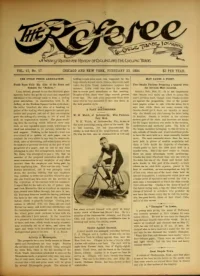
- W. H. Welch of Jacksonville, Fla., aged nineteen, who won his first race at Jacksonville in 2:50 and has raced south of Mason and Dixon's line for the Jacksonville Athletic and Bicycle Club.
- A match between J. J. Clingan on a bicycle and A. Anthes in a row boat, New York to Albany against time for $500 a side, with Billy Edwards as stakeholder.
- Omaha's bid for the 1894 division meet, opposed by some Omaha cyclists because the city lies in the far east of the state, against the paper's case for its half-mile track and its wheelmen.
- A man named McBurney, arrested in New Orleans, who claims to have been the world's long-distance champion after riding 213 miles in 22 hrs. 35 min. in May 1882.
- A Chattanooga citizen says that town is one of the best bicycle towns in the south, with more wheels owned there than in almost any city in that section of the country.
- The Minnette Club of Chicago's cycle show in its dance hall, with the club's history and officers, the makers' machines it displays, and a Saturday raffle of an Ariel.
- James O. Gray is building a four-lap plank track inside the trotting path at his Franklin Park track outside Boston, modelled on Herne Hill, with expert engineers engaged.
- Arthur H. MacOwen of the Athlete has been elected to the Philadelphia city council from the twenty-fourth ward, the cyclists' vote exceeding that of the presidential election.
- Jack Prince has returned to racing against horses, winning a ten-mile race at Jacksonville, Fla., against five trotters in 31:07.
- The Chicago Cycling Club has moved into the Farragut Boat Club's house on Lake Park avenue, re-decorated from top to bottom, with two dozen membership applications already posted and Secretary Barwise and Vice-President Bode credited for the change.
- A note reprinted from British Sport that neither Sanger nor Zimmerman will race in England this season, with praise for Zimmerman as a good sportsman who came back from an early defeat in 1892.
- Short unheaded notes on the Cleveland Wheel Club's Sunday walks, the St. Louis C. C.'s lecture by Bill Nye, a new club at Rock Springs, Wyo., Frank Waller's twenty-four-hour record plan, and the California A. C. C.'s Washington's birthday road race and relay.
- A letter from George Pearce & Co. of Indianapolis thanking the Referee for its mention of their line of lamps, which has brought many inquiries.
- The paper calls Secretary Bassett's claim that seventy per cent. of League members will join to receive the Bulletin a long way from the truth, and favours a weekly organ.
- The paper likens associated cycling clubs to village improvement clubs, praising Philadelphia's association for its street work and cycle shows, while New York and Chicago's clubs do little beyond the Decoration day road race.
- The Metropolitan association of clubs of New York asks the press to tell the trade that it is in no way responsible for the loose conduct of the programme privilege at the late New York show, though the trade still looks to the association for satisfaction, having expected the show's promoters to protect it.
- Charley Luscomb has been elected League president by an overwhelming majority after his fight with Potter, and has much work to undo the incompetency charged against the office.
- The paper criticises ex-President Burdett and ex-Vice-President Brown for leaving Isaac B. Potter under the stigma of a changed contract story, and welcomes Burdett's departure from the League.
- A. T. Reynolds and R. C. Coulter of Mansfield, O., will set out in June on a trip awheel through the western states, Yellowstone park and New Mexico, expecting to cover 10,000 miles.
- Abigail Quay answers Barry Heckla's letter against women's cycling bloomers, defending the bloomer as modest and comfortable for the rider and mocking his arguments on dress and the wheelwomen.
- A party of Philadelphia show-goers at the new Rathskeller plays the German drinking game Salamander with large mugs, the last to empty his mug paying for the round.
- According to the Cyclist, the new track at Antwerp will be widened and banked more steeply than first proposed, with a 400-metre path.
- Bridgeport is likely to get a first-class track, with the owners of Pleasure Beach having virtually agreed to build one, and the Bridgeport Wheel Club planning a big meet there late in the season.
- A ladies' cycling club of seventeen members organised at Los Angeles, with its officers, and a new club at Romeo, Mich., with its officers.
- A writer who knows Ireland describes the Referee tour route, from Dublin's sights through Bantry Bay, Glengariff and Kenmore to the Killarney lakes, with Mr. Walford's offer to meet the tourists at Queenstown.
- Fred Gallaher, the Sporting Life's London correspondent, gives the tour party hotel advice for Queenstown, Killarney, Wicklow, Belfast, Glasgow, Edinburgh and London.
- Road reform in Massachusetts: a 1892 commission led to a permanent law letting towns and counties petition the state for highways, with a $112,000 road estimated (about $4,000 charged to the county) and a $500,000 appropriation likely, and railroads asked to carry road material cheaply.
- Charles H. Luscomb was elected president of the L. A. W. national assembly at Louisville, Ky., by 126 votes to Sheridan's 55, and Denver won the meet over Asbury Park by 93 votes to 70, with Black men barred from membership and the racing board's and Bulletin reports discussed.
- A letter to the editor from Burton F. White welcoming the plan for Chicago's cycling clubs to unite in one large down-town organization, which he thinks sufficient unity should make possible.
- The paper's comment on a lady's wheel for 1894 described to a friend in the Irish Cyclist: 26-inch wheels, a straight double frame, cord dress guards, upward-curved handles, a 55-inch gear and a weight of 30 pounds.
- A column on advertising that holds up the Central Cycle Company, one of the most liberal advertisers in the trade, whose business has grown with its large spaces in nearly every paper.
- Makers such as Featherstone, who sell little at retail yet keep advertising, and the Pope Company, whose ad has appeared in every issue of The Referee.
- The Overman company set the fashion for ornamental advertisement borders, and the Grant anti-friction ball ad in The Referee has a stock border that suits it well.
- An argument for changing advertisements often, since each change costs the printer but advertisers need variety to keep replies coming; the piece is continued.
- A profile of George W. Cokeley, assistant manager of the Providence Tire Company, young in years but with varied tire-manufacturing experience, introduced to the trade for its double-tube tire.
- A column of recent court decisions on trade law, each opening its own point.
- The West Virginia supreme court holds that goods consigned to an agent at a stipulated price remain the principal's until sold to a bona fide purchaser and cannot be levied on for the agent's debts; the agent's lien for commission is personal to him.
- The United States circuit court of appeals holds that design-patent infringement turns on whether a purchaser giving the usual attention to design would be deceived into taking the two designs for the same.
- The Georgia supreme court holds that agency cannot be proved by the declaration of another agent of the same principal, unless that agent was authorised to make it or it formed part of his duty.
- A letter from an eastern manufacturer argues that machines under 25 pounds, catalogued well under $100, mislead inexperienced buyers and that a $100 wheel is not high grade; the paper's reply begins at the foot of the column.
- O. J. Fuchs, a Chillicothe, Ohio jeweler, has patented a brass cyclometer, not over 3.5 ounces, that registers up to 10,000 miles and has a single-trip dial to 100 miles, fixed over the sprocket; its inventor has used one up to 4,000 miles.
- A Referee test of the American Hill-Climber two-speed gear, which weighs two pounds, found it changed without a break while the wheel was running; the lever under the saddle moves the gear from 48 to 63 inches, and the company, capitalised at $100,000, is making a 25-pound light-road wheel.
- Joseph Why has moved from the Hart Cycle Company to A. G. Spalding & Bros.' Philadelphia branch, J. E. Lancaster has secured the Philadelphia agency of the Pennsylvania Cycle Company, and E. J. Bailey has joined the Union Cycle Company's branch from Liberty wheels.
- A. L. Collins, eastern agent for the Monarch, reports trade brisk and easy placing of agencies, and J. H. Zahn, a Poughkeepsie sporting-goods dealer, has contracted to handle the Monarch.
- Josiah S. Quincy, the civil-service reformer, tells The Referee he is not engaged in bicycle manufacturing, though local papers had said he headed a firm to be formed; he has been interested with Berlanger, the unicycle inventor, in inventions and in a company said to be forming at Springfield.
- The paper says the Sperry company of Denver has been questioned in its dealings with the Columbia people; by the paper's information the Sperrys represented that they had $10,000 in the business and gave, or had given for them, a bond. The concern failed last summer, and the Pope company, owed $11,000, has collected nothing.
- Harry Overbaugh of Schoverling, Daly & Gales says the cycle trade lacks confidence, with dealers giving only sample orders and manufacturers unable to make large deliveries.
- The receiver of the Toledo Bicycle Company sought court leave to borrow $8,000 to sell stock on hand, but the stockholders wanted the plant closed out, so the court ordered the whole property sold as one, and the company's president bought it for $15,100.
- C. H. Weld has left the Royal Cycle Works as assistant manager to take charge of manufacturing at W. W. Whitten's Providence business, which has added machinery and will handle other makers' goods and English and American tubing.
- J. Willard Parker of the Niagara Cycle Fittings Company and A. G. Crosby of the Spaulding Machine Screw Company, both claiming to succeed the Niagara Machine Company, competed for its old customers at Peoria, while George Simons of the Surbridge company took a large order there. F. F. Ide, back from the East, refused $10,000 for his spring-crank patent.
- A sketch of an ideal pneumatic-tire valve invented by W. K. Genet of New York, claimed to be simple, quick to inflate and deflate, self-closing and not dependent on a spring or plunger.
- A list of recent United States patents, with numbers, owners, places and filing dates, reported for The Referee by W. E. Auginbaugh of Washington; it includes a wheel by Andrew Nelson of Moline, Ill., a puncture-proof band by Sydney Lee of London, and a velocipede by William L. Decker of Plainfield, N. J.
- The paper regrets that J. A. Barnes, manager of the Eastern Rubber Manufacturing Company, is ill from overwork.
- Unheaded trade notes: a plant at Kenton, Ohio to make the Weston Flying cycle, sales of Punctureless Tire Armor, the fire that destroyed the main building of the Colt Firearms Works, and a new cycle store at Norwalk, Conn. for Bulkly & Co.
- A jesting circular, handed out to delegates at the Louisville meeting, from two hungry Boston young men who advertise for work for regular meals and offer lessons, odd jobs and editorial work.
- A letter from J. W. Sheircliffe of the American Dunlop Tire Company asking to be put on the list for the proposed British Isles tour, praising the hospitality of British cyclists.
- Campbell-Bannerman, the war secretary, asked whether he would support a tax on bicycles and tricycles, said he did not think anyone would tax machines, since cycling benefits health.
- G. Whiz, the Sporting Life's Syracuse correspondent, says the February Referee article hit the Stearns Cycle Company, whose offer to test its wheel against any other is a large, juicy bluff.
- R. W. Slusser, of St. Louis and formerly of Windy Village, and C. M. Fairchild of Chicago are in New Orleans with Mrs. Fairchild and Mrs. Kelly, Century Road Club riders, to ride with the Pelican cyclists, and carry samples of a ladies' riding costume.