Vol 12, No 8
Cite this issue
Citation
The Referee 12, no. 8 (1893). cyclearchive.com, https://cyclearchive.com/magazines/the-referee-cycle-trade-review/vol12-8/
Page numbers are pages of the PDF, which can differ from the numbers printed on the page.
Articles in this issue
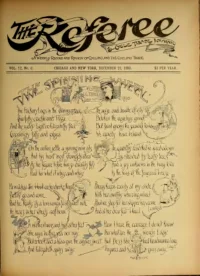
- Cover poem by J. G. Thacker: a young man by the fire watches Elizabeth ride away on her wheel, and after his proposal she says neither yea nor nay before spinning away.
- Rastus, the signature, describes a party of eighteen riders from Paris to Geneva: the forest at Fontainebleau, a ball game at Sens and the Jura roads, where the locals gape at the Americans.
- A short dialogue joke: a stuck cyclist asks a farmer about a muddy road nine miles long, and the farmer's advice is to wait for it to freeze.
- Song with words and music by Roland Hennessy, dedicated to the cyclers of America: three verses and a chorus on the cycle's bell and its night rides; the score runs on to pages 4 and 5.
- By Thomas F. Sheridan, First Vice-President of the L.A.W.: the World's Fair overshadowed wheeling, racing drew large crowds, and the League should claim its share of credit, handle its national meeting with care and push for good roads.
- Cartoon by H. Mayer with a three-line dialogue: she reads that Slope & Co. make the best wheels, he has seen no such statement, and she concludes from the thefts of Slope's wheels that they are the most sought after.
- A page of portrait and action drawings of French racing men, with captions for Desgranges, Stéphane, Terront, Cassignard, Meyer, Louvet, Gaby and Nicodemi, among others.
- Albert Mott argues that race judges and timers should be appointed by the racing board, not by promoters, so that they learn the eye for finishes, and that league clubs should get preference when sanctions conflict.
- Editorial wishing readers a merry Christmas and urging them to put the year's failures behind and enter the new year with good intentions.
- The Referee answers a Chicago Post writer who called the new racing rules a farce and class B a great hoax, arguing that the best men will still race for prizes over $50 only as class B riders.
- The Referee's circular asked makers whether they favoured a trade association and would attend a meeting; the answers were overwhelmingly yes, so the paper will call one, and the New York show management has also announced a meeting at the garden during the show.
- Morgan & Wright's new annex on North May Street will double output to 4,000 tires a day, with a six-ton rubber grinder and 600 men from January.
- A profile of photographer George H. Van Norman, born in Hamilton, Ontario, who has taken many pictures of racers at Springfield.
- The James Cycle Importing Company of Chicago names the James as its leader for next season; hundreds have been sold since the wheels were imported two years ago, and a new invoice of 1894 wheels has arrived.
- Ed Moulton, the 'father of sprinting', an athlete and trainer for many years, who handled cyclists with success last year and now trains football men.
- A. Featherstone & Co. of Chicago closed a satisfactory season with enough orders booked to keep its works busy next year; the Road King, Queen, Duke and Princess are sold by leading wholesalers.
- Billy Perrett, a Raleigh Cycle Company salesman of a little over a year on the road, is praised as clerk of the course with a reputation second to none.
- The Western Wheel Works divides its territory among its salesmen for 1894 so that no two of them handle one district, and prices will be held throughout the season.
- The Anglo-American company, cycle material specialists, denies a rumour that it cannot promptly fill orders, saying its stock and facilities are the first in the country.
- John S. Prince takes the whole south as his exclusive territory for the Niagara, under a contract with the Buffalo Wheel Company, and will use his racing advertising to boom the wheel.
- An alphabetical directory of racing men and trade figures from Adams to Zimmerman, continued from Maltby on page 13, each with a line on his post as consul, manufacturer, agent or racer; William Corcoran ('Billy') was chief of the working forces at the Waltham track last season, and he and the track have since parted company, while Roland Hennessy, editor of Music and Drama, wrote The Merry Cycle Song.
- A verse cartoon of winter's approach: the chill comes into the air, King Frost rules, and the summer's riders are told to get up from their nest and prepare for the coming campaign.
- A page of cartoons by Henry Mayer showing imagined costumes for women cyclists, among them a Dutch fashion, a Mexican senorita, a dandy's outfit, a Cossack and a Little Lord Fauntleroy suit.
- A review of the 1893 season in France, Germany and Belgium: Fischer's Vienna-to-Berlin win in 31 hours, August Lehr's return and records, Breitling's 35 firsts, Terront's 1,000-kilometre track record, and the German cycling union's 40,000 members.
- Profiles of four show men:Thomas Hare, the principal worker at the Philadelphia shows; O. S. Bunnell, official referee of the N.C.A.; and Hildick and Saltonstall of New York, new to the show business.
- A Boston bicycle thief returned a Columbia when he learned of the Pope company's standing reward for the arrest of such culprits, one of many cases where the reward has recovered machines.
- Harry Chapman's article on design and buying: construction has become a science, cheap copies lag behind, light machines need quality material and rigid crank brackets and fork ends, and ball bearings must be ground true after hardening.
- Henry Mayer's account of a trip to Europe, opening with a voyage with Jaffray and Starley, then London and Ostende for Munich, where a beer-drinking race ends with a horse-against-man race that Fischer, winner of the Vienna-to-Berlin race, wins.
- The history of the Chicago 2:50 Club's New Year's Day scorch to Pullman, from its first run on 1 January 1891; in the 1893 scorch Theodore Smith won, ahead of Van Sicklen and Root, after Waller's wheel went wrong.
- First-person story by A. T. Hillyard: a seventeen-year-old London cyclist rides his 52-inch wheel sixty miles to his mother's village through snow and a head wind, arriving in time for Christmas dinner.
- A pair of pictures of the merry cyclist in summer and winter, under the deck 'The merry cyclist in summer and winter', set above the Christmas story below.
- Picture feature of six American cycle works, each drawn in a vignette with its name: Gormully & Jeffery, Overman Wheel, Gendron Iron Wheel, Pope, Ames & Frost and the Winton Bicycle Co.
- History of the Springfield Bicycle Club and Hampden Park: the first race and record there in 1883, the 1883 tournament with Hendee and the English visitors, and the 1884 and 1885 record years and the new track.
- Comic verse defending Augustus, who left the league for the N. C. A.; his five daughters and five pianos end with the pianos sold for a song.
- Comic verse on an immaculate amateur who, once taken on as a clerk, waved his pay away.
- The German minister of war has asked for 300,000 marks from the budget to buy bicycles for the army, reserve men having ridden their own wheels for manoeuvres against a small indemnity.
- Comic verse: Belinda asks Augustus the time while they ride side by side, and his dial turns out to be the clock upon her stocking.
- John S. Leng's Sons & Co. have occupied their present quarters at 4 Fletcher street, New York, for over thirty years; the import of bicycle parts is a small branch of their business.
- The Union Cycle Manufacturing Company has altered its wheel for 1894 and cannot yet give cuts and details for a few days.
- Harry Tyler will take his bride to Denver to manage the Union's depot there.
- By D. E. Miller, president of the Springfield B. C.: advice on running a big tournament, that it needs trial races, a prize list that draws entries, and newspaper coverage of the racing men, which pays better than an advertisement.
- Profile of E. W. Hope, chief consul of the Texas division: learned to ride in Bethlehem, Penn., in 1885, rode the first high-grade ball-bearing bicycle in Sherman, was arrested and acquitted after a runaway, and joined the L.A.W. on 8 July 1885.
- By A. W. Kirsch-King: a $2.50 pair of boots and a cheap cycle share cheap material and labour, the writer argues, and a frame, its tubing and drop-forged fittings are worth buying best, because experience teaches it.
- Ed Porter of Boston: his son Gardie found in an old orchard the fish basket marked E. J. P. that the friends had lost on a raid thirty years before, still holding the skeletons of three trout.
- Fred Merrill, now proprietor of the Cryptal Palace in Portland, which houses a cycling and roller-skating academy and a dancing school; 5,000 people attended the opening, and the house is crowded nightly.
- Fred T. Merrill writes from Portland of his banked indoor track at the Crystal Palace, where a rider three feet from the lower edge holds the steep turn without rising or falling six inches; medals and free admission are to draw large crowds.
- Verse by Frank B. Welch: Santa Claus, his reindeer tired and the children more numerous, finds a bicycle among his goods and rides it over hill and housetop.
- By S. W. Merrihew: the referee has become the most important man on the field, and race meets need paid, competent judges, clerks, starters and three timers, since one timer cannot be checked; umpires should be placed round the track to judge foul riding.
- Sketch of S. Wallace Merrihew, agent at Wilmington, Del., and Philadelphia, a league official in his state, the official handicapper of the N. C. A., a rider with several road records, and a writer on cycling matters.
- Brief note: suits are pending at the year's end; Kirkpatrick's suit against Pope for royalties is still unsettled, and G. & J. v. Kenwood for infringement is dragging on.
- By Henry E. Harris of the Duluth bar: the law of the road gives a cyclist equal rights on the public streets, the right to ride on the roadway and not the pavement, with cases cited from Kansas and North Carolina, and a North Carolina ban on bicycles on a turnpike criticised as bigotry.
- A table of Pacific Coast road and track records, rider and time by distance from a quarter-mile to 50 miles; the track names include W. J. Edwards, W. M. Jenkins and C. Shoemaker, the road names E. E. Stoddard, G. A. Faulkner and W. H. Sewers.
- By J. Elmer Pratt: selling to jobbers and scalpers at ridiculously low prices is no profit for small makers, since makers lost $6,000 to $36,000 through jobbers last season and the scalpers' list will be boycotted by the legitimate trade.
- Lists the concerns in which Colonel Pope holds stock: the Pope Manufacturing Company, Hartford Cycle Company, Hickory Wheel Company, Hartford Rubber Works, Shelby Tubing Company and, probably, many others.
- By H. E. Raymond: he backs the two-class system, with amateurs under the L. A. W. and a separate racing class, against a single rule that forbids racing for cash, and suggests a meeting of race promoters and a registry of racing colours.
- Verse on the pleasures of riding a wheel: climbing hills, coasting down, resting by the fountain, racing till sunset.
- The Malden C. C. of Boston has done well outside its own club events this year, McDuffee winning fifteen time prizes.
- The Referee's review of 1893 opens with January's Milwaukee indoor meet, the Dayton store fire with a $70,000 loss and the racing board's inquiry into Milwaukee amateurs, and runs through the League meeting at Philadelphia that limited prizes and voted down a bar on Black members, the Boston and Worcester sanction quarrel, the New York banquet for Osmond and Zimmerman, and the Pullman road race won by Marinus Nelson. The second half of the year reports Sanger's and Zimmerman's races abroad, Johnson's records at Independence, Wylie's ride from New York to Chicago, the failures of Derby, Sercombe-Bolte and Kirkwood, Miller & Co., the new tariff that put bicycles at 35 per cent, and the racing board's Cleveland meeting, which recommended class B.
- A letter from W. H. Moss, dated Atlanta, 11 December, answering George Davis of the Capitol Manufacturing Company, who called Southern trade poor, by naming Atlanta dealers still doing business, among them J. H. Nunnally in Rambler and Columbia bicycles.
- A page of engraved views with no text, of nine American cycle factories: Buffalo Wheel Co., Wilson, Myers & Co., Western Wheel Works, E. C. Stearns & Co., Black Mfg. Co., Lozier Mfg. Co., Monarch Cycle Co., Warwick Cycle Mfg. Co. and the Hartford Cycle Co.
- A review of the year on the Pacific coast, the trade poor but the sport excellent: the California Associated Cycling Clubs' peace and the rise of C. L. Davis of the Garden City Cyclers, Otto Ziegler Jr. and W. J. Edwards, with portraits of R. A. Smyth and W. F. Porter.
- A column by Stamson on the Jimtown Lyceum debate on whether a bicycle club or a policeman's club does more good, the club runs of the early 1880s, and the charms of winter cycling on a hard frozen road.
- George Adams, sixteen, of Jacksonville, Fla., state champion, whose father reports a mile in 2:19 3-5, a half in 1:07 and a quarter in 31 seconds, and the state half-mile, mile and three-mile medals.
- A dream story signed E. J. P., in which Morpheus shows the writer a procession of wheels for 1894, and the last, the Reading, proves the best; the writer decides the Reading is the wheel for him.
- Compiled by Abbot Bassett, secretary-treasurer, from League of American Wheelmen documents: the first officers and firsts, the first amateur rule, the membership growth to 36,320 by 30 November 1893, a monthly table of applications since 1880, and a list of veterans holding numbers under 100.
- A review of 1893's record-breaking, with Tyler's flying quarter in 25 4-5 and Zimmerman's mile in 2:12 4-5, Sanger's mile at 2:08 1-5 and Johnson's knocking down records from 100 yards to the mile, followed by tables of best amateur and professional records against time and in competition.
- A page of engraved views with no text, of eight American cycle factories: Eagle Bicycle Co., Marion Cycle Works, The Eclipse Bicycle Co., The Snell Cycle Fitting Co., Keating Wheel Co., Indiana Bicycle Co., Sterling Cycle Works and Lyndhurst Bicycle Co.
- A Christmas-eve story signed La Cote Mal Taille, in the manner of Dickens: an old timer in his bachelor quarters is visited by the Ghost of Cycling Past, shown his first ordinary, the tandem tricycle and the old track races, and the defeat of hayseed legislation by the L. A. W.
- Guy P. Wilson argues that the League should not create a special class for makers' amateurs, but should control all racing, taking professionals in on probation rather than barring them, or else abandon control of racing.
- An editorial, signed S. W. Merrihew and running on to page 70, expecting the February meeting to adopt a semi-professional class like the shelved class B, and blaming two or three board members for blocking Chairman Raymond's power to expel suspected men; it argues for a promateur label and for prizes that carry no value.
- Willis's anecdote from the American Ormonde company's Harlem riding school: Bridgeman is set to teach after a coin toss, a timid father takes his weakly son away after Bridgeman's pupil falls and is stunned, and Maltby is engaged as instructor.
- A comic verse signed Puck on the one fear of the happy wheelman: contracting kyphosis bicyclistarum.
- A cartoon dialogue in which a country cousin warns John against racing small bicycles in winter, and John says he can race anyone.
- Trade items: the Fenton 1894 list price of $150 with wooden rims and a Madison Square Garden stand, the Standard Cap Company, the Du Pey lubricant, Bishop & Babcock pumps, Calrow's Greasoline, and an improved Weston fork cyclometer.
- A dialogue in which a cycle agent offers a learner wheel with a pedal guard, and the customer asks for something to hold him to the saddle.
- A dialogue, reprinted from the Buffalo Courier, in which Kidder says riding encourages gambling and the enthusiast denies it, Kidder adding that the bicycle has been a wheel of fortune for the makers.
- A Christmas Eve cycle story by Eric Ward: after Eric dozes at an inn, his friend Jack Berry, who had ridden on alone to Saxby Hall, is found shot dead in the road, and the squire's daughter Madge mourns him.
- Paris will have seven tracks in the coming season, among them the Buffalo Velodrome de la Seine, the Trotting Club, the Bois de Boulogne, Vincennes, Arts Liberaux and the Eden winter track.
- Paderewski, the composer and pianist now in England, is learning to ride the bicycle.
- A. M. Scheffey, on the 1894 trade: the depression bottomed about three months ago with slow improvement, collections are hard, makers are building near their orders, and cut prices and auction sales are the risk; one large maker expects to sell about 20,000 bicycles next year.
- C. H. Schub, a Chicago success of last season, opens a branch at 1051 Market street, San Francisco, for the Warman-Schub Cycle House, a 22 by 160 feet space; Mr. Warman keeps the Chicago end at 469 West Madison street.
- A photograph of M. E. Nichols and family of St. Paul, riding a machine, captioned as an every-day scene.
- C. F. Smith, manufacturer, opposes the trade running the future cycle shows, favours New York as the only city able to hold one, and has no faith in Chicago.
- W. H. Wilhelm & Co. of Reading, Pa., built 2,900 wheels in 1893 and for 1894 will make three styles of men's wheels only; new buildings and machinery should lift output about half, and the firm is already full with 1894 orders.
- Hibbard, Spencer, Bartlett & Co. of Chicago report a satisfactory year and will sell the whole 1894 St. Nicholas output, the Varsity leading at $135, the Courier at $100, with boys' and girls' models at $50 to $70.
- A. L. Collins, formerly of the Taylor Cycle Company, now runs the bicycle department of C. F. Guyon Co., 97 Reade street, New York, which holds the sole contract for a territory on two high grade wheels.
- The velo flaker to be shown at Paris is a tandem tricycle for two to four seats, steered by the conductor, with the passengers doing the pedalling.
- Jack Prince marks eighteen years as a professional cyclist this Christmas.
- A full-width Santa Claus cartoon of racing men asleep in their beds, each bed labelled with a racing man's name, Santa filling the stockings.
- A story of how Artaxerxes Williams, called Tacks, lost his amateur status: he gave a Columbus model 330 won at a Manayunk race meet to his trustee, his mother; the racing board's Handy Kapper and the cycling editor Colin Phillips trace the wheel's number 2,177 to Johnson, who says he bought it from the trustee, not from Tacks.
- A photograph of one rider shown twice, in two positions, on the same bicycle.
- R. A. Robertson, chairman of the Canadian racing board, explains the poor time-trial showing: this was the first systematic attempt at records, and he wants time records struck out so that only bona fide competition records stand.
- A month-by-month review of the 1893 trade's failures, removals and agreements, from the Overman Detroit branch in February to the December licence by which G. & J. let the Pope company use their tyres.
- The A. F. Shapleigh Hardware Co. opens a bicycle department under A. F. Shapleigh Jr., assisted by R. W. Slusser, and takes the west and south agency for the Syracuse Cycle Company's full line.
- The paper's trade directory of bicycle makers, with columns for name, address, wheels manufactured and advertising page. It names American Ormonde Co., Ames & Frost Company, Ariel Cycle Manufacturing Company, Black (The) Manufacturing Co., Central Cycle Manufacturing Company and Derby Cycle Company.
- A directory of bicycle jobbers, with columns for name, address, wheels handled, territory and advertising page. It names American Ormonde Cycle Co. of New York, Andrae, Julius, Cycle Co. of Milwaukee, Bailey, John T. & Co. of Philadelphia, Bill, Overton & Co. of Cleveland, Boley, M. & Son of Savannah and Campbell & Co. of Providence.
- Name, address and articles manufactured, runs pp.95-99 with its continuations; names A. B. C. Company (Newark), Bevin Bros. Mfg. Co. (East Hampton, Conn.), Chicago Tip and Tire Co., Cleveland Machine Screw Co., Crescent Company (New York) and Sterling Cycle Works (Chicago).
- Name, address and manufacturers of, runs pp.99-101; names Ames Manufacturing Company (Chicopee), Billings & Spencer (Hartford), Blake & Johnson (Waterbury), Cleveland Machine Screw Company, Diamond Machine Company (Providence) and Excelsior Needle Company (Torrington).
- Name, address and manufacturers of, runs pp.101-103; names Ames & Frost (Chicago), Brown Sprocket Wheel Co. (St. Louis), Chicago Screw Company, Dugmore & Co. (Boston), Fenton Metallic Manufacturing Company (Jamestown) and Warwick Cycle Manufacturing Company (Springfield, Mass.).
- Name, address and name of saddle, on p.105 alone; names Central Cycle Manufacturing Company (Indianapolis, Ben Hur), Columbus Manufacturing Company (Williamsport, Pa.), Gormully & Jeffery (Chicago, Hart and Rambler), Overman Wheel Company (Victor), Persons & Muller (New York) and Pope Manufacturing Company (Boston, Columbia).
- Name, address and manufacturers of, runs pp.105-107; names American Dunlop Tire Company (New York and Toronto), Chicago Tip and Tire Company, Eastern Rubber Manufacturing Company (Trenton), Hermes Tire Company (Boston), Morgan & Wright (Chicago) and Overman Wheel Company (Victor tire).
- Name, address, wheels imported and territory, on p.107 alone; names Atherton, F. S. (Chicago), Clark Cycle Manufacturing Company (Baltimore), James Cycle Importing Company (Chicago), Quadrant (The) Cycle Company (Chicago and Boston), Roulette Cycle Company (New York) and Schoverling, Daly & Gales (New York).
- Name, address and importers of, on p.109 alone; names American-Ormonde Cycle Company (New York), Anglo-American Iron and Metal Company (New York), Gendron Iron Wheel Company (Toledo), James Cycle Importing Company (Chicago), Raleigh Cycle Company Ltd (New York) and Smith, H. A. & Co. (Newark, N. J.).
- Name, address and importers of, on p.109 alone; names Devany, Hopkins & Co. (San Francisco), Dugmore, V. & Co. (Boston), Jordan & Sanders (St. Louis), Queen City Cycle Company (Buffalo), Raleigh Cycle Company (New York) and Snell (The) Cycle Fittings Company (Toledo).
- Name, address and agents for, on p.109 alone; names Anglo-American Iron & Metal Co. (New York), Chicago Tip and Tire Co., Elastic Tip Co. (Boston), Leng's, John S., Sons (New York), McMullen, R. B. & Co. (Chicago), Newark Hardware Co. (Newark), Parkhurst & Wilkinson (Chicago) and Snell Cycle Fittings Co. (Toledo).
- Name, address and advertising page, on p.111 alone; names Ames Manufacturing Company (Chicopee, Mass.), Buffalo Drop Forging Company, Chicago Drop Forge & Foundry Company (Kensington, Ill.), Philadelphia Drop Forge Company, Pope Manufacturing Company (Boston), Speirs Manufacturing Company (Worcester) and Wyman & Gordon (Worcester).
- Name, address and advertising page, on p.111 alone; names Elwood Shafting and Tube Works and Elwood Tube Company (Elwood City, Pa.), Haines, Wm. J. & Co. (Philadelphia), Ivins, Ellwood, Tube Company (Oak Lane Station, Philadelphia), McIlwaine, D. B. (New York), Pope Manufacturing Company (Hartford) and Shelby Steel Tube Company (Shelby, Ohio).
- Name, address and advertising page, on p.111 alone; names American Ormonde Cycle Company (New York), Dugmore, Vincent, & Co. (Boston), Justice, Philip S. & Co. (Philadelphia), Lamb Manufacturing Company (Chicopee Falls), Mannesmann Tube Company (New York) and Overman Wheel Company (Chicopee Falls).
- Name, address and advertising page, on p.111 alone; names Cleveland Machine Screw Company (Cleveland), Excelsior Machine Company (Buffalo), McMullen, R. B. & Co. (Chicago), Overman Wheel Company (Chicopee Falls), Parkhurst & Wilkinson (Chicago), Snell (The) Cycle Fittings Company (Toledo) and Spaulding Machine Screw Company (Buffalo).
- Name, address and advertising page, on p.111 alone; names English Enamel Paint Company (New York), Hanson & Van Winkle Co. (Chicago, New York, Newark), Louisville Varnish Co., Nicol & Co. (Chicago), Shea Plating Company (Cleveland), Sterling Cycle Works (Chicago) and Zucker & Levett Chemical Co. (New York).
- Rouse, Hazard & Co. of Peoria, consolidated with the Rouse-Duryea Cycle Company (except its tire business), will make the Sylph and handle Western Wheel Works goods, reduce the Overland's list from $125 to $100, drop the Rudge and relinquish the G. & J. agency.
- Lozier & Co., who control the output of the Cleveland wheel, give the 1894 models: the No. 7 (the old No. 4, 32 pounds, $110), the No. 8 at $135, the new No. 9 at $135 and No. 10 ladies' wheel at $125, the No. 11 at $150 and the No. 12 racer at $165, with their combination wood-and-steel rim.
- A. F. Shapleigh Hardware Company of St. Louis, which will push the Syracuse cycles; its head, Mr. Shapleigh, is called a bright business man who will try to boom the trade.
- A Boston telegram of 20 December says the Columbia is expected to be listed at $135, Colonel Pope denies writing or inspiring the Bicycling World's editorial on prices, and the World refused to print an Overman advertisement referring to the editorials.
- John Palmer, a Chicagoan who two years ago was a salesman for Thomas Kane & Co., and whose invention now has the Palmer Tire Company making a stir in the cycling world.
- L. M. Devore of Freeport, Ill., has produced a spring saddle whose form spreads the yielding strain through its whole length, a spring lighter than any before it, thoroughly tested during the past season; a road saddle is promised.
- F. F. Ide, a mechanic and manufacturer for many years, makes bicycles at Peoria, Ill., through the F. F. Ide Manufacturing Company, one of several bicycle factories in that town; his portrait accompanies the item.
- Elliott Burris' detachable tire, named Simplicity No. 47, is to be made by the Manhattan Rubber Company, whose factory at Passaic, N. J., is ready, and which cannot roll, creep or chafe.
- The Referee congratulates the men behind the Christmas number of Cycling Life on its cover, typography and contents.
- The Rambler team has disbanded; Bliss and Dirnberger are home but will be at the New York show with Manager Atkins, and the team goes to Hot Springs in March to train for 1894.
- The second National Cycle Show at the Crystal Palace, Sydenham, opened on 8 December with over 1,600 machines from 236 exhibitors and no side shows, with Humber's display, the Quadrant company's 38 1/4-pound direct-steering tricycle and the spread of detachable gear cases among the features.
- Trade is booming at Covington, Ga., where W. B. Lee handles a nice line of wheels in all grades alongside three or four minor agents, and Emory College, two miles away, has a number of riders.
- Wilber J. Edwards of San Jose broke the record for an eighth mile at San Francisco, in 16 3-5 seconds, 1-5 second under Bliss's time.
- The trade's bad 1893, with manufacturers that failed (Bidwell, Beacon, McCune, Raymond, Common Sense, Vincent, Shaw and others), makers that quit, and the Standard Manufacturing Company of Indianapolis reorganised as the Century Cycle Company.
- A notice from Morgan & Wright, Chicago, that its tyres are covered by six patents (process, tyre, inner tube and valve), that it will enforce them against infringers, and that buyers should beware of imitations.
- A London dispatch of 17 December: the National Cyclists' Union committee kept its amateur licensing rules, Delegate Cross's motion to cancel them losing by thirty-five votes, A. A. Zimmerman's amateur application still under advisement, and a committee of five appointed to draft a scheme for licensing professionals.
- The court of appeals reversed the circuit court, with costs, in the suit by the Overman Wheel and Pope companies against Henry J. Curtis of Hartford over the revolving rubber pedal, which A. Featherstone & Co. had carried up for Curtis.
- C. W. Dickerson, president of the Sterling Cycle Works, formerly in the wholesale drug business, took up the cycle trade through stock in cycle companies and was vice-president of the Stokes and Sterling companies.
- A table of firsts, seconds, thirds and prize value for the principal American racing men of 1893, from A. A. Zimmerman's 101 firsts down to H. C. Tyler's 20, with a note that the Zimmerman, Windle and Tyler records may be incomplete.
- The Hunt Manufacturing Company of Westboro, Mass., in a 104 by 40 foot building, which consolidated with the Garford Manufacturing Company, with A. L. Garford as president and J. A. Hunt as secretary and general manager; its saddles and tool bags are sold by McMullen & Co., Chicago, and John S. Leng's Son & Co., New York.
- The New Howe Machine Company of Glasgow will show eight wheels in five grades at the coming cycle show, the No. 1 racer with Dunlop detachable tyres, and its stand, No. 91, is in the charge of Mr. Thomas.
- George N. Pierce & Co. of Buffalo have completed a new line for 1894 after four months' work, with 24- and 26-inch wheels, full ball bearings and what the firm calls strictly high-grade material.
- The Rouse-Duryea Cycle Company's fabric, with its threads laid transversely so that the air pressure holds, after a year's test; the firm argues that a soft fabric tyre riding at 35 pounds is as good as a woven tyre at 20.
- The Ferris-Wheeler Manufacturing Company of Chicago has bought the repair-outfit business of the Charles H. Sieg Manufacturing Company, will keep making the Perfection outfit and add new specialties from 1 January, and reports next season's orders already greater than the whole of 1893's sales.
- Thomas Sanders of Birmingham, sailing from Liverpool on the 27th or 30th, will be in New York at the Imperial Hotel for the cycle show, representing his own firm, Parker & Sanders, and Perry & Co., the British Seamless Steel Tube Company and Lamplugh & Co.