Vol 16, No 11
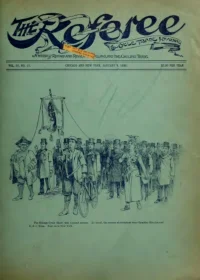
Cite this issue
Citation
The Referee 16, no. 11 (1896). cyclearchive.com, https://cyclearchive.com/magazines/the-referee-cycle-trade-review/vol16-11/
Page numbers are pages of the PDF, which can differ from the numbers printed on the page.
Articles in this issue
- Sterling Elliott, the League presidential candidate, criticises the executive committee for stopping the inserts, questions President Willison's excuse, and proposes changes to the constitution, including dropping the word amateur, limiting proxies and abolishing class B.
- The Referee praises the Bicycle News, published by the W. D. Boyce Company of Chicago and edited by J. M. Erwin, as a young paper with brains and capital behind it.
- The War Department's signal office invites proposals for five bicycles, and more singly as required.
- Eleven Century Wheelmen of Philadelphia led by Captain A. H. Allen ride a century from 12:01 on New Year's morning in 7 hrs. 55 min. and claim the first century run of 1896, while five Brandywine Wheelmen of West Chester finish a New Year century later, held an hour by police.
- New York City Magistrate Joseph M. Deuel prepares a state bill requiring police to accept bail of twice the maximum fine, $10, for riders arrested after the courts close, with the approval of Chief Consul Potter.
- Mr. Gideon's campaign against the railroads' special bicycle rate has diverted over 1,500 wheels from the Adams Express Company to the United States Express, and the Adams people are expected to press the railroads to remove the tax.
- Pippin and Hughes at Denver are waiting for a day with the wind in their favour to beat the tandem straightaway mile record held by Green and Erswell, and train together daily.
- At the Paris winter path, Jacquelin wins the international 1,000 metres scratch with M. Farman second, no French rider of note racing, the Verheyen brothers win the tandem, and Henri Loste fails to beat his own safety record.
- Profile of Henri Desgrange, director of the indoor winter path at the Galerie des Arts Liberaux, former correspondence head at Clement and sportive director of the Mondesir track at Bordeaux, who holds several bicycle and tricycle records and writes on cycling.
- Paris notes: Houben and his manager Cranninckx have parted, Protin becoming Belgium's star; a Christmas Eve meeting at the indoor path; Michael and Johnson to ride six races across America, England and France; and M. Baduel floats the Seine and Buffalo tracks with £12,000 capital.
- The good roads tax was defeated in every central Texas county where the election was held the day before, and few cyclists took any interest in the matter.
- The Century Wheelmen of Philadelphia report at their annual meeting an excess of assets over liabilities of over $11,000 and 480 members in good standing, and appoint a committee of five to secure a country clubhouse.
- William A. Rubey, the Louisville state centurion of the Century Road Club, rode ninety-two centuries in 1895, the largest number on record for that period, and is claiming the club's medal for the most centuries in a year.
- A photographic plate of six views of the Chicago Cycle Show hall, looking south and southeast from the gallery, north from the band stand, southeast and southwest from the gallery and northeast from the band stand.
- The paper expects last year's growth in the sport and trade to make the show a great success, though no forecast touched the full extent of lay interest, and promises descriptions of the exhibits and a summary of features in other columns.
- Mr. Potter's plan to separate racing from League of American Wheelmen control drew little support from the cycle press, and the paper expects the New York division's vote to reach the national assembly, where a popular vote would swamp it.
- L. M. Richardson of the Monarch Company proposes in a letter that the League insure members' wheels against theft, with the initiation fee and yearly dues raised to cover it, and the paper calls it practical and worth the serious consideration of the next assembly.
- Philadelphia's asphalt strips on Broad Street between Buttonwood and Vine streets are delayed until next spring, when the city's winter ban on digging is lifted, and the Associated Cycling Clubs will raise funds meanwhile.
- The Cincinnati Bicycle Club resolves that its secretary write to the city's representatives in Congress urging an increase in the appropriation for the road inquiry office of the Department of Agriculture.
- A cycle show held with the New Year's reception of the Philadelphia Young Men's Christian Association central branch is extended two days, and over 3,000 people attend on New Year's day.
- Portraits of exhibitors and show personnel identified by firm, among them L. P. Halladay of the Marion Cycle Company, T. B. Jeffery of Gormully and Jeffery, H. A. Lozier, C. H. Sieg of Sieg and Walpole, Fred Patee of the Peoria Rubber Company and John W. Caldwell, with Hy-As-Tv-Ee, Head Big Chief of the Sycamores.
- A page of drawings of new 1896 devices labelled with their makers' names, among them the Bellis handlebar, the Hydro Cycle, the Fox brazing furnace, the Owen chain adjustment and the Parsons adjustable bar, around a centre figure captioned The Souvenir Bent.
- A symposium of makers' letters on bearings: the Syracuse Cycle Company on tool-steel cones and a felt-washer dust-proof bearing, the Olympic Cycle Manufacturing Company on an oil-holder set over the bearings, and Arnold, Schwinn and Company on the hardening of their World cones.
- Philadelphia, January 2: the University of Pennsylvania favours an inter-collegiate cycling association, and George M. Coates, third captain of its 1895 track team, argues that the two-mile intercollegiate race is a farce because the fastest riders do not win it.
- The New York cycle show at Madison Square Garden from January 18 to 25 will have electric light displays; exhibitors' goods are received from the 16th, stands are to be arranged by 6 p.m. on the 18th, exhibits may leave the building after 11 p.m. on the 25th only against a written order, and Manager Sanger reserves royal boxes for L. A. W. officials and a reception room for the Quill Club Wheelmen.
- The Century Cycling Club of Maryland elects Harry V. Casey chief centurion and John T. Brooks vice-chief, with other officers, and appoints a committee to wait on the Maryland division officers about a road book.
- Trainer Frank Lyman says pacemakers must be trained to travel at speed and to pick up perfectly, and that each team needs a manager to look after the men; the column also notes Billy Hamilton's Denver season and the slackening of the racing men on the circuit.
- A photographic plate of riders and managers on the circuit: Taylor and Hewitt, McGrea and Terrill, Dad Gleeson's crew, Dave Shafer, Conibear, and Jenkins, Knippenberg and Knapp with a White Flyer banner.
- Waco, Texas, January 2: the Southern Cycle Company has opened for business with a riding academy beside its store and expects to handle several good lines.
- Portraits of show personnel identified by firm, among them A. G. Spalding Bros., Davis and Stevens, Peerless Mfg. Co., the Eclipse Bicycle Co., the Buffalo Cycle Co., Prentiss Tool and Supply Co. and Lovell Arms Co.
- F. E. Spencer, manager of Sweet and Johnnot's riding school, rides a Spalding wheel from Erie to Buffalo on the first century of 1896 in bitter cold, with his feet frozen on several occasions, finishing late on January 1.
- At a Syracuse meeting on December 30, manufacturers, dealers and clubs resolve to investigate and draft a law taxing wheelmen from 50 cents to $1 to make paths for their exclusive use, and a similar law is proposed for Oneida county.
- Frank T. Fowler gives a banquet at his factory for Chicago's cycle press men, the guests including J. M. Erwin, S. R. Duffy, G. K. Barrett and G. C. Sinsabaugh, with R. M. Jaffray and C. P. Root of the Referee.
- The Chesapeake Cycle Company of Baltimore is incorporated with a capital stock of $5,000 by James S. Shipley, Charles H. Porter, Albert G. Riffle, George H. Will and Samuel T. Richards, to deal in bicycles and sporting goods.
- Chairman Gideon proposes a League by-law amendment that keeps the manufacturers' riders but places them in an entirely separate class, 'class B riders', instead of a subdivision of amateurs, and in an interview Old Eagle Eye gives his reasons, saying it is a misnomer to call them amateurs.
- San Francisco track schemes depend on the Southern Pacific railroad, which has not yet acted, and the Alameda scheme alone is taking shape.
- The league's new local officers plan to visit the clubs on set nights and offer blocks of ten or more applicants a reduction of 25 cents each in dues.
- Floyd J. McFarland, head of the class A men, will devote the year mainly to road racing, while Freeman, Downing and McFarland resist transfer from class A.
- A local paper's tables place the leading Pacific coast riders in classes B and A by first, second and third places and times started.
- A leading San Francisco bicycle firm forms a racing team for the Pacific coast; H. W. Spalding buys John F. Burns's half of the Olympic paper, which becomes the league's northern California organ; and Otto Ziegler is rumoured to ride a Syracuse next season.
- Reginald H. Thompson, judge of the Louisville city court, is a friend of wheelmen who has never let an offender off the limit of the law when a wheelman had a good case, and who rides no wheel but is a wheelman at heart.
- Two Philadelphia managers say that carrying two rival high-grade wheels did not pay, since the slightly superior one always took business from the other, and both manufacturers are setting up local branch houses.
- The inaugural races at the Cyclists' Union Club's third-mile track in Mexico on December 22 pass off without a hitch, and the summary of results names Y. Acosta, F. Flores and F. Trigueros among the winners.
- The Keating Wheel Company of Holyoke suggests that Springfield electric car lines carry a rider's wheel with punctured tires, charging a fare for the wheel as for a person.
- A humorous column on the credit clerk who holds back orders and the salesman who resents him, with a big retailer's view that a woman makes the best riding-school manager and a joke on a young-looking woman in a short skirt.
- Buffalo cyclists are surprised that the New York state division officers endorse Mr. Potter's proposal to abandon League control of racing, and think the officers will have to explain it to their constituents.
- A table of the exhibitors at the Chicago show, in alphabetical order from Acme Mfg. Co., giving each firm's booth numbers and the number of wheels it showed, with columns for men's, women's, tandem and juvenile machines.
- A collage of snapshots from the 2:50 Club's New Year's Day run to Pullman, among them the crowd on the steps of the Hotel Florence after dinner, Fred Volkman as chief scorcher, Volkman finishing, Bliss 'the Gink', Githens explaining how the course was cut and 'Ole Skate' Winship finishing anyway.
- The second annual Chicago show, opened on 4 January 1896 in Tattersall's building after the Coliseum collapsed and the Jonathan Clark building was taken in; the crowds on the opening night, and a casual observer's notes on the press quarters, the caterer, the galleries and the souvenir hunters, ending with his cud swallowed and his exit.
- A full-page plate of the souvenirs given away at the Chicago show: pins, buttons, knives, pencils, note-books and pocket pieces carrying the names of makers such as Henley, Elgin, Gormully & Jeffery, Spalding, Stearns, New York Tire Co. and the Referee's own.
- Tom Eck and Johnson with their professionals at the show, both signed with Arnold, Schwinn & Co. for The World; Eck, Johnson, Weinig and O'Connor are to go to Europe, Johnson visiting Sweden first, and Bowe says Bald and Cooper have been offered places. Also covers Titus signing with the Syracuse people, Sanger representing Vim tires, and the cycling-paper and daily-paper men present at the show.
- A report that a dozen or more of the larger makers meant to drop national cycle shows: Bowe of the Syracuse company says the shows benefit small makers at the big makers' expense, Dickerson of Sterling is cool toward them, and Colonel Pope, while denying a concerted move, intimates his company will not exhibit at Chicago and New York and favours local shows. Richardson of the Monarch company means to cut show expense and Kirk Brown of the Dunlop Tire Company says the tire makers follow the manufacturers; rising makers say they will exhibit regardless, and the board of trade may take it up.
- Exhibitors asked about the show's business deals, Pratt & Whitney, Monarch, Syracuse, Peoria Rubber, Dunlop, Jenkins, Henley, Plymouth, Fowler, Continental, Ide and Garvin, all reporting a great success, with orders written and more business than a year before.
- The Chicago show is judged a record for attendance and business: more railroad certificates were countersigned by Monday night than in all of the 1895 show, paid attendance was 4,821 on Saturday, 5,705 on Monday and 7,597 on Tuesday, near 10,000 on Wednesday and an estimated 12,000 on Thursday.
- The 1896 models show little radical change, the improvements being larger tubing, adjustable handlebars, heavier tires, narrower tread, three-point bearings and more spokes; sundries, automatic machinery and parcel carriers show the real novelty, and the striking exhibits are the Fowler sextuplet, the Cycling Jinriksha, a mother-of-pearl Smalley, the Elgin and the Spark with its $1,000 diamond, and the Chinese attendants at the Stearns stand and the Indian at the Sycamore wigwam.
- The paper's stand-by-stand walk through the Chicago show, one paragraph per stand number and firm: from No. 1 (Columbus Bicycle Co., United States Bicyclist's Protective Co.) through Kingman, Prentiss, Boston Woven Hose (the Vim tire welder), Owen and McIntosh-Huntington (the Sunol hydrocycle), and on to the last stands, Nos. 375-384 (Defender, Chief, Hercules Wood Rim, Curtis Machine Works, Columbus Brass and Iron, Huennekens). Each paragraph gives the maker's models, prices, special features and who is in charge; it runs to p.159.
- Exhibits held away from Tattersall's: H. S. Robinson's home-trainer at No. 385, the John Deere Plow Co. and Deere & Webber with Tribune, Peerless and Moline Special wheels in Auditorium rooms, and Anglo-American Cycle Fittings, Hilsendegen of Detroit and Herman Boker & Co. at the hotels.
- Frank M. Smith, a missionary for the G. M. Shirk Manufacturing Company of Chicago for four years, whose territory covers New York, Pennsylvania, Ohio and Indiana, has just returned from the south, where he placed agencies for the Shirk.
- Louisville press and league members came to Chicago during the show to campaign for the 1896 national meet, making extraordinary promises.
- Taylor and Hewitt on a Syracuse tandem broke the three-quarter mile flying paced record and the class B mile record at Coronado, Cal., on Dec. 30, and the tandem mile record for all classes on Jan. 1.
- A. W. Gamage of London, a large sundries dealer, bought in Chicago at the show and is reported to have closed several deals, while rumour has Mr. Lucas securing the right to sell New Departure Bell Company goods abroad.
- Denver riders Hughes, Collins, Dalzell and Renshaw are expected in the front ranks next season, Dalzell holding the world's mile novice record, and Collins will ride a Kearney while connected with Fuller, the cycle dealer.
- C. K. Anderson, formerly junior member of Hales & Anderson, will manage the bicycle department of Von Lengerke & Antoine, who take up the Wolff American, Outing and Ajax lines at their Wabash avenue and Van Buren street store.
- King, a St. Bernard at the Bellis company's stand No. 69, is the show's canine hero, whose story is told in a booklet the concern distributes; W. K. Bellis owns him.
- The Thomas V. Johnson Company of New York, makers of the Owl saddle, was left out of the Referee's directory the week before.
- William H. Bramson has opened a retail store at 422 Madison avenue, Albany, making the Fowler his high grade leader, and wants a maker's wheel listing at $50 to $70.
- The Pacemaker Bicycle Company of Des Moines failed on Jan. 3 with liabilities of $6,000 and assets double that, the crash following the failure of the Lathrop Rhoades Company, which held its stock.
- George H. Proctor of New York bought a woolen mill at Rockville, Conn., for $30,000 and will remodel it as a bicycle factory employing 400 hands.
- The Boston Herald gravely asks whether bicycles are going to supplant skates too.
- Suggestions read at a Chicago meeting of the Illinois L. A. W. highway improvement committee for individual work in the good roads cause, among them forming good roads leagues, securing a state tax system, and sending road commissioners' names to the committee.
- The Lake View Cycling Club of Chicago elected H. M. Gardiner president, W. B. Rix vice-president, F. J. Weiland treasurer and O. F. Bohman captain on Jan. 6.
- Twenty-four new names were claimed this week, bringing the total to 1,001 with 92 claimed by two or more houses; the new names are listed with their claimants, among them Morley Bros., the Syracuse Cycle Co. and H. S. Dukes & Co.
- Lucien and Charles O. Barnes, formerly of the Barnes Cycle Company of Syracuse, are said to be founding a Buffalo bicycle factory with $100,000 capital and a wheel their lawyer finds does not infringe the Syracuse Barnes wheel, which that company will fight by injunction.
- Hulbert Brothers & Co., firearms manufacturers, occupy No. 24 West Twenty-third street, where a retail branch and a warehouse were added, and the Majestic wheels and Mesinger saddle have expanded the business.
- Short Denver items: Knight-Campbell Music Company has received its 1896 Clevelands and Imperials, Walker of the Kearney Cycle Company reports good business and tandems selling well, Charles F. Stokes, Jr., has taken quarters on Cycle row, and the Denver Cycle Company has done well since it opened last August.
- The New York Cycle Board of Trade's interpretation of the manufacturers' guaranty: punctures, cut tires, broken or bent parts, truing, broken spokes and stripped threads are not free of charge, and makers will not keep bicycles in repair.
- Frank T. Fowler sold his half interest in the Fowler Cycle Manufacturing Company for $200,000 to the men who already held the other half, and remains president and general manager, with a salary said to be $20,000 a year.
- The Indiana Bicycle Company opens a wholesale branch for its Waverley bicycles at 339 Broadway, New York, to be managed by W. T. Gardner, its former auditor of branch stores and ex-secretary and treasurer, by Feb. 1.
- The Bignall & Keeler Manufacturing Company of St. Louis, owned by the N. O. Nelson Manufacturing Company, enters bicycles with its Leclaire line of high grade wheels and a tandem to follow, under superintendent George M. Wilder.
- The Deere Implement Company of Denver takes up wheels on a large scale, with the Tribune as its leader and the Sylvan and a make of its own, retailed by the George Mayer Hardware Company; George E. Hannan will handle the World, Puritan and Keating, and Stokes's new store on Stout street is nearly ready.
- Business changes among bicycle and kindred concerns across the United States, among them incorporations of the Electric Cycle Company of Niagara Falls, the Maryland Manufacturing and Construction Company of Baltimore and the Rex Cycle Company of Chicago, and hardware dealers taking up bicycles in Vermont, Ohio and Colorado.
- The Waddel Wooden Ware Works of Greenfield, O., is about to market a wood rim laced with wire through the lock-joint, which it claims will not split, with the patent pending.
- Bicycle patents issued since the last report at Washington on Jan. 3, among them electrical bicycles, an elastic tire, a motor for bicycles and a toeclip, with designs and trade-marks listed beneath.
- The Hampshire Cycle Manufacturing Company of Northampton, Mass., formed from C. S. Herrick and Taintor & McAlpine, makes the Nonotuck and Kathrina bicycles, and in September 1895 became a stock company and enlarged its factory with new machinery.
- The employees of the Central Cycle Manufacturing Company at Indianapolis gave President Wainwright a diamond stud for his birthday, with three cheers.
- Bicycles and bicycle material exported from the port of New York in the week ending Dec. 31, by case and package, to ports including Amsterdam, Antwerp, Havre, Hamburg, Liverpool and Naples.
- W. E. Kenyon, known on the track and in trade circles, has joined the Continental company's forces to travel in the interest of the Rialto wheel.
- The Whitman Saddle Company of New York has gained complete control of a bicycle manufacturer and will name its first-grade machines the Whitman and the others the Patriot, the Whitman listing at $100, the Patriot at $75 and the tricycles at $160.
- The Shelby Steel Tube Works gave each of over 700 employees a turkey at Christmas, and the employees presented President Colonel D. L. Cockley with a sword.
- George Mullett & Co. of Salt Lake City will handle wheels next season, taking the agencies for the Stearns, Ariel and Rouse-Hazard lines, and will build a store with a riding school and carry sundries.
- The Diamond Machine Company of Providence has moved its leather-covered wood polishing wheel department into a new building, more than doubling its capacity, after booking orders for 500 wheels from one firm and 400 from another.
- Gormully & Jeffery has opened a riding academy at 541-543 North Wells street, Chicago, so that buyers can learn to ride in the winter months.
- A decree at Grand Rapids ended the Indiana Novelty Company's suit against the Muskegon Wood Rim Company, enjoining further infringement of its three wood-rim patents and process.
- The Grand Rapids Bicycle Manufacturing Company has increased its capital stock and will trade for 1896 as the Souvenir Wheel Company.
- George N. Pierce & Co. of Buffalo will open a retail branch with a repair shop and storage at 143-145 Columbus avenue, Boston, on Feb. 1, in charge of F. T. Cannon.
- Blauvelt made the first record of 1896 on a Sagamore, covering five miles between Springfield and Elizabeth, N. J., in 11:14 flat on New Year's morning, paced by Johnstone and Wirtz on a tandem.
- James Hay of Hay & Willits received a telegram that the Heath patent had been knocked out, the court of appeals having reversed Judge Baker over the clamp attachment that both concerns use on their pumps; the first decision had favoured the Heath people.
- Short trade items: the Rogers Manufacturing Company organized at Mitchell with $50,000 capital, W. H. Walk succeeding A. W. Heller at Sharpless & Watts in Philadelphia, the Syracuse team's records at Coronado, Hansen's win in the 24-hour race, the Indiana Bicycle Company continuing to supply the G. & J. tire on Waverley bicycles, and Merrihew & Lagen showing the 1896 Robin Hood.