Vol 16, No 2
Cite this issue
Citation
The Referee 16, no. 2 (1895). cyclearchive.com, https://cyclearchive.com/magazines/the-referee-cycle-trade-review/vol16-2/
Page numbers are pages of the PDF, which can differ from the numbers printed on the page.
Articles in this issue
- Rumours of a stormy interview between Chairman Gideon and representatives of the Cycle Board of Trade over the Cabanne-Titus-Murphy affidavits, which was denied in full, and a rumour that Murphy had made a confession.
- Victor Birdseye, appointed guardian of his son Ernest, will sue James Hessler and wife for injuries from a fall from a bicycle on a Syracuse sidewalk where the Hesslers left a heap of dirt.
- The Chicago Cycling Club's annual ordinary run to Pullman drew about thirty old-timers and others; fines brought only $12.50, which Captain Davis blames on the improved roads, and Dasey and Van Nest led the fast section.
- A. A. Hansen rode 375 miles in 23 hours 57 minutes 50 seconds on the track around Lake Harriet at Minneapolis, a distance that would have been an American road record under Century Road Club rules.
- The North Side Cycling Club and the Badger Wheelmen propose an indoor meet at the exposition building in Milwaukee later in the month, to secure the fastest northwest riders.
- The national circuit riders, Eddie Bald, Tom Cooper, Murphy, Spooner and others, arrive at San Francisco, are met at Vallejo Junction by the Bay City Wheelmen and take in Chinatown before training at San Jose for the 8th and 9th meet.
- Fred L. Seybolt won the Garden City Cyclers' five-mile road race at San Jose, while seventeen-year-old scratch man Hardy Downing equalled the course record of 13:32 and took eighth place.
- P. M. Lefevre won first time and second place in the Acme Wheelmen's five-mile road race over the San Leandro course, which J. E. Scott won from a 2:00 mark, riding unpaced almost the whole way in 13:47.
- G. A. Wahlgreen of Denver, business manager of Cycling West, arrived with the circuit chasers, E. C. Bode also arrived, and Wilbur Knapp resigned from the Overman Wheel Company to sell Barnes bicycles for Hooker & Co.
- The Washington Road Club and the Arlington Wheelmen are to settle the club supremacy of the road in a twenty-mile team race, and W. S. McArthur is arranging a twenty-mile open road race for Thanksgiving with a Sterling wheel for first prize.
- Arthur Gardiner rode the mile in 1:42 2-5 at Louisville, beating Johnson's record by two seconds, and Clint Coulter lowered Johnson's three-quarter record to 1:18 1/2, with Troy promising a further attempt on the record.
- W. Coburn and W. M. Randall paced Frank King for a trial half in 55 seconds at the Southern Wheelmen's track, New Orleans, breaking the flying-start tandem record of 55 2-5 seconds held by Titus and Cabanne.
- Isaac B. Potter received 2,197 votes for chief consul of the New York division, against 2,220 ballots last year, with W. S. Bull and W. E. Underhill almost equally supported for secretary-treasurer and vice-consul.
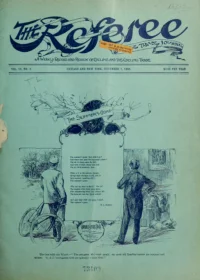
- Monthly calendar plate for November with a verse by Tommy Pad on autumn's passing, under a drawing of two wheelmen sitting by a stream beside a bicycle.
- The preliminary canter of the Chicago Times-Herald's motocycle race, now billed for Thanksgiving, was hardly encouraging, one of the two starters collapsing en route and the other returning with little eclat; the paper argues a practical motocycle would be a valuable ally of the bicycle in the good-roads crusade.
- Columbia College's call for a convention to form an intercollegiate cycle-racing association is welcomed as a way to lift cycle racing from a side show at university athletic meetings.
- Answering the Railway Age's view that railways need not carry bicycles free, the paper finds the rate-charging roads within their rights and blames wheelmen who stored their wheels in baggage rooms for the Pennsylvania road's withdrawal of the privilege.
- The century race between three Chicago ladies, set for 6 November, was indefinitely postponed when the contestants could not agree terms, a loss the paper laments as a defeat for women's athletic progress.
- Men of business reputation and capital are now entering cycle making, which has passed its experimental stage, and competition has left the trade with the smallest percentage of failures of any manufacturing trade.
- The English cycling press is divided over the Simpson chain, and Harold Quill, writing in the Wheeler, argues that no chain can increase the power the rider puts into the pedals.
- The Times-Herald's Chicago motocycle race was put off to Thanksgiving, and in its consolation run over 92 miles the Benz motocycle reached Lincoln Park after the Duryea was put out at Half Day, taking about 8 hours 44 minutes of running time.
- Twenty-three veterans rode old ordinaries on the St. Louis Cycling Club's annual run to Clayton, with Billy Laing on an Eagle and H. G. Wolzendorf on a Star, and over two hundred riders joined the procession.
- Reprinted extracts from other papers on the bicycle's cheap short-distance travel and railway tariffs, the good-roads canvass by candidates, a failed London bicycling dress, Dr. Champoniere's view that women cyclists gain muscle and lung capacity, lighter American machines, and the bicycle's part in country life.
- At the Buffalo path in Paris, Michael rode the seventeen-year-old Lartigue off his legs in a fifty-kilometre match with pacemakers, lapping him at the twelfth kilometre and reaching 50 kilometres in 1:07:43 1/3 after Lartigue fell at the thirty-third.
- Banker won the international 4,000-metre event at the Dijon path, beating Jacquelin and Dumond, at a meeting drawing the pick of the Paris riders on a Sunday with no sprint racing in Paris.
- The racing council of the Union Velocipedique de France found that M. Mousset, the clockholder, had not been present at the start of a road record whose time sheets he sent in, and he has resigned.
- Michael and Gougoltz are matched at Buffalo the following Sunday, best two out of three over one, five and ten miles with pacemakers, for a stake of 80 pounds a side.
- A charity cycle meet for the French soldiers at Madagascar, with about ten thousand francs in prizes and entries from the French and foreign champions, is announced at the winter path on the Champ de Mars, with Henri Desgrange as general manager.
- The prospectus of the Nimrod & Zimmie Cycle Company, Limited, of Bristol, for English investors gives a purchase consideration of 25,000 pounds in cash and 40,000 pounds in shares, a capital of 85,000 pounds, and a five-year guaranteed interest of 5 per cent.
- Chief Consul Isaac B. Potter's scheme to have a two-page League membership leaf printed in every trade catalogue, with A. G. Spalding's support and League funds for the plates, has received its first sample imprints.
- Philadelphia's bicycle policemen have proved their worth, so their number will likely grow next spring and their beat nearly double, and it is suggested that wheels could replace horses on suburban patrols, though snow makes the wheel useless.
- Parker H. Sercombe, the former Milwaukee bicycle manufacturer, has resigned his Laredo, Texas, newspaper to devote himself to mining stocks and bicycle racing, and is reported to be arranging a large meet at Laredo.
- Bob Terrill and Charles S. Wells are welcomed home to the Bay City Wheelmen, Bob Lennie is now Morgan & Wright's coast man with a ranch near Los Angeles, and Jim Temple is taken for Cooper at Denver and Salt Lake City.
- S. C. Cox set a new record for the unpaced standing-start third in 43 seconds, A. F. Senn came within a second of the two-mile flying-start record at 4:29, and Kindervater and Caperton claimed a professional tandem five-mile record.
- De Cardy, paced by the quad in a standing-start three-quarter mile, slowed past the two-thirds mark because he had not been told where the finish was, and missed the record by a little more than a second.
- W. W. Windle arrived unannounced at Fountain Ferry with his quad and a team, and disputed Tom Eck's rejection of his Chillicothe records, and said he would not race in the Blue Ribbon races on 11 November, while Willis B. Troy brought the Humber team and the quint.
- Troy and Eck are set on a rivalry for the mile record, with Sanger's team expected the next week, and Eck says Johnnie will enter the mile open, while a quad tire burst sent Lund and Vogt over the bank with only bruises.
- Angus McLeod rode a straightaway unpaced mile on a Brantford wheel fitted with Morgan & Wright tires, the ride being slightly uphill, and with the wind behind him he might reach 1:30.
- Writing in the English Cycle, R. L. J. urges clubmen and racing men to keep in touch with cycling through the winter and to build original winter programmes, rather than let the club room go quiet.
- A Railway Age review argues that railways need not carry bicycles free, since a wheel takes more room and causes more damage than trunks, and that a railway should not carry one man's two-wheeled vehicle free while charging freight on another's barrow.
- A Chicago club open only to bank employees, with 700 charter members, a gymnasium and bicycle storage, and Frank E. Brown, assistant cashier of the First National Bank, as president.
- Charles Shabel of Rochester rode 200 miles on the road in 11 hours 46 minutes, beating the previous world's record of 11 hours 58 minutes 30 seconds.
- Harold Palmer of Philadelphia rode a Columbia from Philadelphia to the New York City Hall in 8 hours 47 minutes, delayed by a drawbridge, a ferry wait and a head wind, with checkers at each stop, and plans a round-trip attempt.
- Two Baltimore cyclists were fined for riding across Chester bridge, and the League of American Wheelmen, which has lost the case in the lower court and spent over five hundred dollars on appeal, now proposes to take it to the United States court.
- The record-breakers at Louisville have asked the racing board for a special sanction to let class B and professional riders pace each other, and Johnny Johnson would attempt the hour record if it is granted.
- The St. Louis cycle show will be held in February, probably at the Armory hall, and the A. C. C. and the local Board of Trade are meeting jointly to settle the arrangements.
- Milwaukee's council is to pass a bicycle ordinance requiring bells and limiting speed to ten miles an hour, six at crossings, and the Wisconsin Division plans a ward-by-ward campaign through caucuses of both parties at the spring election.
- Charlie Church and Fred C. List are to be matched on the new Point Breeze board track at Thanksgiving, Church leaves for the Atlanta exposition with Fred Rumford, W. S. Rea and William Grubb, and Bob McCurdy goes to Louisville with the Berlo party.
- Citing the New York Sun, the paper notes that bicycles are now used by naval officers at shore stations and carried by large ships, and asks whether the captain of a man-of-war may ride one.
- The Park Bicycle Association, a Baltimore social and outdoor club, has incorporated and secured a stone cottage on the west side of Druid Hill Park as its clubhouse, membership being limited to 200.
- Charley Earle, the scratch man, won the time prize in the Kings County Wheelmen's twenty-five-mile handicap, run over 27 1/2 miles by a marking error, and the New York racing programme closed with the Riverside Wheelmen's races, the South Brooklyn club races and the New York Athletic Club's Citizens' cup run.
- The three-lap cement track at Chester Park in Cincinnati is almost finished, to be inspected and handed to the street railway company on Thursday, with a 35-foot homestretch, 25-foot backstretch and 26-foot banked turns.
- The Century Road Club has allowed a list of road records, from R. A. Schwaner's five miles in 15:54 and the Elgin-Aurora century records to T. T. Mack's Erie-Buffalo century, with state records for Iowa, Texas and Nebraska.
- Walter C. Sanger says Tom Eck is damaging professional racing by advertising Johnny Johnson's appearances that fail, and Sanger, with an Orient from the Waltham company, will try to win back the unpaced mile record W. H. Hamilton lowered at Denver.
- The Michaux Bicycle Club, a social cycling sensation of last year, has re-engaged Bowman's cycling academy as its headquarters, where members ride three times a week through the winter.
- Alexander B. McDonell of Rochester, visiting Toledo on his first season, describes rides spoiled by road hogs and bad country crossroads, and says he will go for the American hour record this season.
- Charles Brazer of the Philadelphia Cycle Company, at Broad Street and Montgomery Avenue, is confined to his room with a brain tumour and reported in a critical condition.
- The Spokesman reports that America's largest bicycle works is building road motors, which the paper takes as confirming that horseless vehicles are at hand, with the road motor in general use within ten years and bicycles taking the lighter traffic.
- The Pennsylvania railroad charges for bicycles whether crated or in a trunk, on the company's view that a bicycle is a vehicle and not baggage, and Philadelphia wheelmen protest, with a petition from the Chester Bicycle Club and a special meeting of the Associated Cycling Clubs.
- Cincinnati's L. A. W. officials plan a petition to the board of administration, backed by the city's bicycle clubs and police, for a dry strip beside the curb for wheelmen, as in New York.
- The Wisconsin division's highway improvement committee circulars members urging the election of W. A. Brown as chief consul and M. C. Rotier as secretary-treasurer, with ballots due by 15 November.
- Walter L. Eckhardt, a nineteen-year-old Baltimore rider, won 31 of the 49 races he entered and holds records including Baltimore to Steelton and Lake Clifton.
- The Penn Wheelmen's lantern parade is set for 14 November, with more than twenty clubs signifying their intention to compete for the prizes, including the Ladies' Bloomer Club.
- The Century Wheelmen raised the entrance fee for active, associate and junior members to $20, V. J. Kelly has rejoined his theatrical company, and two men were arrested in Camden for trying to sell a stolen wheel for $15.
- Robert Trainor, a brother of the English football player, starts from New York on a bicycle for San Francisco, planning to go for the record on his return.
- A. G. Batchelder, official handicapper and a possible chairman of the racing board, now fills the cycle editorial chair of the Morning Journal.
- The paper's register of wheel names claimed by makers, an alphabetical list with each firm and city and the new names starred, after a note that twenty-seven names have been registered since the last issue. Antelope (Hibbard, Spencer, Bartlett & Co., Chicago) and Columbia (Pope Manufacturing Company, Hartford) are among them.
- The Yost Manufacturing Company opens a Boston branch store and office at 259 Columbus avenue under F. S. Hodgman, with George H. Shattuck as travelling salesman for New England.
- Dr. Alfred S. Gubb, a cyclist of many years, defends the forward bend against charges of round shoulders, calling it a hinge movement at the hip joint rather than a curvature of the spine. E. B. Turner, F.R.C.S., has also endorsed the position.
- Overman is building a motor carriage on a bicycle basis at his Chicopee Falls factory, a two-passenger machine with three two-horse-power Pennington gasoline engines, due for its trial trip by 1 December. He predicts that a well-equipped motor carriage will soon sell for $250.
- The Worcester Cycle Company, organised in June with $300,000 capital and Charles S. Boyd as president, will build its Boyd wheel at Worcester and the Munger Birdie Special at Middletown, Conn.
- The Richards Manufacturing Company's Standard combination of foot-brake, coasters and lamp-bracket, made in one piece that fits any make of wheel without removing a nut or bolt.
- Murphy Brothers of Chicopee Falls have a model with large frame tubing and solid joints, its saddle-post and handlebars adjustable without nuts or screws.
- Atlanta's exclusive bicycle houses are doing well late in the season: W. D. Gash sells the Stearns, Wolff-American and Western Wheel Works lines and runs a riding school that has brought the ladies to the wheel. The Lowery Hardware Company handles the Columbia, Rambler, Lovell Diamond and Piedmont, and the Waverley branch under Edward Rolle has sold nearly four hundred machines.
- A new Chicago concern at 183-187 South Canal street, promoted by L. C. Jaquish, chief consul of the Illinois L. A. W. division, with M. H. Guerin as vice-president, A. M. Farnsworth as secretary, treasurer and superintendent, and A. C. Culver as master mechanic. Its one high-grade wheel, the Rialto at $100, is due in running order by 1 December.
- Charles K. Alley, manager of the New York branch of the Humber company, says the Westboro factory has been enlarged to turn out five or six times as many wheels as this season, with the '96 changes only in minor details on Beeston Humber lines.
- R. B. Abbott takes charge of the Chicago branch of the Boston Woven Hose and Rubber Company, and E. J. Welch joins it as salesman, formerly with the Plymouth Cycle Company and the Plymouth Wood Rim Company.
- The bicycle exhibits at the Atlanta fair include the Davis Sewing Machine Company's '96 Dayton with its Reiss coupler, the Overman Wheel Company's stand of '95 Victors, H. A. Lozier & Co.'s Cleveland line, the Peerless Manufacturing Company's '96 line, the consolidated Pope and Hartford Rubber stand and the Western Wheel Works' full-nickelled wheels arranged in tiers.
- Rouse, Hazard & Co.'s new Peoria factory is being fitted with a full line of machinery for the increased demand for the '96 Sylph and Overland wheels, ten models in all, and the old factory is also at work on the line.
- Hill & Lyster, the Philadelphia Humber agents, are building a tandem and a triplet to pace races at local meets, and Handicapper Abe Powell has secured the local Peerless agency. Walter Perrett represents the Western Wheel Works on the road, and Charles S. Smith & Co. show the '96 Rambler and the $50 Pennant.
- Truslow & Co., established in 1827, now direct more of their attention to bicycle grips: natural cork handles with German silver ferules, celluloid mountings (white, black, tortoise shell and other colours) or black composition mountings, in three grades, and Eureka compressed cork that resembles natural cork.
- The Indiana Bicycle Company has appointed William H. Ruef superintendent. He trained as a toolmaker, came west in 1875 to the Brown Sewing Machine Company, and spent twelve years with the Atlas Engine Works, rising to chief salesman.
- The Sager Manufacturing Company of Rochester, N. Y., has moved into a new six-storey factory to meet its growing trade in saddles and Beauty seats, with Parkhurst & Wilkinson of Chicago as selling agents.
- Philadelphia makers and dealers use the dull season after a long spell of fine weather to prepare for 1896, and outside houses such as the Artman & Treichler Company plan to carry bicycles.
- The Bolte tubular hub, made by the Bolte Cycle Manufacturing Company of Milwaukee, is claimed to end broken spoke heads, poor oiling and dust in the bearings, and to remove the weakness of perforated hub flanges.
- The Cincinnati Milling Machine Company's universal and plain toolroom milling machines, with a lever that doubles or halves the feed, sixteen spindle speeds on the back-geared models and a circular swiveling table carriage.
- The Iver Johnson works, founded at Worcester in 1871 and now at Fitchburg, Mass., has five brick buildings of 150,000 square feet and employs 600 to 800 skilled mechanics.
- The Garvin Machine Company's New York works, with 300 men at work, has made bicycle machinery since 1885 and has a new factory inspector, Charles Benson. Large orders have been placed for special machinery to make the Simpson chain, and Mr. Garvin describes his new double-turret screw machine for hub blanks and a spoke-hole driller for hubs.
- A week has passed in Toledo without a new factory: the Brewer Tube Company did not incorporate, the Toledo Machine Tool Company turns out a few hundred feet of tubing and E. W. Smith waits for duplicate machinery. The piece runs on to the Yost company's sample orders sent to Paris and London for the shows and the reopening of the Toledo cycling club's rooms.
- The Warman-Schub Cycle House of Chicago is making a parcel-carrier cycle with the box in front, weighing thirty-seven pounds without the box, with weldless tubing, Eureka barrel hubs and detachable cranks.
- Notes on Toledo and Ohio trade men: J. E. Dager selling Vikings in Missouri, E. G. Eagen placing Viking agencies in California and the northwest, T. T. Cartwright's Warwick sales, and T. B. Terry's return from the east.
- The Syracuse Cycle Company has leased the Bradley company's factory, a $250,000 plant on an acre of ground, for fifteen years, and the Empire Cycle Company will take over its old establishment and sell its wheel separately from Crimson Rims.
- The McKee & Harrington Lyndhurst for 1896 changes almost every particular, with a slotted adjustable handlebar, a horizontal top bar, an adjustable seatpost, barrel hubs and Albert Humber chains.
- Business changes among bicycle and kindred concerns: incorporations at Indianapolis, Bradford and Chicago, a Monarch branch house in New York, Sharpless & Watts's Philadelphia venture and Lozier's purchase of Bennett & Co. at Hackensack.
- The Toledo Cycle Manufacturing Company's new two-storey factory will make only ladies' wheels, the Ouida; over 3,000 orders are booked and the models are shown to buyers only.
- The newly organized Iroquois Cycle Company of Chicago plans 1,500 to 2,000 wheels of high grade, with J. K. Prindiville as president and E. N. Reaser, who organized it, as general manager.
- J. E. Poorman, a Cincinnati dealer and the originator of the Poorman road races, has made an assignment with $25,000 of assets against $30,000 of liabilities, and hopes to resume if his creditors settle.
- The Lockwood-Taylor Hardware Company of Cleveland has added a bicycle department under W. A. Neff, formerly manager of the Peerless factory, and carries the Royal wheel in high and medium grades.
- The Bridgeport Gun Implement Company's Brooklyn stands now take women's as well as men's wheels through an adjustable head clamp, and will be shown in white enamel at the New York and Chicago shows.
- Bicycle exports from New York for the week ending 29 October went to Amsterdam, London (thirteen packages, $603), Liverpool and other ports, and imports for the week were valued at $859.
- Bicycle patents issued in Washington since the last report include pneumatic tires by Alexander Straus and Robert S. Crawford, a pneumatic tire and wheel rim by John S. Sanger and Hugh A. Kingsland, and a sprocket-chain link design by Charles Schrebler.
- Ex-Senator Whitcomb is pushing a company in Springfield to make the Labelle bicycle, designed by the inventor Fred Labelle, who will run the mechanical department; the works will start on a small scale.
- Greenfield may get a bicycle factory to make a model designed by Charles F. A. Eddy, tested for months on the road and with patented features, with negotiations for the works of B. B. Noyes & Co. under way.
- The America wheels of the International Manufacturing Company of Chicago gain new distributing agencies, among them B. B. Emery & Co. of Boston and David Bradley & Co. of Council Bluffs and Minneapolis.
- Morgan & Wright, left out of the first allotment at the New York cycle show, take four gallery stands, which shifts the Columbia Rubber Works, Schoverling, Daly & Gales and the Bridgeport Gun Implement Company.
- Samuel Snell of the Snell Cycle Fittings Company leaves Toledo for England, mainly for rest, but intends to set up agencies in England, France, Belgium and Germany for his enlarged factory's output.
- The Warwick Cycle Manufacturing Company re-elected A. O. Very treasurer and clerk, cut its board from nine directors to five and declared a six per cent dividend.
- E. C. Bode of Arnold, Schwinn & Co. and J. H. Weatherspoon of the Gendron works were in St. Louis, Ross Miller joined the road for the St. Louis Refrigerator and Wooden Gutter Company, and R. L. Hill of the Crawford Manufacturing Company is in the east.
- A new tire shown on the Row in Philadelphia, of spiral springs with a rubber outer shoe, is claimed to be the missing link in bicycle construction and never to puncture.
- George Bowman, a salesman for the Premier Cycle Manufacturing Company, has placed Florida on a large contract for helical Premiers and Louisiana on an equal footing with Fairbanks & Co.
- C. J. Whipple's patented portable safety stand passes for the 1896 season to the Ralph Temple Cycle Company, which will fill orders in quantity and send samples to those who ask.
- Manager Pierrey of the Columbia Rubber Works is dissatisfied with the space allotted to him at the New York show, and reports that the Akron factory has added a four-storey building for Palmer tires.
- The Gilbert & Chester Company of Elizabeth, N. J., under the Pope agency policy, will handle Clevelands next season and continue to make the Gilchesters.
- Joseph Holbrook, a Nicetown dealer, has patented a non-pneumatic rubber and cork tire that he claims is non-puncturable, and a New York firm is making one for inspection in about a fortnight.
- The Speirs Manufacturing Company of Worcester will make the Lovell Diamond bicycle for the John P. Lovell Arms Company of Boston.
- The Palmer Pneumatic Tire Company has sued the Newton Rubber Works for infringement and secured a temporary injunction against its tires.
- L. H. George of Brockport, N. Y., is reported to have lowered the Erie-Buffalo century record, but broken links in the checking chain cast doubt on the ride; he rides a Barnes.
- The Humber team, under manager Willis B. Troy and with pacemakers including Saunders, Cutter and Berlo, is hunting records at Louisville on 24-pound wheels.
- George B. Cobb of Cobb & Archer says the Rival wheels sold so well that the firm may take a large factory and push them generally.
- A Rambler single-steering racing tandem, black enamel with wood rims, was stolen from a basement on Greenwood avenue in Chicago on Monday evening.
- Trade notes on Coulter's record on a Falcon, Bardo & Calvert's new riding school at St. George, the Standard Cycle Works' fitting-up in Chicago, Lodge & Davis's shipments to England, Russia and the New York navy yards, and Ernest Walton's trip to Europe.
- M. G. Heintz, the Cincinnati Bicycle Club's L. A. W. representative, is preparing an Ohio bill making it a misdemeanour to leave nails, tacks, broken glass or thorns on the highways.
- Clippings from other papers on the bicycle: its place in society's suburban rides, its freedom and exercise, Mrs. Logan's objection to bloomers, General Greely's report on bicycle linemen for telegraph repair, and the fit of sewing-machine dealers for the trade.
- A department of short telegraphic items on wheelmen from Wisconsin, Philadelphia, Toronto, Milwaukee, Toledo and California, including a Wausau judgment for a cyclist and the Pacific-coast record plans.
- A Wausau municipal court held that a bicycle has as much right on a thoroughfare as a horse and gave judgment against a liveryman who crowded a rider into the curbing and broke his wheel.
- Germantown society people in Philadelphia, led by Mr. and Mrs. Howard Sill, are forming a bicycle club on the model of the Michaux and Centaur clubs.
- Fred Loughead of the Canadian class A company is recovering from a month's illness and is unlikely to race again, his father having objected to his racing after 1 July.
- Appleton wants the Wisconsin state meet for next year, with local business men ready to contribute if it is secured, and at least four cities are in the field.
- J. J. Vernier, an east side Toledo jeweller, proposes a tire with several small inner tubes, so that one punctured tube can be replaced by another.
- C. D. Elmes, a Rochester dealer, doubts that a woman who was called a new type of cycle thief is new, since a woman stole a wheel from him last July.
- The Humber team is heading for the Pacific coast and the San Jose track, the Morgan & Wright team has engaged a Denver track, and about a hundred men are expected to chase records in California this winter.
- Eddie Bald is treated as the supreme ruler of San Jose cycling, with street cars stopping for him, and the item warns that any racer who beats him on the San Jose track will not be cheered.
- An Indianapolis paper argues that the bicycle is achieving two reforms that persuasion could not, good roads and sensible dress for women.