Vol 16, No 23
Cite this issue
Citation
The Referee 16, no. 23 (1896). cyclearchive.com, https://cyclearchive.com/magazines/the-referee-cycle-trade-review/vol16-23/
Page numbers are pages of the PDF, which can differ from the numbers printed on the page.
Articles in this issue
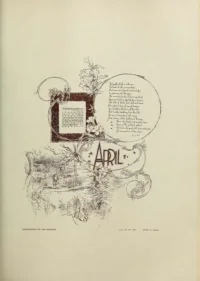
- The April calendar plate of the Referee's supplement: a month calendar set beside a verse on the return of spring and a rider on a country lane.
- Batchelder's sanction for the Buffalo bicycle-athletic meet of March 28 was made conditional on A.A.U. sanction for the athletic events, but Chairman Gideon practically told the wheelmen to go ahead and the joint meet was held. Batchelder now writes that Gideon's action leaves him in a peculiar position and expects A.A.U. retaliation; Goodman and Judge of the Riverside club took many prizes, though Cleland of Buffalo, on a Thistle, fought them well.
- Gideon's sanction of cycle races at Buffalo alongside unsanctioned foot races threatens relations with the A.A.U.; Batchelder had withdrawn his own sanction on learning of the foot contests, and Sullivan says the union meets on the 18th and may run its own amateur racing if not given justice.
- All but four miles of the cycle path from Patchogue to Port Jefferson is finished, and a twenty-mile path from Port Jefferson to Jericho is contemplated.
- Douglas W. Robert, racing board member for St. Louis, will begin publishing the Central Cyclist on April 3.
- Judge McPherson at Harrisburg held that the Provident Bicycle Association of Philadelphia was not an insurance business, so the quo warranto proceedings failed; its membership card promises repairs, cleaning and replacement of stolen bicycles.
- Carl von Lengerke, an Irvington-Milburn winner, tied for first prize in the Great American handicap at Elkwood Park, Newark, a wing-shot contest, his share being about $240.
- The Armstrong bill is expected in the New York senate this week, and Maryland's Chief Consul Sams is pushing a baggage bill in his state.
- At the Associated Cycling Clubs of Chicago the west and north siders kept the Decoration day road race on the northwest side: the motion to reconsider was tabled 37 to 13, the minutes were not changed, and the south siders' move to admit clubs failed 30 to 22. Morgan & Wright offered to spend $300 on the Wheeling course, and the American Cycling Club's rooms were taken for meetings.
- Instalment five of the Tomec and Joni cartoon series: the two travellers, at a hot and cold baths sign and a pool, prepare for a season of scalp hunting.
- The 100-mile relay of the associated San Francisco clubs has moved from the first Sunday in April to April 12, with the Olympic Wheelmen and the Bay City club naming their teams; the national circuit is to open in San Francisco with a six-day meet in the last week of April. Cycling fever has taken hold across the interior of California, and Van Ness avenue is to be closed to heavy traffic as a boulevard.
- Photographs of riding in southern California: a club run party near Los Angeles, a main road in Los Angeles County, W. W. Hatton, and the San Luis Rey Mission, 44 miles from San Diego.
- The Garden City Cyclers picked their relay team after a ten-mile tryout at San Jose, where Oscar won in 30:10; the Fowler people are reported to plan a company of hired riders, with Floyd McFarland and Tantau mentioned.
- The Acmes have selected nine riders, and a new track is designed for Central Park on the site of the old five-lap Bay City track; the national circuit then runs to Oakland (May 1 and 2), Santa Rosa, San Jose and southern California, through Arizona and Texas to Savannah and Boston.
- W. D. Osgood, a University of Pennsylvania football player and Quaker City racer, was on the Bermuda when she was seized in New York, reached Cuba on the 18th and joined the Cuban army.
- The heated debates among the Associated Cycling Clubs' delegates have shown the limits of club representation, tested parliamentary law, advertised the Chicago road race and revealed good and bad roads in the city, and the good of the cause matters more than where the road race is run.
- Hyde Park wheelmen are urged to vote on Tuesday for Charles E. Randall, one of Chicago's oldest riders, a candidate for assessor.
- The Referee defends the cycle editors Zimmerman and Bald of the New York World and Journal against critics who say they write nothing themselves, and quotes a race-finish passage from Bald as proof of their versatility.
- Cheap labour is not only an Oriental product and has long shaped western industry; the paper argues that Asian workmen pose no threat to American cycle trade, but convict labour in prison factories is a menace, and suggests that every prison-made product be labelled.
- Dr. Morrow, twenty-one, and Miss Alice Hall, twenty-eight, were in love until a pair of bloomers came between them and the quarrel turned bitter; the paper says the story should be widely read at the present time as a warning about bloomers.
- The racing board's new entry blank is better than the old, but it should also ask the winner's handicap mark and the finishing place of the scratch man, as the Referee urged during Raymond's term.
- Milwaukee society-club members have formed cycling clubs, the Calumet Club electing officers, with the Iroquois, the Deutscher and other clubs to follow as league clubs.
- A New York paper reckons the bicycles of greater New York, about 200,000, condensed into one machine, would make a wheel 2,682 feet long.
- Ouida has turned on bicycles and their riders, and her ideas on them echo those she expressed about cigars.
- A fable: a princess who rode centuries vowed to wed whoever beat her; Prince Prettiwit won by stopping at the fifty-mile post for an Easter bonnet marked $1.03, and they married.
- W. H. Stephenson of Marinette will ride a bicycle 100 miles up the Menominee river to estimate logs, the first use of the bicycle in logging.
- The '96 Meet Club has set up permanent headquarters with Thomas P. Craig as secretary, and General John B. Castleman has accepted the chairmanship of the entertainment committee; Fountain Ferry track is to get a new press stand for 100 working pressmen, 8,000 bleacher seats and a new pavilion 120 by 75 feet.
- Major General N. A. Miles, in the bicycle number of Godey's Magazine, advocates equipping 100,000 men with bicycles for transport in an emergency, arguing that any army using the cycle would force its opponent to do likewise.
- Huret cut the 100-kilometre paced record to 2 hr. 11 min. 45 sec. at the Velodrome d'Hiver, and in the four-handed match against Fischer and Geiger he won easily, Bauge being brought down and forced to retire at the fifth hour.
- The Columbia brought the American party led by Mr. and Mrs. Tom Eck to Europe; the riders reached Cuxhaven and go on to Wiesbaden and Athens for the Olympian games, Macdonald possibly turning professional, and Eck calls the Johnson-Michael match only a promise.
- The Dutch rider Jaap Eden, born at Groningen in 1873 and winner of the world ice-skating championship in 1893, arrived in Paris from Arnheim and will race there this year among the cracks, after taking the ten-kilometre event at the 1894 Antwerp trials.
- Zimmerman, back from Australia and now writing for the New York World, answers a question on his editorship only with a broad grin.
- The Annapolis bill compelling railroads to carry bicycles as baggage failed in the senate, Senator Randall championing it while opponents objected that it would make the companies liable for machines in their keeping; it was postponed indefinitely.
- The first of the Referee's series on how the bicycle is built, opening with the Iron Age and the history of iron, then its occurrence and main ores: magnetite, haematite, limonite, spathic ore and clay-ironstone.
- A meeting at Freehold, N.J., called by Chairman Zacharias of the New Jersey good roads committee, will choose the route of a path from Trenton to Asbury Park costing $100 to $125 a mile; the Cape May wheelmen have formed an association to build a four-foot path over twelve miles between Cape May Court House and Cape May City.
- Eck, Johnson and the American team reached Wiesbaden, where the club gave them a reception, and will race in Leipsic, Berlin, Hamburg and four French towns, Eck taking Antone Johnson and Macdonald to Milan to prepare for Athens. Eck obtained the amateur licences for them from Chairman Gideon only days before the team sailed.
- The Philadelphia United States Military Wheelmen formed with Dr. L. C. Benerman as president, George W. Anthony vice-president and R. C. Thompson secretary, treasurer and captain, and adopted a red flag with a blue keystone and a white wheel.
- The interclub century run of June 13, from Newark to Philadelphia via Princeton, has a time schedule, four prizes and a $1 entry fee with a medal for each survivor; special trains leave the Huntingdon Street station at 7 p.m. on the 12th.
- At the London Centre of the National Cyclists' Union, delegates voted 63 to 57 against Low's mixing scheme, and the council was to settle it that afternoon; Barden is back at Olympia, where racing continues daily.
- The international tournament opened on Thursday, Betts winning the scratch half mile, Dernancourt the mile handicap and Eteogella the six-lap women's handicap; a 100-mile paced race and a twenty-four-hour race follow.
- Autocar prospects are good in England, with Sir Matthew White Ridley's bill to remove restrictions on their use and the London General Omnibus Company and war office considering them; Jefferson set off from Wood Green on his ride across Siberia.
- The Quill Club Wheelmen of America, mostly New York cycle writers, will elect officers at its annual meeting, the nominated ticket naming Dixie Hines for president and A. G. Batchelder for captain; clubrooms are to be secured in the American Tract building.
- Cleveland's riding season opened on a warm Sunday, the faster riders on new wheels geared to 76 and 80 inches, and a run of the Cleveland Wheel Club was led for nearly two miles by Tom L. Johnson's greyhound.
- An Evening Post story tells of a wheelman whose tyre went flat miles from a station, and a farmer who pumped it full of bran, which made the wheel heavier but carried him to the station.
- New Jersey wheelmen, led by Chief Consul Gentle, had the Francis bill passed to let them build cycle paths statewide, with Senator Johnson's bill for uniform municipal bicycle regulations and the Skinner bill letting towns spend on macadam roads.
- Gideon accuses Chicago weekly cycling papers of selling his bulletin to the dailies, which print it before the printed slips arrive, and threatens to send his reports only to the L. A. W. Bulletin; the Referee's suggestion of telegraphing it no earlier than Wednesday was too costly for him, and the editor's note says the weeklies get their proofs only on Wednesday.
- The Spalding Bicycle Club's entertainment at its Minneapolis store, reported on March 28 as held the night before, drew about 500 of the 2,000 friends invited, with the Spalding band, vocal and instrumental numbers, club swinging, a gymnastic trio and dancing.
- Property owners along the Burbank road, with some county aid, have graded and surfaced it with rotten rock beyond Tropico, sprinkled daily, and the East Side Cycling Club is training on it for its relay team.
- Lee Richardson, son of the assistant manager of the Monarch Cycle Manufacturing Company, has ridden before Edison's kinetoscope at Orange, N.J., and joins the national circuit at San Francisco at the end of April.
- The Wisconsin division of the League of American Wheelmen plans renewals of expired memberships, local consuls canvassing for new members and league clubs, and enforces the racing rules against cash-prize races.
- Chief Consul Sams's letter to the Maryland consuls urges them to organise the state's wheelmen for better roads, protection from damages and legislation, the wheelmen forming a balance of power if they combine.
- Billy Stark leaves the American Wheelman to manage the Waltham company's Buffalo branch, Alfred Reeves takes the cycling editorship of the Mercury, and George Taggart joins the Dramatic Mirror.
- Mme. Melba learns to ride a rented wheel on Michigan avenue, Chicago, after an hour and a half of effort, watched from the Auditorium windows by Calve, Nordica and the De Reszkes.
- A bill passed at Annapolis lets Washington county, Maryland, turnpike companies charge a toll on bicycles, and the Maryland division will examine the toll-road charters to press the companies to keep their roads in repair.
- A Y. M. C. A. cycling club is formed at Milwaukee with its officers named, and a wheeling section is organised among members of the Gravesend Yacht Club.
- Secretary Dorner of the Wisconsin League for Good Roads works for a Milwaukee Sentinel good roads supplement, and the Brown county supervisors plan to petition the legislature for aid in gravelling roads.
- The name jinriksha, which the Referee gave to a carrier tricycle in its Chicago show report, is now applied to tricycles with a passenger seat in front of the rider.
- Charles A. Johnson, a New York banker, will build a four-lap bicycle and athletic track with a model grandstand at Main and Jefferson streets, Buffalo, for about $70,000, to be run by the Press Cycling Club and ready for the Parkside Wheeling Club's Decoration Day meet.
- Gideon says the racing board will not consider the Titus-Cabanne case until September 1, the national assembly having only recommended a one-year suspension, so the men can do nothing on the track for a year.
- John C. Wetmore, of the Referee staff, is appointed official handicapper for New Jersey by Chairman Gideon, succeeding S. W. Merrihew, who has become Maryland chief consul.
- Melvin O. Dennis, of Denver, rides a straightaway mile on East Sixth avenue on a Crescent with M. & W. tires, with a sixty-mile wind behind him, and on March 27 Dennis and Burrows try the Green record in a windstorm, the figures being withheld.
- Percy J. Dasey, of the Fuller Cycle Company, covers a half mile unpaced at Cheyenne on a borrowed Union special in :53 1/2 after slipping his pedals, and plans another try on a Napoleon.
- The Chronograph Club will officially time the Dedham road race on April 20, the winner and first-time prize winner choosing a prize up to a cash value; J. J. Fecitt starts the race, J. C. Kerrison handicaps, and entries go to F. C. Gould, Box 482, Dedham.
- Secretary Fairchild of the Century Road Club backs the Chronograph Club, and Arthur W. Porter argues that races need competent timers rather than men with a pull, a movement the riders as a whole cannot but welcome.
- Boston riders in training for the spring road and track season, among them the Butlers, McDuffee, Walleston, Foster, Urquhart and F. P. Kent, who finished a twenty-five mile race in 1 hr. 5 min. after twenty miles unpaced, dropped by Walleston's pacers. The piece then looks over the field for the Dedham road race, naming Barnaby and Spiers, Walton, Wettergreen of Malden and Parker of Clinton, and Hewins of Harvard against MacFarland of Yale.
- Joseph Holbrook's five-mile road race from Jenkintown on May 20 will be two events, professional and amateur, while the South End Wheelmen's Good Friday race draws interest, with local notes on Parker Rich's return to the pures, Billy Taxis, 'Abe' Powell's reappointment as handicapper, P. K. Manning's pacing quad and a Somers Point race won by W. E. T. Keates, Jr., in 15:04.
- Chairman Gideon sends the Chicago sanction dispute between the Illinois Cycling Club and the Chicago C. C. to the whole racing board, the Chicago club arguing that it is a league club exempt from fees and that its application was in the mails before the Illinois one.
- Minneapolis dealers sign racing teams for the northwestern meets: the A. A. Hansen Syracuse team under J. A. Wirtensohn, the Thistle team of sixteen headed by A. C. Mertens, the Stearns team under Collie Bell training from April 1, and the Barnes White Flyer and March teams.
- The National Cycle Exhibition Company secures the Chicago Coliseum for cycle tournaments for five years, on condition that the Chicago Exhibition Company builds a $4,000 quarter-mile portable track before June 4, with a first meeting probably in the last week of June.
- The Associated Cycling Clubs, which will practically control racing in Milwaukee, apply for a Saturday in August on the national circuit, Milwaukee having been left off for years because the clubs would not work together. All handicaps are to be arranged by the association's paid representative, and Gerhard Aussem of the North Side club is a candidate for the post.
- The Yale squad of about twenty-three men, led by E. Hills, Jr., expects to enter eight single riders and two tandems in the intercollegiate races and three men in the one-mile race at the Yale-Princeton games, while a Yale meet in May is doubtful this year.
- The Toledo clubs plan to take up a Decoration day road race to Cincinnati, a $150 silver cup, a tandem and a single wheel being offered at the Cincinnati end, and Alex B. McDonell of Rochester, a holder of long-distance records, is to train for new ones.
- Short-distance records made on the Coronado track are questioned because its grade is said to give riders an advantage, and an engineer has been employed to survey the track.
- Milwaukee's fastest road riders, Morgan S. O'Brien, Henry Zerbel, Harry Crocker, Edward Roth, William Sanger, Walter Schrader and Albert Bingenheimer among them, turn professional and are barred from road events, leaving amateurs such as Chandler of Waupaca to fill the field.
- The Evening Wisconsin will conduct a Milwaukee road race during state fair week this fall, managed by Frank Harbach and T. Andrews, who will seek sanctions from the Associated Cycling Clubs, with a prize list to outclass any yet shown.
- The Princeton and Yale team race before the June 3 intercollegiate meet at Charles River Park is abandoned, and a Columbia and Cornell match is being arranged in its place, with the University of California also approached to send a team.
- Short items: Parsons lowers the Australasian mile record to 2:03 and holds every Australian record from one to fifty miles except the five-mile; M. Paige and C. Earl will ride tandem, C. F. Oakley joins the Kings County Wheelmen, and A. C. Edwards breaks a collar bone at Olympia.
- The Maryland division board finds the charters of the Reisterstown, Belair and Dulany's Valley pikes under examination to press turnpike companies to keep a four-foot bicycle path in repair, agitates for the repair of Druid lake drive and Mt. Royal avenue, and offers the Park cycle track sublease for $450.
- Canadian customs now require an incoming tourist to deposit the duty on his wheel's retail price, refunded on leaving with the collector's paper, a change expected to cut American tourist travel through Canada.
- A survey of Toledo's cycle trade for 1896: the Gendron, Viking, Gold Crank Falcon, Lozier, Dauntless, Rugby, Yale and Cleveland wheels, the Snell fittings, Brazed Fork and Tube and Lozier works, the Truman hub, the Tally-Ho tandem, Colton, Wilson and Gold Star concerns, the Harden saddle, and the Nelson Hubbell and Betts Red Cross supply houses, each with its output or staff figures. The piece ends by noting numerous retail agencies and two or three new factories rumoured to be on the way.
- Reports of cycle shows at St. Paul, Toledo, Cincinnati and Baltimore, with the St. Paul show ended after four days in dispute, the Toledo exhibitors and the Cincinnati and Baltimore results, and the dealers' racing teams.
- The St. Paul show closed after four days when a meeting of exhibitors ended in dispute, and the report lists the local houses: the Bird Cycle Company's Victor, Diamond and National wheels with a racing team, the Fowler and Thistle agencies with their riders, Burkhard's Dayton, Winton and Crescent wheels, and A. D. Smith's Napoleon, America and Norwood wheels.
- The Toledo show opened with a good attendance and a full line of exhibits, among them Morgan & Wright's repair outfit, the Davis triplet, Valentine wheels, the Yost Falcon booth, the Maumee Volant, Dauntless, Union Viking, Gendron, Lozier, Colton, Nelson-Hubbell, Harden, Truman, Rugby, Kirk-Young Yale and Columbia exhibits.
- The Cincinnati show at Music hall drew crowds and will be an annual January event; its Chester Park cement track miniature goes on to Minneapolis in the charge of Charles E. Tudor, and Tom Cooper goes home to Detroit before training at San Jose for the coast circuit.
- The Baltimore show adds $400 and an electric light system to the Central Branch Y. M. C. A., with about 230 machines sold and 6,000 to 10,000 visitors, and the managers plan another show in December or January under the National Cycle Board of Trade.
- A Monday fire at 338-344 Wabash avenue, Chicago, destroys the Davis Sewing Machine Company's building, loss about $30,000, and the White Sewing Machine Company's, loss about $3,000; the Davis company saves most of a shipment of 300 Daytons, moves to the Clark building, and keeps trading from its Washington street salesroom under Irvin White.
- The Maryland Manufacturing and Construction Company, of which Postmaster Warfield is president, opens its Baltimore factory to the public to introduce the Postal wheels, letting visitors see every stage of construction and giving them souvenirs.
- The Betts Patent Headlight Company's new offices at 17 Warren street, New York, occupy the second floor, and the Twentieth Century lamp has gained wide popularity, F. E. Castle reporting big business.
- The Fashion, Figure and Novelties Company rents paper figures of bicycle girls, some four and a half feet tall, for cycle store windows, and Mr. Selleck says the Morning Journal will use them on the elevated railroad stands.
- Boulder, Colorado, has two cycle dealers: the Boulder Cycle Store, managed by H. F. Sprecher and selling the Eldridge, Belvidere, National, Crawford, Temple and America wheels, and the Lee-Kinsey Implement Company, handling Waverley, Ben Hur and Sterling wheels, with Mr. Clark taking orders on his own Ben Hur.
- The Spencer brake, a light brake of six ounces whose chain runs through the frame to the bottom bracket and works on the crank axle, is shown on Liberty, Wolff and Crescent wheels; the Spencer Brake Company at 140 Chambers street will not sell it to manufacturers this season.
- George R. Bidwell of the Spalding-Bidwell Company, Fifty-second street, New York, says the firm will not have 500 wheels to sell by July; the store's sporting goods, women's costume and custom-suit departments and its sixth-floor cycle school are described.
- The Hygienic Wheel Company's Charles L. Travis has devised a cushion frame with three air cushions and a spring that adds 2½ inches of resiliency; President Hetherington calls it the foundation of the modern bicycle's success.
- Photographs of cycle shop fronts with their signs, among them the Orient, Phoenix, Henninger & Shockley (La Mi-Num aluminium bicycles), Monarch and Pope stores.
- Cleveland's spring shows and trade notes: the Lewis & Booth and O. P. De Mars openings, Schauwecker Brothers' gold-plated Dueber and diamond-studded Elgin wheels, the Arena offered at $55 against its $100 list, Noderer Brothers' doubled business, Kuntz's new rim factory, and the Cleveland Cycle Exchange on Erie street with the Calumet wheel.
- A Boston firm's bicycle caps, made of direct importations in original patterns and designed by Ora D. Shaw; dealers wanting up-to-date caps are advised to correspond with the house.
- The Singer Cycle Company is to leave the American market after the Dennison Manufacturing Company bought the South Framingham factory building; Pope opens a branch on Massachusetts avenue and a parkway riding school, and Billy Taxis joins the Union Cycle Company, while Andy McGarrett advertises the Waverley on the Boston subway fence.
- American wheels find a ready market in Paris, selling at $95 to $100 beside the Columbias, Clevelands, Falcons, Monarchs, Feltons and Tribunes; Lu-Mi-Num orders are heavy, Gladiator opens a London depot, and the Peugeot works, flooded for some days, are to extend for bicycles and autocars.
- William Lutz opens a store on Main street for the Davidson at high grade, with the Dundore at $60, the Neptune at $75 and the Stormer at $50; the Waltham Manufacturing Company opens a store for the Orient on April 11, and Weed & Co. open a store showing the Victor and Erie.
- Perry Ransom of Oshkosh, Wis., sends cuts of a Vulcan strapping attachment, bolted to a grinder frame so that bicycle frames can be strapped without a floor support, and a bicycle brazer with a 20 by 22 inch fire-brick table and a controlled air and gas flame.
- The Stodder single-tube hosepipe tire, of Para rubber and Sea Island cotton, is claimed to be impenetrable by glass, nails and thorns without loss of resiliency; more than a thousand sets have been used in two years, made by the B. F. Goodrich Company for the Stodder Punctureless Tire Company of Chicago.
- The week's catalogues include James Lochrie's Antelope, the Huseby, Frontenac and Hector wheels, S. D. Childs & Co.'s nameplates, the Tinkham pamphlet, the Holton, Souvenir and Climax catalogues, the Jenkins Napoleon catalogue and the Von Lengerke & Antoine list.
- The E. W. Bliss Company's new straight-sided presses for trimming drop forgings and punching heavy blanks, with long slides, the Meeker patent adjustment, large shafts, the New Bliss automatic clutch and cam-actuated stripping; the stripper plate clamps the blank before the punches enter.
- The Perfection hot-blast enameling oven, of double-walled galvanised iron, reaches 350 degrees in ten minutes on gas or gasoline at under two cents an hour, and is made by the White Manufacturing Company of Chicago and Syracuse.
- Sharpless & Watts of Chestnut street lost about $25,000 when a fire destroyed the neighbouring Thackara, Buck & Co. plant; the Philadelphia notes add that Charles S. Smith & Co., the Rambler agents, have taken a storage floor, and that Frederick W. Seese, Charles H. Rubican and W. A. Darrah have new agencies.
- Toronto dealers welcome the sun and the C. W. A. delegates; the Lozier factory at the Junction opens next week, the Remington riding academy is crowded, and the Sterling, Patee, Dayton, Victor and Spalding wheels are being pushed by their local agents.
- The Timms Manufacturing Company of Seymour, Ind., puts on the market a bicycle with its handlebars at the rear of the rider, linked to the front fork crown by rods, and a Business bicycle with two rims on one hub; a self-instructor attaches to the frame by three arms.
- The Soo railroad has granted a rate of one cent a mile to the Minneapolis cycle show, beyond the fare-and-a-third rate of the Western Passenger Association, and exhibits have spread onto a third floor.
- Hull & Dekker of the Omaha Building, Chicago, have sold over 3,200 wheels since January 1, handling the Gordon, Eldorado and Norman and acting as western agents for several makers of tubing and stands.
- J. Trancle-Armand of Toronto has patented a bicycle carrier attachment, shown in the cut, and a family and livery-stable carriage, and will negotiate the sale of his patent rights.
- Greeley, Colo., has a standstill in the bicycle trade after a year of overproduction, though the town lies only fifty-six miles from Denver on the century course.
- A press report of a strike at an eastern factory, and of a threatened boycott of its wheels, led a Fort Collins buyer to cancel an order for one of them.
- A. M. Scheffey & Co. of New York took the United States agency for F. Brampton & Co.'s saddles; the New York custom house levied a penalty for undervaluation, which the firm won on appeal to the board of general appraisers.
- Notable recruits are expected among the licensees under the Tillinghast single-tube tire patents, which the owners have carried through the courts and which are offered on fair terms to any maker.
- The Fidelity Cycle Company, former Wisconsin dealers, opens a Chicago store at 44 Congress street, handling 24-inch to 28-inch wheels at $50 to $100 under the Volante, Drexel and Fidelity names.
- John Caldwell & Co. of Chicago are placing large orders for the Olds Wagon Works' second-growth hickory wood handlebar, which is elastic and adjustable to any position.
- The Keating Wheel Company of Holyoke is expected to move its works to Middletown, Conn., where $100,000 has been raised for a 900-foot building, or else somewhere within a year.
- J. M. Schloenbach leaves the Toledo News to become advertising man for the Dauntless Bicycle Company, fifty Falcons go to Paris, Porter & Gilmour want 500 Vikings, and E. P. Luck of Richmond, Va., has ordered 500 Dauntless wheels.
- A. C. Wignall & Co. have opened an office at 59 Dearborn street, Chicago, as manufacturers' agents and dealers in wheels, parts and sundries; A. C. Wignall, a former buyer for Chicago factories, and Harry Ernest, a salesman, are the partners.
- A montage of six Los Angeles, Cal., cycle store fronts, among them a livery and repairing shop and a Columbia agency, with the title lettered on a scroll.
- Bicycle patents issued at Washington since the last report, among them Thomas B. Jeffery's pneumatic tire, Adolphe Clement's fork-crown heads and the Monarch Manufacturing Company's trademark for the word "Continental".
- Iver Johnson's Arms and Cycle Works of Fitchburg, Mass., has shipped many carloads of bicycles to its agents, and a consignment of M. & W. tires from Chicago reached it in twenty-seven hours by special messenger.
- The National Cycle and Entertainment Company shows its Crawford bicycles in Central hall; Maryland towns bid for the 3 and 4 July annual meet, Hagerstown backing Frederick; the Palais Royal takes the Aztec wheel and the Eastern Cycle Company the Orient, Zenith, Adlake, Massasoit and Senator bicycles.
- Price cutting has left the Longmont trade with no hope of selling a wheel for much over $55; a drug-store clerk selling an advertised $85 wheel sells it at $55 with express charges paid.
- The Labor Saving Devices Company of Marlboro, N. Y., has patented a bicycle attachment that its inventor, Herman Showman, says can give a mile a minute, a test said to have run a mile in 58 seconds; $150,000 has been offered for the patent.
- C. J. Smith & Co. of Milwaukee have been granted a permit for a five-storey addition, costing about $28,000 and due in two months, to their bicycle factory at Park and Clinton streets.
- The Baltimore Mutual Cycle Company, incorporated to make and sell bicycles and sporting goods with $100,000 of capital, names five incorporators, among them Albert G. Alford and Edward A. Maull.
- A visitor to the Dayton store on Washington street remarks to Manager White on the Daytons' reputation for heat while a fire is going on at the Wabash avenue warerooms, and White learns of the fire only afterwards.
- Fort Collins has about a hundred riders, but of six concerns that handled wheels last season only two will continue this year.
- The Hartford Rubber Works Company moves its western branch from 335 to 178 Wabash avenue on April 15 for larger quarters.
- Notes from several towns: H. K. T. Wright is placing New Haven agencies in Ohio and Michigan, W. W. Hamilton hopes to ride paced records at Denver, Edward Buffum now looks after E. C. Stearns & Co.'s New England trade, and the Shapleigh Hardware Company's bicycle business is ahead of expectations.
- Mayor, Wescott & Guhl open an agency at 615 North Clark street, Chicago, for the America, Jordan Special and Dragon wheels, the last their own make, with a full line of sundries, renting and repairing and a riding academy.