Vol 16, No 3
Cite this issue
Citation
The Referee 16, no. 3 (1895). cyclearchive.com, https://cyclearchive.com/magazines/the-referee-cycle-trade-review/vol16-3/
Page numbers are pages of the PDF, which can differ from the numbers printed on the page.
Articles in this issue
- The editorial argues that League division elections in Maine, New Hampshire and Massachusetts have turned into personal feuds, with circulars and attacks that drive good members away from the League.
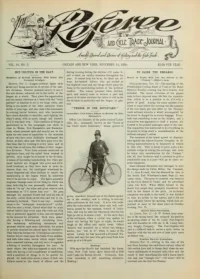
- Officer Lou Robert of the Louisville police, who enforces the city's lamp and bell ordinance, rides a 22-pound Waverley and says any man who escapes him must be riding at a 2:20 gait.
- A short item quoting the Boston Herald that New York horse show boxes selling at $500 each show that first-class horseflesh still has value despite the bicycle.
- The Philadelphia Cycling Board of Trade protests the Pennsylvania railroad's excess-baggage charge on wheels, agrees to discriminate against the Adams Express Company, and leaves Eddie Miller's complaint over the South End diamond prize without action.
- D. W. Robert resigns as sporting editor of the St. Louis Post-Dispatch to join the E. H. Linley Railway Supply Company, leaving the paper without a cycle writer as familiar with local news.
- Rain on the last three Sundays has stopped Boston century riders chasing souvenir rides, so half a dozen centuries and a 150-mile triangle run are expected on the first fine Sunday.
- The Louisville blue ribbon meet of 12 November, with 1,500 spectators, where Ziegler rode the mile open in 1:53 2-5, the best competitive mile, and Johnson and Crooks won their races.
- Johnson rode an unpaced mile in 1:50 1-5 at Louisville to beat Ziegler's time by a fifth of a second, while Miller of Chicago took the five-mile paced record and S. C. Cox the two-mile flying-start paced record.
- Consul reports from Chemnitz describe Otto Potsch's road material of artificial stones of gravel and Portland cement, squared only on the upper face, which cuts cost and avoids sand beds and ramming.
- Louisville cyclists carried election returns for the four dailies from as far as thirty miles, and all were in by 9:30 p.m. despite a blanket ballot of over a hundred names.
- A Syracuse woman who rented a wheel and never returned it, was brought back by police, then slipped away from the station and was later sentenced to months in jail.
- At the Champ de Mars Paris winter path, Jacquelin wins the Grand Prix de Madagascar by nearly two lengths, Banker and Bourrillon dead-heat for second, and Bouhours wins the paced fifty kilometres for a charity meeting for soldiers in Madagascar.
- At the Buffalo indoor path in Paris, Michael beats Gougoltz in the three-distance match, Gougoltz winning the mile in 2:02 3-5 while Michael takes the five miles in 10:25 1-5 and the ten miles in 21:29 2-5 after Gougoltz retires.
- Tommy Dod's drawn verse plate in which the imps of Winter, with snow and frozen winds, beat down a rider who is racking the record, until the record itself calls for rest and peace.
- The Pennsylvania Bicycle Club has dedicated an addition to its clubhouse as an amusement hall for dances, smokers and theatricals, built under Captain Heishley's committee, with the club's minstrel show to move there.
- J. D. Armstrong, a Toronto real estate broker, is instantly killed when a trolley approaching from behind strikes him as he attempts to turn off the devil strip.
- The editorial warns that bicycles sold through department stores at low prices are a bad bargain, since no high-grade maker supplies them and their guarantees are unstinting only in name.
- The editorial argues that the L.A.W.'s good-roads work by distributing literature to farmers has achieved less than local cycle paths, such as Buffalo's planned path to Niagara Falls, and urges the divisions to build paths instead.
- The editorial objects to the L.A.W. circular and application blank, printed in makers' catalogues, which it says mislead applicants into thinking $2 is due and could endanger the Bulletin's second-class mailing rate.
- The editorial calls for the road-record cheats of 1895, who ride with railroad cars, passing wagons and pacing tandems, to be blacklisted for good, since the cycling public has been too lenient with them.
- The editorial, whose subject is Mr. Crackerjack, alias Cracker-jack and Crack-a-jack, asks that confidence and patronage be withheld from him until the grounds of suspicion are removed, with unheaded notes on the Atlanta exposition ride and the motocyclist that follow.
- Charlie Palm rode 100 miles paced in 5 hr. 19 min. at Minneapolis, beating the state century record of 6 hr. 25 min. made unpaced by Gus Hanson, while Hanson and Nilsson on a tandem set a new American road record and lowered the state twenty-five-mile record.
- From Toronto, the racing season is over, though Angus McLeod, Harley Davidson and T. B. McCarthy are still going for records, and George H. Orr is reported unwilling to remain chairman of the racing board next year.
- The New York-Brooklyn trustees, after a petition got up by Alfred Reeves, cut the bicycle toll on the Brooklyn bridge from three cents to a penny and will ask the legislature to abolish it altogether.
- A column of reprinted clippings: the Charleston Tribune on wheelmen's courtesy to women, the Johnstown Tribune on the railroads' baggage charge, the Los Angeles Times on scorching and the London Truth and New York Tribune on cycling.
- The first national circuit meet at San Jose, on 8 and 9 November, sees Bald beat Murphy in the mile open and Murphy win the five-mile national championship from Bald, after Wells is given the third-mile race on a doubtful verdict following a spill.
- A caption under Fred Patee's portrait reports that he has resigned as secretary of the Indiana Bicycle Company after two or three years to form a company of his own, having earlier been with Rouse, Hazard & Co.
- Notes from the California circuit: the riders who will train on the coast in spring, Edward Cannon Bald's account of his racing methods, Murphy's plan for a mile-a-minute record and Wilbur Knapp's debut in a White Flier outfit at San Jose.
- The Century Cycling Club of Syracuse, once the city's most prosperous, is in bad shape with back dues and unpaid bills, and its directors considered dissolving it but deferred the decision.
- A Philadelphia house has been granted a patent for a table-cover and rug design showing a bicycle and a young woman in bloomers against a landscape.
- L. V. Moulton's water bicycle, with two long cylinders and a rear wheel, lies at anchor off the Washington arsenal wharf, and G. W. Shook, in charge of it, towed a drifting yacht to her anchorage and afterwards sold the owner a machine.
- John A. Barnes, formerly general manager of the Eastern Rubber Company, is indicted at Trenton for grand larceny after Frank A. Magowan accuses him of taking $7,000 of stock, while Barnes sues Magowan for $100,000 over alienation of his wife's affections.
- A two-mile bicycle race at the University of Pennsylvania fall games ends in a spill that breaks J. F. Chattin's collar bone and cuts Eglin and Stackhouse, with A. T. Coates winning from the 75-yard mark.
- The Murphy-Cabanne-Titus evidence has stalled with one racing board member, and Chairman Gideon says a conviction would need a sentence that deters crooked work in the future.
- Milwaukee's South Side club, organised six weeks ago, has over 250 members, two parade prizes and a new clubhouse at National avenue and Reed street, and plans a road race from Racine.
- A dialogue between a College Girl and an Average Girl on whether the bicycle changes character, in which two indolent friends who took to wheels in June now ride at six in the morning, and a stingy man and an extravagant boy are made economical by theirs.
- Bald's 1895 circuit record set against Zimmerman's 1893 season: Bald has fifty national circuit firsts on a regular circuit against sixty class B team riders, so the writer gives him the better argument.
- The Century Wheelmen's troupe of twenty-five is rehearsing E. H. Collins's two-act farce for the club gymnasium theatre, run extended to two weeks because many were turned away.
- Philadelphia's lantern parade by the Penn Wheelmen, thirty clubs and perhaps 1,500 to 2,000 riders, and a proposed association of local club captains outside the Associated Cycling Clubs for a century run, race meet and parade.
- Waitresses at an all-night Nassau Street lunch room refuse the manager's order to wear silk stockings and bloomer costumes.
- Fred C. List of Syracuse claims the Steelton road record from McKnight's to the Monument house at 12:17, ten seconds under H. F. Lawson's, paced by three tandems.
- A Washington rider carrying lumber on his shoulder down crowded Seventh Street is flung from his machine onto the cobbles after striking a dray.
- A reprint from the Industrial World arguing that once frame design is settled, makers can spend the year perfecting minor parts.
- F. A. Sirrine, entomologist at the Jamaica, L.I., agricultural station, rides a bicycle carrying an insecticide reservoir and a spraying knapsack to advise growers across the island.
- The Wisconsin League for Good Roads presses for state aid to extend the Sheridan drive from the southern boundary to Milwaukee, with Secretary Otto Dorner enlisting help along the line and farmers' institutes to show good-roads maps.
- Milwaukee's bicycle ordinance, pushed by Alderman Starkweather, would hamper road races because it makes no provision for races and most finishes lie within the city.
- Milwaukee clubs have planned about ten road races for next year, among them the Milwaukee Wheelman's race from Waukesha, the South Side race from Racine and the Badger Wheelmen's Lovers' Lane race, with track meets likely.
- Alex Laing and Bert Harding of the St. Louis Cycling Club ride a Sickles Flyer tandem 683 miles to the Atlanta exposition by way of Evansville, Henderson, Nashville and Chattanooga, arriving on St. Louis day, with Jack and Dave Coburn on a second tandem.
- Pennsylvania L.A.W. secretary-treasurer Van Nort denies the election rules were broken and says he never sought office or solicited votes.
- The Toledo National Meet Association hears that the railroads will co-operate on low rates, a Detroit write-up of Toledo is to be handed out at the editors' convention in Cincinnati, and twenty-three Crescent Club members have joined the L.A.W.
- The Wisconsin L.A.W. division is about to print a road map of the principal state roads, with tour charts compiled by local consuls and secretary-treasurer M. C. Rotier.
- A three-lap wooden track inside the trotting track at Point Breeze, Philadelphia, designed by architect George I. Lovatt, 1,760 feet round, to cost about $10,000 and expected to bring fast records.
- Chief Consul Potter reads 299 3/4 miles on his cyclometer, rides on to add a quarter, and then finds the instrument reads 290 after a short spin.
- A February cycle show for Philadelphia, probably in the First Regiment armory and possibly run by the Cycle Trade Publishing Company, with the Wissahickon Wheelmen planning a rival show at Germantown town hall.
- A St. Louis Republic piece urging wheelmen to find out why the assembly delays appropriating gravel for boulevard repairs, which the street commissioner wants before freezing weather ends the working season.
- The racing board is said to be investigating Wisconsin class A riders who took expenses from manufacturers, with several to be moved to class B and W. F. Sanger ready to turn professional in the spring.
- The New York Sun's Office Cat gives mock advice to the street commissioner's foremen newly mounted on wheels, such as dismounting for oncoming traffic and not riding hands off, and jokes about their proposed uniform.
- Quoting the Los Angeles Times, the writer welcomes police arrests of scorchers but asks that the drivers who crowd cyclists into the curb be arrested too.
- A Newark joke on Senator Morgan, who has married, told as a race in which Miss Lillie C. Stilger set the pace and he is suspended from the single class for life.
- A joint meeting at New York of the L.A.W. and the board of trade names a committee to confer with the trunk line managers on carrying bicycles as baggage.
- The New York Sun notes that November still offers good weather for long rural rides before the rough winter days.
- Milwaukee's clubs propose one association of all the city's clubs, which the writer says is needed because 15,000 wheelmen saw no race and past meets failed.
- Milwaukee may have two winter shows, the North Side club's in January at its Reservoir avenue rooms and an Ethical Society show at 558 Jefferson street, if dealers back it.
- Ex-Mayor Stokley of Philadelphia is reported to want wheelmen kept out of Fairmount Park, after Councilman Hicks's similar remark.
- Thirty-seven wheel names newly registered since the last issue, the new ones asterisked, with makers who have not reported urged to send in their claims at once; the list runs to three columns of makers and models.
- Former racing board chairman Howard E. Raymond criticises I. B. Potter's plan to drop racing from the L.A.W., and Potter replies that racing keeps thousands of wheelmen out and that the league should press for road books and signboards instead.
- Western roads agree that from 1 December excess baggage on bicycles costs twenty-five cents a fifty pounds, sixty cents to St. Paul or Minneapolis, with a storage charge after twenty-four hours.
- The Liberty Cycle Company gives Wheeler & Wilson, the sewing-machine maker, the western, south-western and south-eastern sales of the Liberty, with some 2,500 agents, while its New York office keeps the eastern states under J. S. Bretz.
- The Gallison & Hobson Company of Astor Place, whose artists and writers produce illustrated catalogues for cycle makers such as the Pope Manufacturing Company, Wolff-American and American Dunlop.
- Peoria milliner E. J. Graves has made a single-wheel carrier holding eight hat boxes, fitted to a 22-pound Sylph, for a delivery lad in Peoria.
- Toronto dealers prepare for 1896 with few sales as yet, Columbias to be handled by McDonald & Willson, and a new American Tire Company is to make the Flexifort tire under Sidney Davis.
- Springfield may gain a bicycle factory as Clarence H. Smith and partners consult Mr. Bunn about the watch factory, and the Keating Wheel Company at Holyoke takes more room and runs evenings for 1896 wheels. The piece runs on to p.34 with a gasoline explosion in Gilbert Loomis's Westfield repair shop, the Union Cycle Company's new four-story annex at Highlandville (5,000 wheels planned against 2,500), new sporting-goods and bicycle factories at Wakefield and Waltham, and a six per cent Warwick dividend.
- The Hoffman Bicycle Company of Cleveland, begun by L. E. Hoffman in 1893 and joined by L. M. Sigler in 1894, which turned out 2,000 machines last season and plans 6,000 wheels, moving into a 25,000 square foot factory, with its specifications listed.
- The Lu-Mi-Num factory counts the patterns its line allows by combining frame height, pedals, handlebars, tires, seat posts and gears: 3,072 roadsters, 6,144 men's machines and 8,192 ladies', a total of 14,336 patterns.
- Boston trade notes: W. E. Miles of the Victor branch goes retail only, the Overman company aims at baseball teams, the Pope store gains a balcony office, Fred Graves opens a Providence Waverley branch with ex-Captain J. E. Towne taking his place, J. E. Savelle joins A. O. Very & Co., Harry Walker opens an Eclipse salesroom with A. H. Gaudlet, and the Rambler people turn the Newton street armory into a riding academy.
- The Associated Cycling Clubs and the St. Louis Cycle Board of Trade fix the local show for February 21 and 22 with the hall still to be chosen, then short St. Louis trade notes on Alex Meyer's western trip, the Board of Trade presidency and a Warwick & Stockton visit.
- Porter & Gilmour of 16 Warren street, New York, makers of the Sagamore, which they renamed from their P. & G. Special once they had more floor space, with the features of the wheel's steel, bearings and balance, and Luther H. Porter's writing on cycling.
- The Kenwood models for 1896, with drop forgings throughout, a double-crowned front fork, tubular hubs with detachable sprockets, and a direct seatpost patented by Frank Douglas that sets the saddle forward or back, of which over 30,000 saddles have been sold.
- The new hub and cone machine of the Lodge & Davis Machine Tool Company of Cincinnati, which can be changed to a standard screw machine in under ten minutes, with its Parkhurst automatic chuck, massive hub rest and tool feeds.
- The W. F. & John Barnes Company of Rockford, Ill., whose upright drills serve nearly every prominent bicycle factory, with ten 20-inch drills ordered by a western maker and many supplied through English agents.
- R. H. Wolff & Co. of New York, makers of spoke wire and steel rims for twenty years, promise better '96 Duplex and single wheels, with spring-temper frames, tubular hubs and clock-spring pedals, and Mr. Wolff warns against over-large tubing. The piece runs on to p.40.
- The Davis Sewing Machine Company of Dayton opens uptown and downtown branches in New York, the downtown headquarters at 76 Reade street and a riding hall at Fifty-seventh street and Broadway, to push the Dayton wheel.
- Edward A. Lefebre, Jr.'s light steel-wire bicycle stand, worked out in two hours after H. K. Smith's jest that a 7-pound stand could not hold a 17-pound bicycle, which weighs a pound and holds a quad, tandem or single.
- The North American single-tube tire sold by Parkhurst & Wilkinson, with its thickened three-ply tread and sound lining, from a factory able to make a thousand pairs a day.
- The Maumee Cycle Company of Toledo, incorporated at $50,000 with Joseph L. Yost as president, F. J. Cheney vice-president and F. M. Joquist secretary-treasurer, to make the medium-grade Volant wheel, with a first-year output of at least 5,000 for the wholesale trade.
- The Yost Manufacturing Company opens its retail store on Adams street, Toledo, under Al Hoff, with a riding school, bicycle livery and repair shop in the basement.
- The Gendron Wheel Company runs its bicycle department night and day, with 500 '96 wheels waiting for retailers and several thousand in stock by the season, and thirteen travelling men out.
- Short notes on the Toledo trade: a deal for J. V. Todd to take the Columbia agency from Frank Chapman, E. G. Eager called to Toledo from Chicago, the Truman company's 250 assembled wheels, and the Lozier factory addition at Toronto, inspected by its superintendent.
- Gormully & Jeffery's five '96 leather tool-bag models, among them the Triangle Telescope, the Full Triangle, the Folding bag, the Wallet and an oblong No. 1.
- C. S. Henshaw of the Greenwich Wheelmen is appointed by Frank White as salesman and to look after the racing interests of New York tires, after his tandem road records with Oscar Hedstrom of 25, 50 and 100 miles on New York tires.
- The Fred J. Meyers Manufacturing Company of Hamilton, O., makers of architectural iron goods, begins bicycle manufacture under H. L. Warner as superintendent, with a new wheel called the Bluegrass to list at $100 with its own detachable tire and an adjustable handlebar.
- Business changes across the trade: new incorporations at Chicago, Syracuse, New York and East Orange (Porter & Gilmour), the Double Diamond bicycle business of Donnelly & Deward sold to the Cash Buyers Union, and Jesse W. Starr's new factory at Westville, Conn.
- The Compress Wheel Company's polishing and buffing wheel of compressed leather, canvas or felt sections, made to any density and shape for roughing and finishing bicycle work.
- The Schlueter Cycle Manufacturing Company of Cincinnati, whose wheel output went from a few dozen in 1893 to 1,100 in 1895 and will exceed 7,000 in 1896, with 5,000 of its supplies already bought, F. C. Schlueter in the office and G. Schacht, the superintendent, who has invented several machines.
- The Philadelphia trolley companies' discontinued transfer, which has lifted local cycle sales, with notes on the Spalding show, the Pope company's orders for the '96 Columbia, Jacob Rech & Sons' Sterling model and Harry Simmons's Waverley premium and recovered wheel.
- Short Philadelphia and trade notes: Pop Brewster in New York, Harry Le Cato back from inspecting the Warwick at Springfield, a Trenton stock company formed with "Little Josh" Lindley at its head, and a burglary at Hill & Lyster's store.
- Fred Hazleton, a Syracuse man and member of the New York division and national representative in league politics, takes charge of New York, Pennsylvania and Michigan for the Eclipse Bicycle Company of Elmira.
- The New Departure Bell Company's two additions to its factory, now 28,000 square feet with threefold capacity, its bells grown from six styles to sixteen, and its new cyclometer, with Lucas lamps at a reduced price.
- The Garvin Machine Company's turret-machine base, its spring leg split and fastened with taper pins so that the leg springs and the bed is not twisted when the machine is bolted to an uneven floor.
- The bicycle patents issued in the Washington report of November 9, among them a pneumatic tire, a spring wheel, a handlebar, a combined pump and saddle-post and a gearing.
- The bicycles and bicycle goods exported from the port of New York in the week ending November 5, by destination, from single machines to several cases bound for Hamburg, Florence and Liege.
- Arthur R. Peck, manager of the Barnes Cycle Company at Syracuse, is elected alderman of his ward, and the business in White Flyers is booming.
- The Tourist Cycle Company of Syracuse names H. E. Maslin president at a directors' meeting, with its factory building under way and a large part of the 1896 output already sold.
- The Kokomo Rubber Company, organized in July with $50,000 by local capitalists to make tires and rubber goods, with D. C. Spaker president and G. W. Landers secretary-treasurer, in enlarged former stamping-company buildings, will market a detachable tire and hose-pipe tires reinforced at the tread, to be called the Defender.
- Porter & Gilmour of 16 Warren street, New York, jobbers and retailers who build the Sagamore wheel, incorporate to develop their manufacturing interests and turn out enough wheels for a rapidly growing demand.
- The quarterly export reports from the United States consuls, with cycle exports from Birmingham at $68,834.90 against $49,714.53 for the same period last year, and figures for Leith, London, Nottingham and Bristol.
- Holbrook of the Elastic Tip Company and Barton of the Puritan, delayed by fog on a Sound steamer off Whitestone, were lowered on a rope to a small boat and reached New York by train ahead of the others.
- The Brown-Lipe Gear Company of Syracuse adds Lee Richardson, the Monarch Cycle Company's fancy rider, to solicit orders for the Bi-Gear as well as the Monarch wheel he already represents.
- The Newton Rubber Works of New York passes on a telegram from its attorney at Parkersburg that the order is vacated in the Palmer suits.
- Trade notes: Oliver G. Tayman to open a wholesale supply house in Topeka, Harry T. Dekker to represent Remington Arms in the west, W. De Cardy's ten-mile standing-start record on a Syracuse, the Simmons Hardware Company's 2,000 Iver Johnson cycles, the Ames '96 catalogue and the Monarch branch at San Francisco.