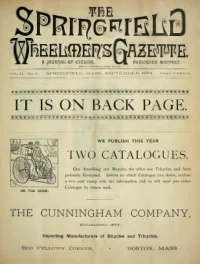
The Springfield Wheelmen's Gazette, Vol 2, No 5
Articles in this issue
- The editors weigh in on the bell-vs.-voice debate sparked by a New York Times complaint, arguing that a politely spoken word is more intelligible and less startling than a bell or whistle when warning pedestrians.
- Following last month's appeal for decent racing dress at the Springfield tournament, the editors cite Illinois authorities jailing women for the Mother Hubbard costume as evidence of American sensitivity about public dress, reiterating their expectation that racers appear as gentlemen.
- Col. T. W. Higginson of Cambridge corrects a published report that he was 'seriously injured by being thrown from a tricycle,' explaining only a minor bruise was sustained, and advises Coventry Rotary riders to remove the dangerous foot-rest near the right foot.
- Three St. Louis cyclists — C. F. A. Beckers, John S. Rogers, and Arthur Young — coasted down Mt. Washington on ordinary crank bicycles on July 31, with Beckers completing the descent in 49 minutes despite seven headers, and Rogers and Young finishing in 1 hour 14 minutes.
- An editorial cautions wheelmen against reckless riding stunts — citing the death of a man named Oldroyd who rode off a pier in Douglas, Isle of Man — and urges ordinary riders to exercise safely rather than court glory through dangerous feats.
- The editors condemn the spread of pool-selling and bookmaking at bicycle tournaments, contrasting Springfield Bicycle Club's proud refusal of a $3,000 gambling concession at its 1883 meet with unrestricted betting at the recent Philadelphia tournament, and call on the L. A. W. racing board to prohibit it.
- Full programme for the New Haven Bicycle Club's fifth annual races at Hamilton Park on September 23–24, 1884, including race events, prize details, transportation, hotels, and committee appointments; fancy riders Profs. Canary, Pressy, Sewell, and Armaindo are featured.
- A Hartford correspondent describes excitement surrounding the Connecticut Bicycle Club's first open race meeting at Charter Oak Park, previews entries from Hendee, Burnham, Frazier, and Dolph, and gives a lively account of the club, its rooms, and Charter Oak Park.
- Full prize list for the four-day Springfield Bicycle Club tournament at Hampden Park, September 16–19, 1884, covering professional and amateur bicycle and tricycle races, the tug-of-war, and the elaborate fireworks programme for Thursday evening, plus the Wednesday parade route.
- Preview of the joint race meeting of the Philadelphia, Germantown, and Pennsylvania Bicycle Clubs at the Gentlemen's Driving Park, Philadelphia, on September 13, including the 20-mile race for the Columbia Prize Cup held by A. C. Bates of Cleveland.
- Letters from correspondents: a Brattleboro Cycling Club race report from August 16 with results for Sherman, Atherton, and Alexander; Salt Lake City results from the Salt Lake Bicycle Club's July 24 meet won by William Wood and W. Jennings.
- A correspondent from Ottumwa recounts a comic evening ride with ten wheelmen that ends in two crashes and a two-mile hobble back to town carrying the disabled 49-inch machine atop a 52-inch bicycle.
- A party of Nashville bicyclists — members of the Nashville Bicycle Club and Rock City Bicycle Club — rides 25 miles to Eldorado Springs on July 4, with one rider sustaining multiple serious falls before the party enjoys a hotel serenade and grand hop.
- A humorous fictional account, told before a village magistrate by 'Doc' of the Expert Bicycle Club, of accepting a street-race challenge from a friend on horseback, racing at full speed, and ending up flying through a shop window.
- J. H. Kennedy describes a self-organised five-man informal Cleveland cycling club of clergymen, a superintendent, and an editor who ride daily without rules, accumulate health benefits, and endure good-natured mockery from bystanders calling them 'dudes.'
- 'Jake' reports on the Essex Bicycle Club's Long Branch run, a rain-spoiled July 4 gathering with the Harlem Wheelmen, the New Jersey Wheelmen's Chinese lantern parade of over 120 cyclists through Newark and Orange to West Orange, and C. R. Zacharias and C. W. Northrop's upcoming three-week tour to Springfield.
- Club notes covering the Manchester Club's growth to 35 members and Lieut. Moses Sheriff's 700-mile Vermont and Canada tour; the Nashville Bicycle Club's lavishly furnished new rooms; and brief items on clubs in San Francisco, Boston, Holyoke, Meriden, Philadelphia, and Washington.
- A short comic exchange, reprinted from the Detroit Free Press, in which an old man selling sassafras root watches a bicyclist and concludes that anyone who works as hard at riding as the cyclist does would quickly earn enough for a real horse.
- A column of short items: Fisk and Brooks order Royal Mail racers; D. J. Canary marries Sallie Hathaway of Meriden and joins an Anthony and Ellis skating combination at $125 a week; E. P. Burnham wins the Boston B.C. 19-mile tricycle road race in 1h. 14m. 40s.; F. R. Cook aims to beat Hendee's half-mile record; and many further domestic and international cycling notes.
- Full results of the Providence Bicycle Club's first annual race meeting at Narragansett Park on August 2, with winners G. S. Walker (half-mile), V. W. Mason (one-mile), Fred Binford (three-mile open), and J. W. Watson (five-mile championship).
- Brief international and domestic cycling records: Marriott and Bird's 231-mile tandem ride in 24 hours; Karl Kron's 3,534 annual miles; English champions for 1884 including Speechly, Chambers, and Liles; William Collins's 155-mile overnight ride from Meriden to Nashua; and H. C. Finkler's 787-mile solo bicycle tour of California.
- Reprinted from Harper's Magazine for August, Julian Hawthorne argues that athletics are essentially social and communal, that fellowship rather than personal health is the true driver of physical effort, illustrated by the Oxford-Cambridge boat race and Winship's and Blaikie's athletic careers.
- A concise practical guide for tricycle riders covering cornering, braking, hill-climbing, gearing, lubrication, and the art of applying steady rhythmic power to the pedals rather than jerking.
- Reprinted from the Boston Globe, a lyrical account of moonlight club runs explaining why cyclists find night riding easier than daylight, and describing the popular Chestnut Hill Reservoir circuit in Brookline where fast training times are made by moonlight.
- A detailed editorial profile of the Royal Mail Works' bicycles and tricycles, introduced to America by William Read & Sons of Boston, noting 15 first prizes won in the United States and riders including Burnham, Prince, Dolph, Morgan, Brooks, Fiske, and English champion Chambers choosing the Royal Mail.
- Frank S. Dobbins of Allentown, Pa., describes his recovery from months of insomnia and poor appetite after acquiring a Victor tricycle, praising its safety and ease compared to the bicycle and its suitability for ministers making parish visits in hilly country.
- The first-prize essay awarded by the magazine Wheeling, by Alan Hiley, argues that Sabbatarian objections to Sunday cycling are illogical, asserting that riding through nature is itself a form of worship promoting sobriety, virtue, and mental health.
- Amos W. Hart of Washington, D.C. surveys the 900-odd U.S. velocipede patents since 1869, describing curious annular and skeleton-cage monocycle designs, and noting that two Washington youths, Seeley and Dinwiddie, now ride one-wheeled machines through city streets.
- Rev. W. S. Hawkes of South Hadley Falls recounts buying an Overman Victor Rotary tricycle after reading Ezekiel's vision, riding it first through Holyoke and Springfield, and recommending it to ministers and women for parish visits, touring, and daily errands.
- Reprinted from a western agricultural paper, arguing that if farmers' boys rode bicycles they would advocate for better roads, improving market access and farm prosperity, illustrated by British farm labourers who ride up to a dozen miles to work on bicycles.
- A collection of humorous cycling squibs and editorial quotes from the Bicycling World, Burlington Free Press, Wheeling, London Cyclist, Boston Herald, Cycling Times, New Haven Palladium, Albany Journal, and Boston Star, including the 'Woman at the Wheel' verse and a full prize poem on the Wandering Jew and his bicycle.
- Reprinted from the Cyclist, a warning about the dangers of tandems for inexperienced riders, citing the hushed-up death of a rear rider thrown over his companion's head on a downhill, and calling for the facts to be publicly known.
- A humorous rural dialogue, reprinted from the Rockland Courier-Gazette, in which old Uncle Lewis gravely predicts that Thomas Stevens, attempting to bicycle around the world, will be stopped cold when he strikes 'the old original genuine North American Atlantic Ocean.'