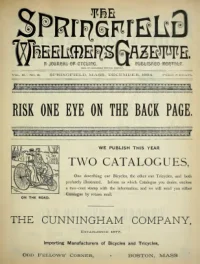
The Springfield Wheelmen's Gazette, Vol 2, No 8
Articles in this issue
- The editor argues against the Bicycling World's claim that gambling is necessary for bicycle racing's popularity, pointing to the Springfield Club's own successful, betting-free tournaments as proof.
- A short editorial wish-list of open questions for the cycling world, including whether Sellers can make 2.39 on English tracks, Prince's potential at 20 miles in the hour, and the true membership of the L.A.W.
- A companion list of aspirations: a mile in 2.32 at Hampden Park, 10,000 L.A.W. members, Hendee at his best, and good roads from Maine to California.
- A London correspondent signing as 'Waverley' surveys the 1884 British season—championship results, club runs, record-breaking feats by R.H. English and others, machine developments including the Kangaroo safety and Humber 'Cripper' tricycle, and the proliferation of cycling weeklies.
- A humorous reprint from the Washington Star recounting how an elderly Black man near Oxen Hill mistook a group of Capital Club cyclists' nickel-plated machines for stacked rifles, fearing the Democrats' election meant a return to slavery.
- A fictional extract from 'A Family Affair' in the English Illustrated Magazine, in which curate Sylvanus Mordle rides his tricycle 25 miles to visit his bishop and wins episcopal approval for the machine.
- A comic reprint from the English Bicycling News about a prize-hunting city racer tricked in the final heat of a country meet when local conspirators swapped the announcing bell for a tiny tinkling one.
- A detailed profile of Preston Bicycle Club's Sanders Sellers—his background, build, racing career in England in 1883–84, and his triumphant American tour including a world-record 2m 39s mile at Hartford and victories over George M. Hendee at Springfield.
- A comic reprint from the New York Times about Vermont farmer Deacon Smedley, who buys his small boy a bicycle only to suspend it from the barn rafters and use the boy as pedal-power to drive a feed-chopping machine.
- A profile of seventeen-year-old Cincinnati Bicycle Club champion Edwin Forrest Landy, noting his wins at the Capital Club meet in Washington and predicting a glorious national future for the young Ohio racer.
- Two reader letters: a Hartford correspondent reports the Connecticut Club's presidency passing from T. Sedgwick Steele to L.A.W. treasurer Stephen Terry and autumn road runs to New Britain; a Macon correspondent describes the Macon Bicycle Club's first State Fair tournament (October 28–29), with J. H. Polhill winning multiple events, and poses a disputed judging question about a lapping incident.
- Club notes covering the Washington Cycle Club's new 45-member headquarters at No. 1023 Twelfth St., Manchester Bicycle Club's autumn races and hill-climbing contest won by Moses Sheriff, club elections for Jamestown, Kenton, Louisville, Nashville, and Pennsylvania bicycle clubs, and brief items on the Citizens, Chicago, Portland, Springfield, and other clubs.
- A comprehensive comparative table of 1884 amateur and professional bicycle and tricycle records, both American and English, listing holders from ¼ mile to 100 miles including Sanders Sellers, George M. Hendee, R. H. English, J. S. Prince, and H. J. Webb.
- A New York correspondent reports on city cycling gossip: new racer Searls clocking 2.53 in a trial mile, the Ladies' Tricycle Club run, the Citizens Club's new Central Park privileges obtained by F. G. Bourne, and commentary on the inactive New York Club.
- A miscellaneous column of short items including Prince's ambition to ride 20 miles in the hour, the C.T.C.'s 16,409 members, Sellers receiving a gold watch from D. Rudge & Co., the Ixion Club road race to Yonkers won by P. M. Harris, and various other domestic and British cycling snippets.
- Full results from the Minnesota State Meet at Minneapolis (September 25) and the Kansas City Wheelmen's first annual tournament (November 8–10), with John Nicholson sweeping the Minnesota state championships and E. E. Stone dominating the Kansas City open events.
- Short international notes: S. G. Whittaker's 100-mile road record, an intercolonial race at Melbourne drawing 12,000 spectators, the Birmingham county court ruling a bicycle a 'necessary,' and F. Turrey riding 212 miles in 23.5 hours on a Kangaroo machine.
- A tart editorial rejoinder to the L.A.W. official organ's editor, who called the Gazette the 'Duckerian Oracle,' cataloguing thirteen alleged misstatements about the Springfield Club over six months and declaring the Gazette's tournament and circulation a self-evident answer.
- A table ranking modes of locomotion by speed over a mile—locomotive, running horse, trotting horse, bicycle (2:39), skating, tricycle, down to swimming—placing the bicycle fourth fastest.
- Brief reprints from the London paper Wheeling praising Gaskell's and Chambers's conduct in America and the Springfield Club's hospitality, with a note that Mr. Bale had trouble finding a steamer large enough to bring Gaskell and his prizes home.
- A reprint from the London World describing the panic of Russian villagers near Vologda who barricaded their doors when a youth from St. Petersburg rode a bicycle into their market-place, believing the Evil One had arrived.
- Three short comic poems signed 'Geeseb' tracing the arc of a bicycle ride—confident departure, a spectacular header, and the lame aftermath.
- A comic dialect poem about Herr Schnitzerl's single-centred velocipede, which achieves astonishing speed on Broadway before a fatal slip of the feet ends the experiment violently.
- A humorous poem reprinted from London Fun imagining London police issued bicycles for their beats, speculating on the comic and practical results for burglar-chasing and housemaid-wooing.
- An essay by H. J. Webb of the London Tricycle Club extolling the physical, moral, and commercial benefits of tricycling, arguing that no sport so expands mind and body or so suits the needs of merchants, country doctors, and postmen.
- Karl Kron, writing from Washington Square, urges every sector of the American bicycle trade to subscribe to his forthcoming book 'Ten Thousand Miles on a Bicycle,' arguing that its 3,000-subscriber appendix and road reports will boost the entire industry.
- A summary of Dr. B. U. Piper's paper for the Chicago Bicycle Club on the physiological effects of cycling, based on 1,200 miles of personal testing, finding significant benefits for respiration, circulation, and general health.
- A report on the London Lancet's debate over cycling's health effects, featuring naturalist W. B. Tegetmeier—nearly seventy, who rides for all journeys under 60 miles—declaring he is practically ten years younger than a decade ago and knows none of the alleged ill effects.
- Reprinted notes from the Amateur Athlete, Travelers' Record, and Boston Herald, including the Maryland Bicycle Club's Thanksgiving Day cornerstone-laying for a new Baltimore club house attended by 100 wheelmen, and a Druid Lake race won by J. Kemp Bartlett in 5.18.
- A Boston correspondent's sketch, reprinted from the Chicago News, on how the bicycle has transformed the stereotypically sedate New Englander into a fast-moving figure in knee breeches and cap.
- A detailed description from the Boston Herald of the Massachusetts Bicycle Club's new $30,000 building on Newbury Street, Back Bay—three stories with gymnasium, wheel room, ladies' parlor, and bowling alley—credited to Col. Albert A. Pope.