The Springfield Wheelmen's Gazette, Vol 3, No 7
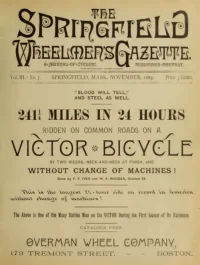
Articles in this issue
- Editorial arguing that the 1885 Springfield tournament produced genuinely fast times by compelling riders to race from start to finish, and that the new American records — led by W. A. Rowe on a Columbia — are superior to anything previously achieved in England.
- Rebuttal of British cycling editor G. L. Hillier's insinuations in The Cyclist that American timekeepers at Springfield were incompetent, defending the honour of the League of American Wheelmen and the integrity of the 1885 record times.
- Short editorial dedicating the issue's illustration to 'American muscle and skill,' celebrating W. A. Rowe's world records from one-half to twenty miles on a Columbia and F. F. Ives's American records on a Victor.
- Correspondent 'Waverley' reports on the close of the English cycling season: the Rover 100-mile safety race won by George Smith in 7h. 5m. 16s., Rudge's 24-hour tricycle race won by J. H. Adams (232½ miles), T. R. Marriott's end-to-end tricycle record of 883 miles in 6d. 15h. 22m., and British cycling papers' debate over the Springfield times.
- Ohio correspondent 'Wilhelhm' covers the Avondale Wheelmen's moonlight run and social, Cleveland's plans for a monster race meeting in August 1886, and a Cincinnati club's country run and the Kenton County Wheel Club's second-anniversary entertainment.
- Brief column describing autumnal pleasure rides around Stamford, Connecticut, including cider sampling, coasting through fallen leaves, and the merits of the Facile over the ordinary bicycle on rough roads.
- Three letters to the editor: Harry Etherington of Wheeling thanks Americans for their hospitality; Geo. I. Bechtel, captain of the Reading Bicycle Club, corrects false claims about the club from a pseudonymous writer 'Cycle'; and a Nashville correspondent reports club officer elections and a 40-mile run to Franklin.
- Reprinted from the L. A. W. Bulletin, challenging Kennedy-Child's implication that Springfield timing was dishonest, arguing that rival machine representatives, fifty newspaper men with stop-watches, and the American press all corroborate the official times.
- Profile of 20-year-old William A. Rowe of Lynn, Mass., tracing his race career from Pittsfield through Hartford, Springfield, Providence, and St. Louis to his world-record mile of 2.35⅖ and 20-mile record of 58m. 20s. on a Columbia bicycle.
- Satirical reply (reprinted from the L. A. W. Bulletin, signed 'Hermes') to The Cyclist's doubts about Springfield times, systematically dismantling arguments about slow watches, track measurement, and the 18-inch versus 12-inch standard.
- Day-by-day log of Hugh J. High's 3,409-mile round-trip ride from Pottstown, Pennsylvania to Seward, Nebraska and back, completed in summer and autumn 1885 and celebrated on return with a street parade and brass band.
- Double-page spread reproducing The Bicycling News cartoon satirising Springfield records as an optical illusion, paired with an 'actual appearance' counter-image showing the records as honestly made.
- Table comparing W. A. Rowe's new world records from one-half mile to twenty miles (and one hour) against the previous bests, showing improvements of one to several seconds at every distance.
- Officers elected for the new season by bicycle clubs in Bloomsburg Pa., Chicago, Cincinnati, Cleveland, Detroit, Holyoke, Jamestown N.Y., New Orleans, Norwalk Ct., Salem Mass., Tecumseh Mich., Toledo, Brooklyn (Wayside), and Worcester.
- Official results for three meetings: Colorado Wheel Club (Denver, Sep. 25–26) featuring H. G. Kennedy and W. L. Van Horn; Albany Bicycle Club (Sep. 30) with A. P. Dunn and H. S. Kavanaugh; and Canton Ohio Bicycle Club (Sep. 30) with Chas. E. Kluge winning the 5-mile open.
- List of United States and British bicycle and tricycle patents granted in late September and October 1885, compiled for the Gazette by Duffy & Brashears (Washington) and Hughes, Eli & Hughes (London), covering saddles, pedals, bearings, lamps, and frame improvements.
- Extracts from American and British cycling and sporting papers — Boston Herald, L. A. W. Bulletin, Sporting Life, Wheeling, Bicycling World, Cycling Times, Springfield Republican, and others — commenting on the Springfield records controversy and other cycling news.
- Reprinted from Wheeling, comprehensively defending the Springfield times: citing acceptance by The Sporting Life and The Sportsman, unanimous American press endorsement, the presence of rival manufacturer agents, and the professional credentials of timer Ethan Robinson who had timed Maud S.
- Extract from the Journal of Health calculating that a mile on a bicycle requires muscular exertion equivalent to one-sixth of a mile on foot, and that six foot-tons of effort per mile limits a healthy daily ride to under sixty miles.
- Humorous excerpt (Milton Bradley in Good Housekeeping) arguing the bicycle is a selfish machine unsuited to family recreation, and imagining a future Edison motor to power the family sociable tricycle.
- Report on the growing popularity of tricycling for women at Central Park, New York and Commonwealth Avenue, Boston, arguing that unlike rowing, driving, or equestrianism, the tricycle is available to all classes year-round.
- Medical argument by Alick R. Stockton (In Health and Home) that tricycling is especially therapeutic for invalid women, developing waist-breathing and strengthening pelvic muscles, illustrated by the case of an 'incurable' invalid restored to health.
- Poem in five stanzas by T. W. E. describing a wheelman's melancholy farewell ride before winter, ending with the discovery of snow and the closing of the outdoor season.
- Short comic verse by T. W. E. celebrating William A. Rowe's record-breaking season, punning throughout on 'row' and 'Rowe.'
- Narrative poem signed 'Fifty-Three' recounting a Nashville club run of 40 miles to Ashland City, Tennessee, with autumn scenery, a fall into a creek by one rider, and refreshments at Tritchler's cellar before the return crossing of the Cumberland.
- Excerpt from Thomas Stevens's Outing article describing the fine roads between Gaillon and Vernon, the thrifty patchwork-pantaloon Normandy peasants, and stone villages whose cobbled streets are mostly too rough to ride.
- Historical sketch (reprinted from the Chicago Inter-Ocean) tracing the bicycle from Baron von Drais's 1816 running machine through the boneshaker era of 1868 to the 1885 American industry producing 6,000 machines a year.
- Fictional story (from Wheel News) about Dennis Johnson, a poor English workman and his sister who in 1818 invented the first bicycle, used it to raise a factory fire alarm, and thereby won recognition and wealth from a formerly scornful employer.
- Humorous account by 'E. W.' of two Elizabeth Wheelmen — one on an American Star, one on a crank bicycle — riding up the Hudson River to Tarrytown and across to Nyack, with a header at King's Bridge and a nighttime row across the river.
- Letter from Thomas Stevens, written at Tabreez on September 18, describing 389 miles from Erzeroum through Kurdish territory and past Mt. Ararat, his encounters with inquisitive mobs, and the 400-mile onward ride to Teheran for the winter.
- Reprinted from the Boston Herald, rebuking The Cyclist's use of words like 'impossible' and 'screw loose' about Springfield times, and vouching for the track, the field of riders, and the experienced timekeepers.
- Karl Kron recounts his 1,400-mile autumn 1883 bicycle tour from Windsor, Ontario through New York and Pennsylvania to Staunton, Virginia — undertaken to recover from malarial fever — averaging 37½ miles a day over 38 days and establishing the longest continuous straightaway trail then made on American roads.