The Springfield Wheelmen's Gazette, Vol 3, No 8
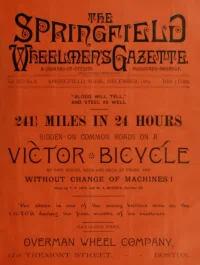
Articles in this issue
- The editors defend the precision of Springfield tournament timing against English cycling journals that dispute American records, demonstrating through statistical analysis that British record times are implausibly round and likely inaccurate.
- Detailed account of post-tournament record-breaking at Hampden Park track, covering performances by W. A. Rowe, R. Howell, F. F. Ives, W. M. Woodside, and George M. Hendee across bicycle, tricycle, and safety distances through autumn 1885.
- Editorial exposing the hypocrisy of the London Cyclist magazine, which privately acknowledged Springfield's timers and credentials while publicly questioning the accuracy of Springfield records.
- Nostalgic prose-and-verse piece by "Willhelm" on the sentiment of keeping an old 54-inch high-wheeler despite its defects, recalling rides through Kentucky, Ohio, and the Wabash.
- Dispatch signed "Waverley" from London, November 16, 1885, reporting on rainy British cycling conditions, the gradual acceptance of Springfield times by English opinion, trick-rider Dan Canary's success at London music-halls, and the formation of the North Road Cycling Club.
- Correspondence from a Philadelphia-area cyclist reporting on local racing indifference, T. A. Schaeffer's mile championship win for the Pennsylvania Bicycle Club, pleasure riding on Lancaster Pike, and the incorporation of the Pennsylvania Bicycle Club.
- Column of brief news squibs covering William A. Rowe's records, Dan Canary's English exhibitions, the Waltham Bicycle Club's formation, bicycle thefts, Karl Kron's writer's cramp, and the Springfield Bicycle Club adopting the L. A. W. uniform.
- Correspondence by "Willhelm" from Ohio reporting on the late cycling season, John Kerch of Canal Dover winning a 36-mile road race, a lawsuit involving a bicycle falling on a child in a Canton shop, and appeals for Ohio cyclists to send season records to the Gazette.
- Local notes from the Solitary Club of Stamford, Connecticut, covering fine November road conditions, J. Broinfield winning a 54-inch Expert bicycle in a raffle, and plans for a wheel exhibition with polo on Stars, club drills, and fancy riding at the rink.
- Letter from two Reading, Pennsylvania, cyclists describing a Sunday ride along the Lancaster Pike to Paoli, including encounters with riders from Wilmington, a steep hill near Berwyn, and a hospitable meal at Mrs. Shoemaker's.
- Chapter I ("A Conversation") of a serial fiction by Chris Wheeler, set at Illston Grange in Somersetshire, introducing the rector's family and a conversation about Jessie Thompson's suitability for their son Robert, who visits her daily on his bicycle.
- Brief miscellany noting the Kangaroo 100-mile road record, Percy Nix's 254-mile Facile ride in England, the Massachusetts Bicycle Club's 122-rider lantern parade, and the results of the Worcester Bicycle Club's annual road race to Boston.
- Comprehensive comparative tables of American and English amateur and professional bicycle records from the quarter-mile to 100 miles, with holders, venues, dates, and times; American records set at Springfield by Rowe, Hendee, Ives, and Woodside are shown to equal or exceed English marks.
- Parallel tables of American and English tricycle records listing Hendee, Howell, Furnivall, Cripps, and others at distances from the quarter-mile to 100 miles, comparing Springfield and Crystal Palace performances.
- Account of how Colonel Pope reluctantly built racing Columbia bicycles only three months before the Springfield tournament, resulting in Rowe, Woodside, Brown, and McGarrett setting world records; reprinted from the Springfield Republican.
- Thomas Stevens recounts a frustratingly slow meal at a German hotel in Rothenburg while on a bicycle tour, waiting over two hours for supper to appear; reprinted from Outing.
- Humorous anecdote reprinted from the American Wheelman about racer Whittaker borrowing a Rudge Safety from Phil Hammil at the Chicago October races and unexpectedly beating champion Van Sicklen, who had encouraged him to enter for the attractive second prize.
- Comic verse by Arthur Young satirising English cycling editors who refuse to accept the Springfield record times, contrasting American precision timing by electricity with English chronometer inconsistency.
- Club news covering the Massachusetts Bicycle Club's fancy-dress carnival at Mechanics' Building, the Lynn Cycle Club's complimentary dance for world champion William A. Rowe with twenty-seven prize trophies on display, the King's County Wheelmen's road race from Prospect Park to Coney Island, and the Ixion Bicycle Club's new New York clubhouse.
- Lists of newly elected officers for the Junior Wheelmen Club (Washington D.C.), Star Bicycle Club (Harrisonburg, Virginia), and Yonkers Bicycle Club.
- A poem by T. W. E. contrasting the winter silence of the cyclist's bell with the merry sound of sleigh bells, depicting couples riding together on winter evenings.
- List of United States and British patents granted in October–November 1885 for velocipede, bicycle, and tricycle innovations, compiled for the Gazette by Duffy & Brashears (Washington) and Hughes, Ell & Hughes (London), including a Marquis of Lorne bicycle patent.
- Whimsical verse by "Fifty-Three" addressed to a nickel-plated 53-inch bicycle, drawing comic parallels between the machine's parts and human attributes during an early-morning country ride.
- Report on Lynn's reception for world amateur champion William A. Rowe on his return from Springfield, featuring a torch-lit parade by the Lynn Cycle Club, addresses by Mayor Baldwin and Colonel A. A. Pope, and an exhibition of twenty-seven prize trophies; reprinted from the Daily Union.
- Reprinted from the Cycling Times, a report of the London supper honouring English cyclists returned from the Springfield and Hartford tournaments, with speeches by Hillier, Furnivall, Etherington, and Joseph Pennell defending the correctness of the Springfield times.
- Satirical piece reprinted from the American Wheelman, mocking English cycling editors Nairn and Hillier for refusing to accept Springfield times, sarcastically confessing to the "fraud" of using carefully regulated watches.
- Essay signed "President Bates" arguing that L. A. W. racing records should be confined to results of open contests against competitors, with private time-trials listed separately, warning that unchecked record attempts by solitary riders will destroy public interest in bicycle racing.
- Selection of extracts from other cycling and sporting papers commenting on the English dispute over Springfield records, the Columbia bicycle's racing successes, women as tricyclists, and the prospects for Continental bicycle touring.
- Travel narrative by Karl Kron (excerpt from his forthcoming Ten Thousand Miles on a Bicycle) describing a cycling tour from Windsor, Ontario, through the Thousand Islands and down through northern New York State to Syracuse, with detailed road-condition notes.
- Classified advertisements from readers offering bicycles, tricycles, a shotgun, a type-writer, roller skates, and other items for sale or exchange.