The Wheel: Journal of Bicycling, Vol 12, No 25
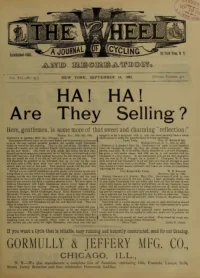
Articles in this issue
- Editor F. P. Prial comments on E. J. Shriver's political canvassing for Henry George's United Labor Party, warns cyclists against autumn chills, and endorses a proposed bowling league for New York wheelmen's winter entertainment.
- New York State Division L. A. W. Chief Consul Bidwell appeals for financial aid to cover the cost of the Road Book and Liberty Bill campaign, listing subscribers including the New York Bicycle Club ($100) and individual members such as H. P. Porter and Thomas A. Raisbeck.
- Reports on the Kings County Wheelmen's upcoming lantern parade on September 29 along Bedford Avenue, Brooklyn, and notes that T. J. Hall Jr. rode over 2,100 miles from May 1 to September 1, earning the club's first 2,000-mile record medal.
- Correspondent L. B. G. describes the cycling exhibits at the Minneapolis Exposition Building, including Heath & Kimball's display of Champions and Columbias, and discusses the proposed consolidation of the Minneapolis Club with the Mercury Club.
- Chief Consul Heath of Minnesota announces the fifth annual division meet on September 15, with an illuminated lantern parade and road races at Lake Harriet open to amateurs from Minnesota and Dakota.
- Reports on visiting wheelmen J. Jacobsen (Detroit Bicycle Club), R. E. C. Wheeler, and C. Wagner (both Williamsport Bicycle Club) who were shown the city by Louis Rubenstein and rode around Mountain Park, Little Mountain, and out to Lachine.
- E. P. Baird wins the final race of the Montreal road race series from the M. A. A. A. gymnasium to Valois (15½ miles) in 1:02:00, lowering the previous record by 2½ minutes; J. H. Robertson was forced out by a mechanical failure while riding neck-and-neck with Baird.
- Previews the upcoming New Orleans race meet with approximately 55 starters in eleven events, highlighting the Louisiana State Championship contested by Alford, Guillotte, Guedry, Hill, Hughes and Rea; C. T. Mitchell of the Louisiana Cycling Club withdraws following the death of his mother.
- Reports on the Hartford Wheel Club's race meet at Charter Oak Park on September 7, attended by an estimated 7,000 spectators; W. A. Rowe won both professional events and W. E. Crist took the one-mile amateur scratch and five-mile amateur lap race.
- Summary of wheel contests held September 9–10 at the Crawfordsville fair, where Ed. Hulman won the half-mile open (1:35), two-mile lap race (7:12), one-mile open (3:35), and the two-mile handicap, while Josh Zimmerman took the consolation mile in 3:25.
- Advance notice of the fifth annual race meet of the Binghamton Bicycle Club at Riverside Park on September 22, featuring nine events including the two-mile New York State Championship and an evening entertainment at the Binghamton Opera House.
- French professional Jules Dubois rode 21 miles 498 yards in the hour at Coventry on August 24, breaking all English professional records from three to twenty-five miles; Dubois also rode two miles in 5:25 on August 25, and Allard and Oxborrow set a new tandem tricycle mile record of 2:37 2-5.
- A. Kennedy-Child writes to defend W. A. Rowe's conservative pace at Lynn, arguing that Rowe rode to win against Columbia teammates rather than to break records, and that rival manufacturers should offer better prize incentives to push Rowe to faster times.
- A cable dispatch from London describes trials at Hanwell of a military bicycle by Wilkins & Co. of Holborn Viaduct that can be ridden across ploughed fields and swampy meadows, with inflatable bags at the handles allowing it to be floated and towed across rivers.
- A miscellany of short cycling items covering W. A. Rowe's delayed voyage to England, George W. Nellis's cross-continent arrival in New York, the Pope Mfg. Co.'s likely Rover-type safety for 1888, the Queens L. I. track mile record of 3:19½ by G. E. Todd, a Kingston road team race won by the Toronto Wanderers, and the South End Wheelmen of Philadelphia moving premises.
- A detailed history and architectural description of the New York Bicycle Club's new Riverside Drive building designed by Joseph H. Taft, recounting the club's founding in December 1879, its spring 1887 merger with the Ixion Bicycle Club, and plans for a wheel room capable of accommodating 150 bicycles.
- Karl Kron responds to a scathing review of his book 'Ten Thousand Miles on a Bicycle' in the London Bicycling News—which compared him to the recently executed murderer Lipski—quoting its personal abuse alongside favorable notices from the Boston Advertiser, Hartford Courant, and The Critic, which called the book 'remarkable,' 'unique,' and 'emphatically one for the times.'
- A short verse by William D. Kempton bemoaning loose gravel, thick dust, and dry weather, and pleading with Jupiter Pluvius for rain to ease the rider's misery.
- Calendar of upcoming cycling events from September 13 through October 16, including the Tennessee Division Meet at Memphis, the N. A. A. A. A. Championship Race (September 17), the Rhode Island Division at Narragansett Park, and the Boston-Chicago Road Race (October 6).
- J. A. Lewis, Secretary-Treasurer of the Missouri Division, recounts hiring a locally-made bicycle at Interlaken, Switzerland, and coasting approximately twelve miles down a mountain road cut from solid rock to beat a horse-drawn carriage back to the valley hotel by ten minutes.
- A. B. Barkman, W. E. Fuller, F. M. Demarest and C. F. Ackerson of the Brooklyn Bicycle Club ride from the Delaware Water Gap up the valley of the Delaware to Port Jervis and Middletown, planning to return via Poughkeepsie, Fishkill, Newburg, Greenwood Lake, Morristown and Orange.
- L. A. W. member No. 2,449 describes a superior cycling route from New York to Newark and the Oranges via the Weehawken ferry, Bulls Head Road, Carlstadt and Rutherford, emphasizing newly macadamized sections and avoiding the notorious Hackensack sand.
- F. L. Bingham of the Harlem Wheelmen proposes a winter Bowling League for New York and New Jersey bicycle clubs, modelled on the road-racing association, inviting clubs within twenty miles of New York City Hall to send delegates to an organising meeting on September 30.
- Reprints a description from The Cyclist of August 31 of the 'Coventry Gentleman,' a bicycle design first built in 1875 featuring a 26-inch rear wheel, bow spring and hind-wheel brake, proposed by an 'old-timer' as a vibration-free and truly safe alternative to contemporary safety bicycles.