The Wheel: Journal of Bicycling, Vol 13, No 12
Articles in this issue
- Editorial announces forthcoming road reform legislation in New York, advising secrecy until passage; argues that a roads improvement association should be led by horsemen rather than wheelmen to win broader public and legislative support, citing England's R.I. Association as a model.
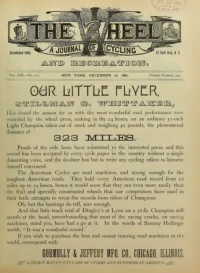
- Detailed account from Minneapolis of Frank E. Dingley's world-record 24-hour ride of 350½ miles on a new 53-inch Champion light roadster at the Washington Rink on December 9–10, 1887, with A.A. McCurdy, W.F. Knapp, S.G. Whittaker, and T.W. Eck as pacemakers; Eck also set a 50-mile American record on the new Champion safety during the attempt.
- Correspondent "Bl." reports on deliberations over a Mardi Gras lantern parade (a previous effort cost Chief Consul Hodgson $40 out-of-pocket), the Louisiana Cycling Club's November mileage of 1,011 miles led by C.M. Fairchild's 422, and the demise of the Bicycle South cycling journal after nearly four years.
- Correspondent "Claw Hammer" covers the Owl Cycling Club's December meeting and its vote on changing the club's name, the new Lincoln Cycling Club's rapid growth to 102 members in three months, and the McCurdy–Whittaker five-mile race match for $5,000 a side planned for the Washington Rink in January.
- "Keystone" reports growing cycling interest in Pittsburgh and surrounding towns, noting W.D. Banker's plan to open a riding school in McKeesport (population 18,000) and the Sewickley Valley Wheelman holding the first of a series of smokers on December 17th at their club-house.
- Correspondent "Art." discusses the commercial logic of New Year's Day hotel prizes for early-arriving cyclists, debates handlebar length and racing posture versus comfort riding, and advocates year-round winter cycling on frozen macadam roads as the healthiest cold-weather exercise.
- Reprinted from the Jacksonville, Fla., Times-Union (November 24), reporting the formal organization of the Jacksonville cycling club with fifteen active members, officers elected including president J.H. Crosby, secretary-treasurer W.N. Benedict, and captain L.A. Wilson.
- Race results from the Pacific Coast Amateur Athletic Association and Ariel Bicycle Club championship meeting at Oakland on Thanksgiving Day; W.G. Davis of the San Francisco Bicycle Club won multiple events including the half-mile L.A.W. State Championship and the one-mile open.
- Miscellaneous department noting the first bicycle crossing of the Alps (Simplon Pass, June 1884, by J.T. Soanes and A.E. Thorburn), Singer & Co.'s new 24-inch rear-driving safety for youngsters, H.B. Smith Machine Co. experimenting with a Rover-type safety driven by Star mechanism, Hudson County Wheelmen voting 1,000-mile medals, and Pope Mfg. Co. preparing its 1888 catalogue featuring a new safety and tricycle.
- Notes on the December meeting at which club members presented two bronze "warrior" statues to the Board of Trustees in appreciation of their work planning and building the new club-house; annual elections scheduled for January 6, with Messrs. Mabie and Bradford competing for the presidency.
- Brief notice of the Citizens Club's December 19 meeting, with two candidates for election—J.W. Love (proposed by Elliott Mason) and W.H.P. Veysey (proposed by W.B. Krug)—three new members elected, and a New Year's Eve stag gathering planned.
- L.D. Aylett, Treasurer of the Georgia Pacific Railroad and President of the New South Wheel Club of Birmingham, Ala., sends Karl Kron a review calling Ten Thousand Miles on a Bicycle valuable as a reference, while criticising excessive ego and the chapters "Curl" and "Castle Solitude" as unrelated to cycling.
- A San Francisco L.A.W. member (No. 15,219) who covered 1,500 miles in his first cycling season praises Ten Thousand Miles on a Bicycle for its bulk, cross-referencing, and the opening chapter "On the Wheel," while wishing for maps, illustrations, and larger type, and pledging to buy Kron's next book.
- Fourth instalment of the series describes the Tourist's Pocket Camera (1½ lbs., folds to 5¾ × 4½ × 2 inches), explains diaphragm stops and depth of field, and reviews leading lens brands—Beck, Darlot, Ross, and Morrison—ranging from $25 to $200, strongly recommending one of the first-named.
- London correspondent of the Philadelphia Record describes bicycles and tricycles becoming practical working-class vehicles for commuting and delivery in London, where bus fares (ten cents per ride) are unaffordable for mechanics earning sixteen cents an hour, and notes a military experiment with "The Scout" bicycle as a vedette.
- Historical survey of road-building from Roman military highways and Incan mountain roads through English Parliamentary road acts of 1523, arguing with Macaulay and Bushnell that improvements in locomotion are among the greatest contributions to civilization and that good roads increase the value of rural homesteads.
- Thirty-two numbered practical rules for roadmen by "Ais Initio," covering stone sizing (two-inch ring-gauge maximum), patching with chips, drainage maintenance, sweeping, and keeping road surfaces clear of projections, issued freely by the Roads Improvement Association, 57 Basinghall Street, London.
- Reports the R.I.A.'s ongoing work distributing roadmen's instruction pamphlets through surveyors and waywardens, its planned exhibit of properly broken stone samples and photographs of defective finger-posts at the forthcoming Stanley Show, and an appeal for donations to sustain the entirely honorary operation.
- C.T.C. Gazette correspondent reviews three lamp-mounting positions on safety bicycles and recommends the new Lucas & Son improved "King of the Road" lamp for Rover-pattern safeties—fitted with rubber hinges and a spiral spring to prevent jolting out—while also praising horse-skin shoes for durability; an appended note advises Myddleton's spirit enamel for re-finishing machines.