The Wheelmen's Gazette, Vol 1, No 12
Articles in this issue
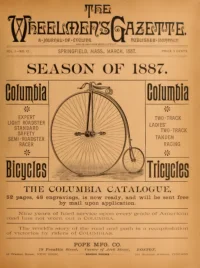
- Pope Manufacturing Co. announces their 1887 catalogue covering Expert, Light Roadster, Standard, Safety, Two-Track, and Tandem models, noting nine years of road durability without a worn-out machine.
- The Springfield Bicycle Mfg. Co. promotes the improved gear-level clutch system, claiming it to be perfectly smooth and noiseless with no friction added when power is applied.
- Rev. Homer A. King's lever-driven safety bicycle for 1887 is described with adjustments for rider height and a silent coasting clutch, backed by testimonials from riders Charles Quimby, Rev. O. P. Gifford and Chas. E. Kluge of the Hamilton Park Bicycle School.
- Detailed pricing is given for the King Light Roadster in various finishes, with parallel bearing models starting at $75 and anti-friction bearing versions from $95, plus a 10% clergy discount.
- Albert J. King of 51 Barclay Street, New York advertises the merged monthly cycling and religious publication, offering running records and cycling news alongside evangelistic and temperance content for fifteen cents a year.
- William Read & Sons of Boston promote the New Mail, built by the Ames Manufacturing Company of Chicopee, Mass., featuring Warwick's perfection backbone and forks with greater metal thickness at stress points.
- An editorial opening the 1887 season urges every wheelman to bring at least one new recruit into the ranks of American cyclers, arguing individual effort matters as much as collective League action.
- An editorial argues that as L.A.W. state divisions have grown as large as the whole League was a few years earlier, governing power should shift from the centralized national executive to the divisions themselves.
- The editorial contrasts Chief Consul Hayes's administration with predecessor Henry E. Ducker's, citing figures showing Massachusetts L.A.W. membership fell from 1,440 to 1,025 between January and March 1887 under Hayes.
- Reports a $4,650 shortfall in League treasurer's accounts allegedly omitted from the published Bulletin report of the May 1886 Boston meeting, implicating secretary John Wells and reprinting the suppressed accounting table.
- An editorial subtitled "The Amateur Definition Must Go, Let America Lead" argues cycling should scrap its amateur/professional distinction as horse racing, cricket and baseball have, since the public only cares about close racing.
- Investigates rumors of a $2-per-uniform commission on the L.A.W.'s Browning, King & Co. uniform contract, reprinting the board's Resolutions of Inquiry, editor Henry E. Ducker's exchange with League President N. Malon Beckwith, and Beckwith's refusal to sign an exculpatory statement.
- Profiles W. W. Sheen of Quincy, Mass., a 20-year-old lumber surveyor who rode a Star bicycle 7,451 miles between May 1 and December 5, 1886, missing only two riding days, and reprints his day-by-day cyclometer log.
- A "Castanet Cyclics" short story signed "Stamson" follows wheelmen on the Telford Pike pursuing "Daisie Pelham, the Queen o' the Pike," ending a year later with club member Jo Dodson married to the belle's tandem-riding escort.
- Reprints English cyclist G. Lacy Hillier's defense of the amateur definition against J. R. Hogg's National Cyclists' Union abolition motion, paired with W. McCandlish's rebuttal citing suspended amateur champion J. E. Fenlon as proof of the rule's unfairness.
- A poem prompted by a Columbia calendar item about a 72-year-old Florida, N.Y. man ordering a new bicycle, contrasting an aging farmer, miller, doctor, minister and lawyer with the "jolly ancient wheelman" still riding at seventy.
- The Gazette's English letter, signed "Faed" from Biggleswade, reports home-trainer racing at the North Road Club (Backhurst of Eastbourne beating Stokes of Hastings's mile record), the close of the Stanley Show, and a planned ladies' tandem tour to Killarney.
- Reprints Fred Wood's letter from Sydney, Australia challenging newly professional riders W. A. Rowe and G. M. Hendee to a $1,000-a-side race of one to twenty miles, or a sweepstakes including Howell.
- Profiles the Ilderan Bicycle Club of Brooklyn, organized in September 1884 by J. B. Cruikshank, H. Greenman and others, describing its Flatbush Avenue clubhouse wheel room and card room and listing its 1887 officers under President Howard Greenman.
- Philadelphia correspondent "Chris" reports a hard winter curtailing local riding, the New York uniform-commission row hurting L.A.W. renewals, and the Pennsylvania Bicycle Club's stalled club-house and dues debate.
- A narrative poem, signed "G. W. N., Jr." of Herkimer, about four wheelmen — Ned, Brick, Tom and the narrator "Guy" — racing a runaway locomotive, with Ned leaping aboard to apply the brakes before it collides with the mail train.
- Reprints touring mileage narratives from Karl Kron's forthcoming road book: Scotsman Hugh Callan's $250 Tit-Bits-prize European tour, Irishman William Bowles's decade of diary-kept mileage from Castlemartyr, and New Zealander William H. Langdown's 1885 tour across the North Island.
- Signed "Erkie," a touring story about three cyclists — the narrator, Frank Gunning and John McGrady — lodging with a backwoods farmer before a broken crank and lost brake send the narrator careening down a mountain in what turns out to be a nightmare.
- A miscellany column of short cycling-world items, including League renewal statistics, Thomas Stevens joining Outing's editorial staff, Ed Bullock's record 100-mile win over Tom Eck at Omaha, and Gormully & Jeffery's purchase of the Lillibridge saddle patents.
- Reprints and rebuts an English correspondent's warning, via The Cyclist, that foreign manufacturers touring the Stanley Show and Coventry factories would copy English methods, retorting that Pope Manufacturing and the Ames Works fear no comparison.
- A short item subtitled "Solid Truth from the Hub," quoting Bicycling World on whether the American Cyclists' Union has the vigor to fill the void left by the League's "retrogressive" handling of race governance.
- Signed "Stamson," a personal touring column describing off-season riding near Boston, praising spade handlebars for hill-climbing and mud, and planning summer sketching outings with "Artist Roorback" of Elizabeth, N.J.
- Reports the New Orleans Bicycle Club leasing a new three-story clubhouse on St. Joseph Street, R. G. Betts of the Crescent Wheelmen having ridden over 1,700 miles since June 1886, and an upcoming lantern parade for "his Majesty Rex."
- Signed "Cycle," reports the Ariel Wheel Club of Reading joining the city's Board of Trade for club rooms, gives touring-route directions from Reading to New York, and replies to "Stamson's" earlier article on the League uniform question.
- Profiles the Boston Rudge agency's history since 1878, its 80-by-40-foot Congress Street salesroom stocking Rudge Light Roadsters, Roadsters and Bicyclettes, and staff riders H. M. Saben and W. S. Doane under manager Mr. Corey.
- A correspondence letter from Thomas Boyd, captain of the North Canterbury Bicycle Club, describes the club's home-built quarter-mile track at Rangiora and member Barlow's race times on a 56-inch Rudge roadster.
- Reports the club's anniversary banquet at Parker's Hotel in Boston, with toasts and speeches from E. C. Hodges, A. Kennedy-Child of London's Ripley Road Bicycle Club, C. P. Donahoe, and George B. Child.
- Lists newly elected 1887 officers for roughly two dozen clubs, including the American Cyclists' Union (President H. E. Ducker), the Massachusetts Bicycle Club (President Charles Richards Dodge), and the Rambler Cycle Club of Baltimore.
- Signed "H. D. P." and subtitled "Ridden, Written, and Illustrated by a Pure Amateur," a humorous first-person account of a solo August 1886 tour from New Gloucester through sandy Maine roads, including a "great North American header" and a collision with a farmer's steers.
- An unsigned survey of the coming season's cycle types, from the ordinary and the Star to Rover-type safeties, the geared Facile, and the new Columbia and Victor Clipper tricycles.
- By A. Kennedy-Child, explains why Pope Manufacturing, Stoddard Lovering, Overman Wheel, W. B. Everett, Read & Sons and the Coventry Machinist Company organized a board of trade to stop dealers quoting two different prices for the same machine.
- A synopsis of a chapter in Karl Kron's forthcoming road book tabulating mileage records from more than fifty British and Australasian riders, including Hugh Callan, William Bowles, H. Etherington and G. P. Mills's cross-country ride.
- Samuel T. Clark & Co., importers and sole agents, advertise their 60-page catalogue of 12 patterns, including Light Roadsters and Rover-pattern safeties with True Tangent wheels, plus single and tandem tricycles with Quadrant steering.