The Wheelmen's Gazette, Vol 1, No 2
Articles in this issue
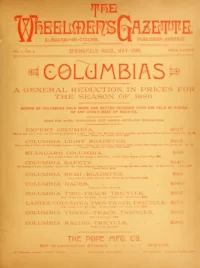
- Pope Manufacturing Co. presents the full Columbia range including the Expert, Light Roadster, Standard, Safety, and racing tricycles, citing eight years of proven road performance.
- Freeman Lillibridge advertises his adjustable saddle as the only one on the market offering multiple adjustment points in length, width, height, and rear position, with a bifurcated seat design.
- George W. Rouse and Son offer Columbia, Champion, and other cycle brands on instalment plans with little extra charge beyond interest, alongside repair and nickel-plating services.
- The American Sportsman weekly sports journal announces a combined subscription offer with the Wheelmen's Gazette, targeting cyclists interested in hunting, fishing, and outdoor sports.
- The Royal Mail bicycle company publicly announces that it employs no paid racing riders and never will, distinguishing itself from manufacturers who use salaried cyclists to promote their wheels.
- Advance notices promote an upcoming reference book featuring biographical sketches of over two hundred leading wheelmen, complete record tables, club directories, and forty-nine lithograph portraits.
- A Dayton, Ohio dealer advertises an extensive stock of second-hand bicycles and tricycles at clearance prices, offering trade-ins and repair services.
- A new patent bicycle lock is advertised that can be applied instantly and locks automatically, claimed to be neater and more compact than any other lock on the market.
- Editor Henry E. Ducker rebuts Racing Board chairman Abbot Bassett's expulsion of Springfield Bicycle Club members Geo. M. Hendee and F. W. Westervelt for professionalism, reprinting the club's protest letter to League president Dr. N. M. Beckwith and Bassett's own circulars demanding riders prove their innocence. Ducker argues the Board acted without consulting its own members and outside the League constitution's rules on amateur status.
- An editorial accuses English cycling editors of hypocrisy for condemning the Springfield Bicycle Club's offer to help arrange an international one-mile championship, while some of the same 'pure amateur' advocates have secretly asked Springfield to pay their travel expenses.
- Reports that England's National Cyclists' Union, per secretary Robert Todd, has rescinded its blanket suspension of 'makers' amateurs' and will instead investigate each suspected rider's case individually before barring him from N.C.U. contests.
- London correspondent 'Faed' contrasts the L.A.W.'s decisive suspension of makers' amateurs with the N.C.U.'s timid handling of riders such as Furnivall, Webber, and R. H. English, and previews the Surrey Bicycle Club's spring meeting and the new Ripley Road Club's quarrel with the North Road Club.
- A Philadelphia correspondent reports on the Philadelphia Bicycle Club's planned $20,000 clubhouse near Fairmount Park, the Germantown Cycling Club's musical winter socials under Dr. Kner, and the newly formed Association for the Advancement of Cycling led by Chief Consul Eugene M. Aaron.
- An advertorial describes the low-priced American Rudge roadster sold by Stoddard, Lovering & Co., detailing its crescent steel rims, gun-metal hubs, and Rudge 'Unequaled' ball bearings as a first-class machine within reach of riders who cannot afford costlier wheels.
- Describes the Pope Manufacturing Company's lightened version of its Two-Track Tricycle built for ladies and lighter men, highlighting its new ball-and-socket steering mechanism, the improved Kwart chain, and the Wallace patent sprocket-wheel.
- Announces the L.A.W. National Championship bicycle and tricycle races to be held at Boston's Union Grounds on Dartmouth Street on May 29, 1886, with entries made to Racing Board chairman Abbot Bassett at the Cycle office.
- Prints the full programme for the Woodstock Amateur Athletic Association's two-day meet at Woodstock, Ontario, on May 24-25, 1886, listing amateur and professional bicycle races, foot races, and jumps under C.W.A. and C.A.A.A. rules.
- A wheelman called 'Ajax' recounts a night ride near Nashville, Tennessee, with companions 'Gip' and 'Sandy' in which he crashed his wheel through a closed toll-gate at speed and slid down a hill seated on the road before the three reached a country-hotel dance at Cayce's Springs.
- A touring story about Harry Miller's courtship of Carrie Van Houten, whose father Colonel Van Houten had forbidden him her company after a college billiard-room prank; a chance seaside meeting at the Ocean House and Monmouth hotels leads the Colonel to reconsider his ban.
- An essay contrasts English inventor James Starley, honored by a Coventry monument, with Pope Manufacturing Company's Colonel Albert A. Pope, arguing that Starley's mechanical genius and Pope's commercial promotion were equally necessary to establish the bicycle industry.
- Announces a two-day international tournament at Alexandra Park Athletic Grounds, London, on May 21-22, 1886, including a five-mile scratch bicycle race for the International Challenge Shield, with prospectuses available from Henry E. Ducker of Springfield.
- Chicago correspondent 'Growler' previews the Prince-Schock long-distance match at Minneapolis, reports the John Wilkinson Company's move to State Street with exclusive rights to the American Champion, and describes plans for a six-day race organized by Sam Miles of the Sporting Journal.
- A Brooklyn correspondent, 'J. W. S.,' reports on repairs to Bedford Avenue, racer Farr's switch from the Expert to a Royal Mail, the new Independent Wheelmen club, and the Kings County Wheelmen's team challenge from the Elizabeth Wheelmen, featuring racers A. B. Rich and Captain Pettus.
- The American Bicyclists' and Tourists' Association, managed by dancing instructor P. Harvard Reilly, announces a ten-week cycling tour of Ireland, Scotland, England, and France departing New York on the steamer City of Berlin on July 3, 1886, with stops including Blarney Castle, Edinburgh, and Paris.
- In an open letter dated May 5, 1886, Karl Kron argues against rotating the L.A.W. presidency by geography and urges the League to keep a capable president such as the outgoing Dr. N. M. Beckwith in office indefinitely rather than replacing him for sectional reasons.
- A poem by 'T. W. E.' dedicated to Col. Albert A. Pope of the Pope Manufacturing Company, celebrating the Columbia bicycle and its maker as emblems of American enterprise.
- A reprinted note from Spirit of the Times wryly observes that the L.A.W. Racing Board, having suspended most prominent amateur riders on what it called conclusive evidence, let C. O. Danforth of Cambridge clear himself with ease.
- A column of short items reports Elsa Von Blumen's win in a fifty-one-hour race at St. Catharines, Ontario; Tom Barber and Eugene Crist's new tandem road record from Washington to Cabin John's Bridge; and the Massachusetts Bicycle Club's $200 contribution to the League's meet fund.
- A Connecticut correspondent, 'Stamson,' reports that Schuyler Merritt of the Yale & Towne Manufacturing Company now commutes on a Facile tricycle, and argues that macadamizing roads would benefit cycling more than pouring money into race tracks.
- Reader letters cover a Reading, Pennsylvania cycling club's spring runs; Woodstock, Ontario correspondent 'Sandy' previewing the Canadian Wheelmen's Association meet and racers W. G. Ross and Herbert W. Clarke; and Omaha's Benj. F. Fell announcing the newly formed Nebraska division of the L.A.W.