The Wheelmen's Gazette, Vol 2, No 1
Articles in this issue
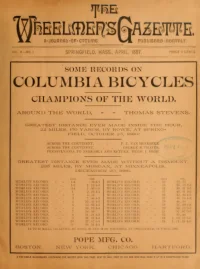
- Pope Manufacturing Co. opens the new volume by presenting a comprehensive table of world cycling records held by Columbia riders, including Thomas Stevens' round-the-world journey, Rowe's 22-mile hour record, and Morgan's 235-mile non-stop ride.
- Pope Manufacturing Co. offers a free facsimile blackboard reprint of their world records page to any cyclist who will display it prominently, as a promotional exercise.
- The Springfield Bicycle Mfg. Co. continues its promotion of the Roadster's clutch mechanism, illustrating the roller bearings and gripping system that prevent headers and allow smooth coasting.
- The King Wheel Company publishes updated prices for the 1887 King Bicycle, offering both solid crescent rim parallel-bearing models from $75 and hollow-rim anti-friction bearing models from $95.
- William Read and Sons promote the New Mail bicycle with the Trigwell Ball-Bearing Head, describing how its cones move without friction so that one oiling and one adjustment serves for months of riding.
- An engineering explanation of the New Mail's strengthened backbone, which is thicker at the neck end to resist the stress point where most frames break, with similarly tapered forks.
- A reprint from the L.A.W. Bulletin describes how the ball-bearing head was initially ridiculed by established manufacturers but has become recognised in 1887 as a necessity for any first-grade bicycle.
- W. B. Everett & Co. of Boston advertise the Apollo Light Roadster, Challenge Roadster, and Apollo Safety alongside the S.S.S. tricycles and tandem, describing the ball-head Apollo as the highest-grade wheel made and the Challenge as the best machine for the money.
- The Baltimore importing house advertises its sixty-page illustrated catalogue of Full Roadsters, Light Roadsters, and Rover-pattern Safeties with True Tangent wheels, plus Quadrant single and tandem tricycles with quadrant steering.
- W. G. Wilcox of New York details six 1887 Facile patterns — the regular Facile, a light roadster, the plain Standard Facile, a chainless Geared Facile with 250 balls in 21 rows, a rear-driver, and a 40-pound ladies' tricycle — all fitted with the new Abingdon ball-bearing head.
- The Dayton, Ohio dealer advertises the largest stock of second-hand bicycles in America, offering an illustrated price list, exchanges, and cash purchases of used machines.
- The Gazette's opening editorial welcomes the 1887 riding season with a florid tribute to spring cycling, predicting that touring, racing, and new records will soon end the winter's fractious League squabbling.
- An editorial mocks the L.A.W.'s amateur rule as a farce, citing a Springfield tournament in which only two of sixty-three entered 'amateurs' owned their own wheels, and rebuts a Wheelmen's Record item alleging favoritism between Massachusetts Division officials Ducker and Hayes.
- The editors print three corrections to the previous issue: a misidentified 1886 Royal Mail cut used for the New Mail ad, a mistaken charge that League officers suppressed a treasurer's report, and an overstated claim that the Springfield Roadster was untried before 1887.
- James M'Intosh, who has lost both legs, is reported to have ridden a lever tricycle 517 miles from Dundee to London in twenty days, working the machine entirely by hand and being robbed of his savings en route.
- English champion Richard Howell challenges American racer W. M. Woodside to a match of one to twenty miles for up to $2,500 a side, and team manager W. J. Morgan's published reply, printed from the Sporting Life, declines to be rushed into the contest.
- An essay traces how home-built American bicycles overtook imported English machines in popularity and predicts an English manufacturer will soon abandon its U.S. agency, followed by press notices praising the Gazette's March number.
- Dr. Geo. H. Blackham's address to the Rochester Academy of Science traces the bicycle's history from Baron von Drais's 1816 Draisine through Pierre Lallement and Pope Manufacturing's Columbia, and argues that cycling's health, business, and social benefits make it a genuine civilizing force.
- Reprinted from the Wheelmen's Record, this editorial urges the L.A.W. to adopt formal rules for track time trials, road racing, hill-climbing, coasting contests, and home-trainer races instead of leaving them unrecognized.
- A humorous verse reprinted from Cycling World has a maiden list every possible excuse for not cycling before revealing the real reason: propriety forbids her to straddle a wheel.
- The Overman Wheel Company of Boston advertises its Victor Tricycle, built with tangent spokes, forged steel hubs, and compressed tires, and the new Victor Safety bicycle, claimed to be the first safety with every high-grade feature of the best bicycles.
- London correspondent 'Faed' reprints Arthur J. Wilson's full arbitration report clearing the Springfield Bicycle Club of falsehood over its 1886 English-rider announcements, and surveys N.C.U. politics, C.T.C. badge disputes, and prospects for American racers Woodside, Morgan, and Temple in Ireland.
- Lists the chairmen of the committees organizing the L.A.W.'s May 20–21 annual meet at St. Louis, including manager J. S. Rogers, and names the Lindell Hotel as headquarters at $2.50 a day.
- Correspondent 'J. W. S.' reports on new club uniforms for the Long Island Wheelmen and Ilderan Bicycle Club, a newly formed Calumet Cycling Club, growing demand for Star bicycles among Brooklyn riders, and a header taken by Ilderan member J. F. Borland.
- Chris Wheeler begins a history of Philadelphia cycling clubs with the May 1879 founding of the Philadelphia Bicycle Club by eight charter members including T. K. Longstreth, tracing its early meeting places and its role opening city parks to wheelmen.
- A column of short items reports Col. Albert A. Pope's newborn son, Gormully & Jeffery's patent-infringement suit against Pope Manufacturing over the Smith ball-bearing and Lillibridge saddle patents, and gossip on the New Mail's strong sales and the Overman Company's new tandem saddle.
- A full-page advertisement lists the Marlboro' Tricycle's 1886 racing victories across England, including the N.C.U. five-mile tricycle championship won by F. W. Allard and the fastest tricycle mile ever ridden in a race, 2 min. 45 3/5 sec. at Coventry.
- Correspondent 'Stamson' describes a late spring, a proposed six-week cycling tour of England and the Continent, the Solitary Club's winter riding record, and grumbles about leaky oil cans and L.A.W. political squabbling.
- Correspondent 'Elyp' reports Wilmington's forty-one-member cycling club moving into new headquarters, Victor K. Pyle taking the Springfield Roadster agency, and continuing complaints about the city's rough 'Nigger Head' rubble streets.
- Edward J. Shriver's open letter accuses the L.A.W. board of officers of ignoring a members' resolution instructing that the president and vice-president be elected by the full membership rather than the board itself.
- Karl Kron itemizes the printing costs and pricing of his forthcoming 800-page book Ten Thousand Miles on a Bicycle, setting the price at $2 and estimating a modest profit despite the volume's 657,400 words and four years of work.
- D. Rogers & Co. of Newark, sole importers of the Cunard Convertible Tandem, print a testimonial from T. J. Kirkpatrick of Springfield, Ohio calling it the best tandem yet produced for its compactness, folding handle-bar, and ease of conversion to a single machine.
- A directory of newly elected officers for dozens of clubs nationwide, from the Albany (N.Y.) Wheelmen to the Wilmington (Del.) Bicycle Club, alongside notes on the Brookline Club's April run schedule and the Keystone Bicycle Club's mileage-based medal contests.
- O. E. Duffy's monthly compilation of U.S. patents of interest to wheelmen granted through March 15, 1887, including Homer A. King's velocipede patent assigned to the King Wheel Company and a Pope Manufacturing-assigned patent from J. S. Copeland.
- Hughes, Eli & Hughes of London compile new English cycle patents for the Gazette, including W. Starley's detachable handle-bar for bicycles and G. Singer and J. Dring's velocipede improvements.
- Karl Kron dissects the Cyclists' Touring Club's finances and governance from its 1886 annual report, arguing the London-based club is effectively run by an autocratic Secretary-Editor and urging American members to withhold renewal fees over a forgery scandal.
- A comic monologue has a hobo recount how a cast-off L.A.W. racing uniform, given to him in gratitude for not stealing a young cyclist's bicycle, got him mistaken for a criminal and then threatened with a demand that he join the League or stop wearing it.
- The N.C.U. of England, on motions by Cyclist editor Henry Sturmey, adopts resolutions easing professionals' club membership and drawing up parallel rules for professional racing.
- Reprinted from the Boston Herald, this account credits Col. Albert A. Pope's financial backing for enabling Thomas Stevens to ride a Standard Columbia around the world after purchasing it in San Francisco, and notes Pope's continuing control of Outing magazine.
- Reprinted from the American Wheelman, this editorial blames L.A.W. officials' restrictive amateur legislation for ruining 1886's racing tournaments and driving English amateurs away from American meets, and urges the League to focus on good-roads advocacy instead.
- Reports results from a Sydney, N.S.W. test-race series won largely by Fred Wood, a $500-a-side match between R. James and Australian champion Rolfe, and the Los Angeles Wheelmen's second annual meet featuring winners J. P. Percival and R. C. Woodworth.
- A comparative table of grass-track and cinder-path racing times sets Australian, English, and American record times side by side across distances from a quarter-mile to ten miles.
- A calendar lists upcoming meets including the Springfield Bicycle Club's May 6 annual supper, the L.A.W.'s May 20–21 annual meeting at St. Louis, and division meetings in New Hampshire and Pennsylvania.
- A technical article explains how the Facile's chainless sun-and-planet gearing, invented by James Watt a century earlier, drives the front wheel one-and-a-half revolutions per crank turn, and compares it with the rival Kangaroo and Rover geared-bicycle types.
- Classified notices offer a second-hand Victor Tricycle, a 51-inch Columbia Light Roadster with lamp, a 48-inch American Star, and a Special Pony Star with bicycle rifle, alongside a Rudge Agency price list and Crosby's Vitalized Phosphites nerve tonic.
- H. B. Smith Machine Co. promotes the Star bicycle as the only machine combining safety, speed, and hill-climbing in the highest degree, citing a world road record of 305 miles in 24 hours.
- An advertisement for the Gazette's own reference book promises biographical sketches of over two hundred leading wheelmen, complete English and American record tables, a club directory, and forty-nine lithographed portraits of racers including Rowe, Stevens, and Hendee, for fifty cents.
- The Chicago manufacturer lists prices and features for its full 1887 range — the American Champion, Eight Champion, Challenge, Safety, Light Safety, and Ideal bicycles plus Ideal and Challenge tricycles and tandems — from the $25 boys' Ideal to the $135 Challenge tandem.