The Wheelmen's Gazette, Vol 2, No 2
Articles in this issue
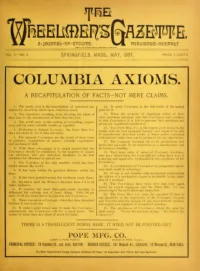
- Pope Manufacturing Co. publishes twenty-three numbered axioms arguing for Columbia's superiority, citing ten years of American road experience, world records from a quarter-mile to 24 miles, and the claim that no Columbia has ever been discarded from wear; the page closes with an offer of the company's free 52-page, 48-engraving catalogue.
- The Springfield Bicycle Mfg. Co. reiterates the mechanical advantages of the Roadster's patented clutch system, including noiseless operation, no dead centres, and smooth hill descent.
- The King Wheel Company promotes their lever-driven bicycle as the safest machine and best hill-climber available, with parallel bearing models starting at $80 and anti-friction models from $95.
- H. B. Smith Machine Co. promotes the Star bicycle's world road record of 305 miles in 24 hours and announces the new 1887 catalogue, emphasising the machine's combined qualities of safety, speed, and hill-climbing.
- William Read and Sons again promote the New Mail bicycle's ball-bearing head, Warwick's perfection backbone and forks, and seamless hollow rim, inviting cyclists to see the machine before purchasing.
- An unnamed agency advertises the Apollo range including the high-grade Light Roadster at $135, a Challenger Roadster at $105, and the Apollo Safety at $140, alongside S.S.S. Tricycles and Tandem.
- The Baltimore importing house Sam'l T. Clark & Co. advertises a 60-page illustrated catalogue of Full Roadsters, Light Roadsters, and Rover-pattern Safeties built with true tangent wheels and Quadrant-steering tandems and tricycles; a companion clearance notice on the facing page offers formerly $125-$165 machines at a sacrifice to make room for new stock.
- W. G. Wilcox of New York advertises six Facile patterns for 1887 — the Regular Pattern, a Very Light Roadster with the new Abingdon ball head, the Standard Facile, the chainless New Geared Facile front-driver, a Rear-Driver Facile, and the Facile Tricycle — priced from $88 to $150.
- The Gazette reprints Lieutenant-Colonel Savile's corps order commending the Cyclist Corps' performance at the Easter maneuvers in Kent, England, and Major G. W. Wallace Carpenter's notice recruiting a new volunteer Cyclist Guides corps, arguing cycles have proven their military value for scouting and reconnaissance.
- A burglar breaks into Henry E. Ducker's wheelhouse in Springfield and steals his Expert Columbia, but is tracked and captured in Roxbury, Mass. thanks to a police circular; the article urges wheelmen to publicize thefts immediately with printers' ink rather than waiting quietly.
- A comic verse tribute celebrates Thomas Stevens's round-the-world bicycle journey, tracing his route from Boston through Persia, China, and Russia and comparing his feat to Paul Revere's ride and Tam O'Shanter's, before the poet begs off following further.
- A satirical essay reprinted from a Tricycling journal mocks the N.C.U.'s amateur-professional definition as an arbitrary, ineffective rule that lets wealthy amateurs profit from books and paid-for endorsements while barring only openly salaried racers.
- The Gazette's English correspondent reports on poor spring racing weather, comeback rides by Furnivall, Cripps, and Mecredy, and the National Cyclists' Union's controversial decision to hold all 1887 championship races at Birmingham's Aston Lower Grounds, plus notes on Alfred Nixon's failed Edinburgh-to-London record attempt and a legless sailor's 500-mile tricycle ride from Dundee to London.
- Correspondent 'Phoenix' previews the L.A.W. national meet in St. Louis, describing the planned parade, a Mississippi steamboat excursion aboard the Charles P. Chouteau, and the Clarksville road-race course where George Weber won the previous year's championship.
- The Overman Wheel Company runs a paid catechism-style page of questions and answers claiming the Victor's rigidity, pure Para-gum tires, and forged-steel construction make it the best coaster and hill-climber on the market, and denying that it pays cycling papers to praise its wheels in their reading columns.
- Wilkesbarre, Pa. customer John V. Brownell writes to the Overman Wheel Company ordering a custom 64-inch Light Roadster, citing the Victor's reputation for workmanship as reason enough to trust it with an unusually large machine.
- A Brooklyn correspondent reports on the club-house boom among the Long Island Wheelmen, King's County Wheelmen, and Ilderan Bicycle Club, Thomas Stevens's well-attended Academy of Music lecture, and Ed Pettus's defeat in the King's County captaincy election.
- An editorial from the English journal Wheeling argues the N.C.U. should relax the amateur-professional divide to let American and English champions race internationally, and reports that Coventry manufacturer Hillman, Herbert & Cooper is offering $500 cash prizes for record-breaking mile and hundred-mile road times on their wheels.
- Correspondent 'Chris' surveys Philadelphia's cycling boom, including the Pennsylvania Bicycle Club's growing membership and clubhouse, a University Bicycle Club 25-mile road race won by Keen over Whittaker, and plans for a six-day bicycle race at the West Philadelphia Amateur Athletic grounds.
- Chris Wheeler's serialized history recounts the rivalry between the Philadelphia and Germantown Bicycle Clubs and the fight led by members like T. K. Longstreth and H. B. Hart to win cyclists the right to ride Fairmount Park over the objections of superintendent Gen. Russell Thayer and Captain Chasteau.
- The Gazette excerpts the bibliography chapter of Karl Kron's forthcoming cycling encyclopedia, printing a lengthy alphabetical list of cycling books, guides, and annuals — from 'Around the World on a Bicycle' to Kron's own 'Lyra Bicyclica' — as a curiosity showing the young sport's already-extensive literature.
- A comic German-dialect story follows Fritz Loudenschlager's disastrous first attempts to ride a bicycle, a Star, a Rover safety, and a tricycle bought from a Philadelphia dealer, ending with him selling the wrecked tricycle for $20 and swearing off cycling.
- Gormully & Jeffery Mfg. Co. of Chicago lists sixteen selling points for its American Champion bicycle, touting its bearings, dust-proof rear wheel, one-piece detachable handle-bar, and 3½-inch head-bearing surface as proof of the largest American cycle manufacturer's engineering lead.
- The Coventry Machinists' Company advertises its new easily-converted double-steering tandem ridable by two ladies, the 1887 Marlboro' Club single tricycle with a 26-inch steering wheel, and the Club and Universal Club bicycles, through its Boston agency at 239 Columbus Avenue.
- In a signed opinion piece, Julius Wilcox of New York cautions wheelmen against rushing to buy the new Rover-type rear-driving geared safety bicycles, recalling how the earlier Kangaroo-type safety craze fizzled, while admitting he expects geared bicycles will eventually prove genuinely useful.
- A correspondent signing as 'An American Who Rides an American Machine' argues that price reliably tracks quality in the bicycle trade and that American-made machines now rival or beat British ones, warning readers not to expect a $125 machine's quality for $50.
- A self-described European member of the L.A.W. argues the amateur-professional rule is an import of Old-World class snobbery that has no place in democratic America, urging the League to welcome professional cyclists as full members rather than excluding them.
- Correspondent S. F. Rooth Jr. reports on the Bay City Wheelmen's fourteen-hour, hundred-mile run from San Francisco to San Jose and back, the club's new Van Ness Avenue rooms with a gymnasium, and preparations for the California Division's annual meet at Santa Cruz.
- A column of short cycling-trade items reports George M. Hendee selling over 2,000 Springfield Roadsters in three weeks, Woodside lowering Irish records from one to five miles, Punnett reporting brisk uniform sales, Stoddard, Lovering & Co. offering a prize for the Clarksville hundred-mile road race, and Rev. Dr. Logan of Scranton praising the bicycle as 'a means of grace.'
- Correspondent 'Stamson' reports improved riding distances on the hilly, sandy roads between New York and Springfield, notes the poor response to an offer of a water-proof helmet, and describes new Overman Victor Light Roadster features such as spade handles and true tangent spokes.
- A Wilmington correspondent describes a well-attended club meeting at new rooms on Market Street, a member who has already ridden 970 miles this season, and the club's mix of Expert, Standard, Rudge, Royal Mail, Star, and other machines soon to include the Springfield Roadster, King, and New Mail.
- A Reading correspondent grumbles good-naturedly about the late, changeable spring weather and describes a club run interrupted when a German-speaking woman's horse bolted at the sight of a bicycle, leaving the English-speaking Ariel Wheel Club members unable to reassure her.
- A rider argues from personal experience that true tangent spokes far outperform direct spokes for hill-climbing power and durability, citing his own Victor's two-plus seasons without a loosened spoke against direct-spoke owners' frequent retightening.
- The East Hartford Wheel Club reports track improvements (banked turns, a widened straightaway) ahead of its June race tournament, previews riders including Ed Morton, Steve Tyrrell, and H. E. Bidwell, and lists newly elected club officers.
- 'Daisie,' conductor of the League Bulletin's ladies' column, advises women riders on cycling dress — a medium-weight gown without back drapery, flannel underclothing without corsets or crinoline, a light hat or ventilated helmet, and silk or linen gloves rather than kid.
- The Ilderan Bicycle Club, grown from seven founders in 1884 to sixty-seven members, describes moving into its new three-story Brooklyn club-house with a wheel room, billiard room, card room, and a parlor furnished with a piano and bronze clock.
- A. C. Willmott of the Canterbury Bicycle Club wins the New Zealand Cyclists' Alliance's 25-mile bicycle championship at Invercargill in 1h 36m 28¾s, beating S. Kerr of Otago and local riders F. H. King and G. Rough.
- The Gazette reprints correspondence showing Thomas Stevens was quietly dropped from the League of American Wheelmen for competing in a gate-money race against a Boston cyclist named Young just before his round-the-world tour, and questions whether the League should reconsider expelling the man who carried its badge around the globe.
- The L.A.W. Uniform Committee announces John Wanamaker of Philadelphia has been awarded the contract to supply the League uniform (coat $8.20, trousers $4.34, cap 84 cents), and a table of reduced railroad fares is published for wheelmen traveling to the annual meet in St. Louis.
- Karl Kron recounts skeptical predictions from cycling-trade figures about sales of his 41-chapter, 592-page 'Ten Thousand Miles on a Bicycle,' declares his intention to sell 30,000 copies at $2 each despite a $5,000-plus personal investment, and lists depositaries across dozens of American cities who will hold copies for subscribers.
- Pope Mfg. Co. introduces its new Columbia Light Roadster Tricycle, describing its handle-bar steering, tubular axle with balance-gear, Wallace interchangeable sprocket, and Ewart detachable-link chain as combining lightness with the durability of heavier touring tricycles.
- The Gazette offers roughly eighty free photographs — of champions W. A. Rowe and George M. Hendee, the 1886 Columbia and Victor promateur teams, race starts at the Lynn and Springfield tracks, and figures like Thomas Stevens and L.A.W. secretary-editor Abbot Bassett — to any reader who signs up two new subscribers.
- An advertisement for Poultney Bigelow's Outing magazine previews its May issue's colored lithograph portrait of Thomas Stevens crossing Hindoostan, a further installment of Stevens's Persia travels, and Charles E. Pratt's article on American wheelmen's legal right to the public highways.
- Gormully & Jeffery Mfg. Co. of Chicago lists its full 1887 catalogue and prices, from the $100 American Champion and $70 American Challenge through the American Safety, Ideal boy's bicycle ($25-$60), and matching Ideal and Challenge tricycles and tandems.