The Wheelmen's Gazette, Vol 2, No 4
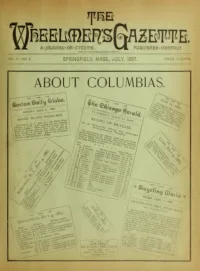
Articles in this issue
- Pope Manufacturing Co. continues its season advertising for the Columbia range, summarising the machines' competitive strengths and inviting prospective wheelmen to inspect them at branch offices across America.
- The Springfield Bicycle Mfg. Co. repeats its detailed mechanical description of the Roadster's clutch, emphasising smooth and noiseless operation and freedom from dangerous headers.
- The King Wheel Company argues their lever bicycle is the only machine in which levers are raised without springs, saving energy for amateur riders and making it the most practical hill-climber.
- A. W. Gump of Dayton, Ohio advertises the largest stock of second-hand bicycles in America, taking in machines in exchange, offering cash for second-hand wheels, and providing repair and plating services.
- W. G. Wilcox presents the six Facile patterns for 1887 including the new Geared Facile front-driver with 21 rows of balls and no chain, described as the fastest machine ever produced.
- Sam L. T. Clark and Co. of Baltimore advertise a clearance sale of tangent-spoke light roadsters, direct-spoke full roadsters, safeties, and tricycles at prices formerly ranging from $125 to $165, to make room for incoming New Rapids and Quadrants.
- Signed "Phoenix," a St. Louis correspondence column surveys the post-League-meet cycling boom in St. Louis, the new St. Louis Cycle Club, rumors of Henry Ducker's departure from Springfield, the origin of the "old Frisco Club," and W. F. Foster's long-running complaint about his 1882 expulsion from the L.A.W.
- A short comic dialect poem, signed "Tentoone," about the stir a passing "bicycle man" causes among girls and shopkeepers.
- Reports Henry E. Ducker's farewell from Springfield for a new position in Buffalo, reprinting testimonials and news accounts of the Springfield Bicycle Club's reception in his honor, including a life-membership resolution and a gift of Haviland china.
- Reports the Long Island Wheelmen's new clubhouse and moonlight excursion, Brooklyn Bicycle Club road races at Bath, a dangerous carriage collision with wheelman Wm. Schumacher, and full results of the King's County Wheelmen's sixth semi-annual race meet.
- A poem by James D. Dowling celebrating the impending publication of Karl Kron's long-delayed cycling road-book, "Ten Thousand Miles on a Bicycle."
- Correspondent "Pakeha" of Christchurch surveys new and growing cycling clubs across New Zealand and reports the season's long-distance road records and the year's Cyclists' Alliance bicycle championships, mostly won by W. D. Bean.
- "Chris" reports on Philadelphia's quiet racing season, Louis Kolb's inter-university and city championships, and touring news including Harold Lewis's European tandem trip and a proposed inter-club road race over Lancaster Pike.
- A dramatic retelling of the great Clarksville, Missouri hundred-mile road race among rival bicycle makers, in which Robert A. Neilson beat William A. Rhodes by 24 seconds to give the Victor team first and second place.
- Words and music by C. B. Holcomb of Tariffville, Ct., a rousing song for club runs celebrating the freedom of the open road.
- A comic account signed "G. W. N., Jr." of a February crust-cycling outing along the frozen Mohawk with a companion nicknamed "Poker," featuring header-filled encounters with cattle, a ram, and an angry farmer whose pig gets lassoed by mistake.
- The Ariel Wheel Club's tour to Washington and the Maryland Division's third annual meet at Baltimore, including a Soldiers' Home visit, an illuminated evening parade of 200-300 decorated machines, and full results of the Arlington race meet.
- Chris Wheeler concludes his history of the Philadelphia Bicycle Club, profiling captains Harold Lewis and Ewing L. Miller and clubhouse custodian G. N. "Gus" Osborne, and describing the club's growth to about a hundred members including several ladies.
- Thomas Stevens announces publication of Volume I of "Around the World on a Bicycle" and offers $500 cash prizes to whoever sells the most autograph copies and to a purchaser chosen by lot, aiming to sell 10,000 copies among wheelmen.
- Jas. Slack of New Knoxville, Ohio, reprints the state's 1886 law requiring vehicles to keep to the right and leave half the road; Stoddard, Lovering & Co. of Boston separately protest an advertisement disparaging foreign-made bicycles as discourteous to the trade.
- A long column of cycling-world items: Ducker's move to Buffalo, the passage of the L.A.W.'s "liberty bill," record rides by Woodside and Howell, club and division notes, and gossip on Thomas Stevens's book sales and the amateur rule debate.
- Full results of the Vermont Division L.A.W.'s annual meet at Montpelier (won by S. W. Kirkland and C. C. Fletcher) and the Springfield Bicycle Club's Fourth of July tournament at Hampden Park, headlined by a close mile-open race between Hart and De Blois.
- Describes a joint run of the Wilmington Wheel Club and visiting Pennsylvania Bicycle Club members to Kennett Square, new firebrick pavement trials in Wilmington, and the club's adoption of the League uniform.
- A directory of newly elected officers for wheel clubs including the Bay City Wheelmen of San Francisco, the Brunswick Bicycle Club, Capital City Wheelmen of Sacramento, Massillon Wheel Club, Passaic County Wheelmen, Terre Haute Bicycle Club, and the Washington (D.C.) Cycle Club.
- The monthly list of U.S. patents granted for cycling devices — bicycles, cyclometers, handle-bar attachments, and luggage carriers — compiled by patent attorney O. E. Duffy, followed by a parallel list of new English cycle patents including H. J. Lawson's military-velocipede designs.
- The Pope Manufacturing Company rebuts Gormully & Jeffery's account of the pending Chicago federal-court patent suits, disputing whose counsel sought postponement of the injunction hearings, reprinted from the Bicycling World.
- A tall tale in which the narrator, napping in a Florida swamp, wakes to find his bicycle chained to a sleeping alligator, which drags him through a bayou, down through the earth's center via a golden tunnel, and up through an artesian well in France.
- The Cycling Journal rebuts Lacy Hillier's Land and Water article accusing the Springfield Bicycle Club of forging letters in the English-amateurs dispute, walking through each of Hillier's claimed "fallacies" about the arbitration.
- Col. William V. Shelton Bey writes from Constantinople to Outing defending Thomas Stevens's round-the-world bicycle trip as thoroughly genuine, recounting Stevens's cool conduct under threat on the road from Meshed.
- Traveling salesman Lester E. Hickok of Birmingham, Ct. describes a ten-week, several-thousand-mile business tour of New England on his six-thousand-mile Expert Columbia, finding cycling faster than rail between towns and cheaper than his pre-bicycle trips.
- A tall tale, signed "F. W. P.," recounting a record-breaking dash from Trenton to New York pursued by a giant Jersey mosquito, which leaps the Hudson, crashes Barnum's circus tent, and is felled by an elephant.
- Charles E. Pratt, chairman of the L.A.W.'s Rights and Privileges committee, surveys the constitutional and legal basis for wheelmen's right to the road, citing restrictive statutes in North Carolina and Oregon and park-riding disputes in New York's Central and Prospect Parks.