The Wheelmen's Gazette, Vol 2, No 6
Articles in this issue
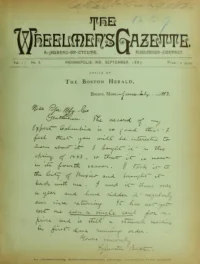
- The Boston Herald's office is cited in a testimonial context as recognising the Wheelmen's Gazette's advertisements, reflecting its growing readership and advertising standing.
- The Springfield Bicycle Mfg. Co. continues its season-long advertisement for the Roadster, highlighting the Yost and McCune clutch's smooth grip and complete safety against headers during hill descents.
- The King Wheel Company presents its September price list with parallel-bearing models from $75 and anti-friction bearing models from $95, with the usual clergy and first-county-purchaser discounts.
- The New York Bicycle Co. of Park Place advertises its speciality in exchanging second-hand machines for new Sparkbrook, Quadrant, New Rapid, Victor, and other high-grade makes.
- George W. Rouse and Son of Peoria offer easy payment terms on New Rapid, American Champion, Star, Rival, Otto, and other cycles, along with a comprehensive catalogue of second-hand machines.
- Sam L. T. Clark and Co. of Baltimore continue their clearance sale of high-grade lightweights and full roadsters, priced from $125 to $165, available with approval return privileges.
- The editorial column reports a general revival of interest in path and road racing during August and September 1887, and notes the League of American Wheelmen is threatening to prohibit road racing under penalty of expulsion, making it all the more popular as forbidden fruit.
- A report notes that arrangements are underway for a thousand-mile road race from Boston to Chicago, reflecting the growing enthusiasm for long-distance competitive cycling events.
- An extended editorial review debates the merits and structure of Karl Kron's massive travelogue "Ten Thousand Miles on a Bicycle," weighing its narrative chapters, including "A Fortnight in Ontario" and the original Big Four road race, against its reference-heavy statistical sections.
- A satirical send-up of sentimental romance fiction, framed as a manuscript submitted by a young lady and mockingly annotated by the "Foreman" and "Intelligent Compositor," follows Irene DeLacey and cyclist Charley St. Clair through a header, a rescue, and a tandem-borne wedding.
- Correspondent "Stamson" reports on the poor state of English road surfaces encountered on a recent tour, describing dusty macadam, flint-strewn cross-country lanes that cut his new Facile's tires, and chalk-hill scenery near Biggleswade and Ripley.
- A reminiscence by "Verax" recounts New York's earliest cycling clubs of the early 1880s — the New Yorks, Manhattans, Lennox Club, Ixions, and Mercury Club — culminating in the meeting at Dr. Beckwith's dental parlors that founded the Citizens' Club.
- Correspondent "Eagle Rock" rebuts a report that New Jersey club officers oppose road racing, cites Irvington-Milburn course residents who welcome the races, and reprints a circular seeking $800 in subscription shares to fund a New Jersey Cycling and Athletic Association race meeting.
- Overman Wheel Co. of Boston advertises the Victor bicycle across two pages, touting its wins in open 100-mile events such as the Eastern Club Race and Wanderers' Road Race and its coasting and tire durability.
- A transcribed speech by Dr. J. B. Helwig to the Ohio Division banquet traces the bicycle's evolution from Baron von Drais's 1816 draisine through the velocipede and "bone-shaker" to the modern machine, and argues for its moral and economic advantages over the horse.
- A reader "Archibald" asks the editor for touring advice on the best route from Oshkosh to Kokomo and whether bicycles will doom the railroads; the tongue-in-cheek reply gives absurd landmark directions and dismisses the railroad-monopoly question.
- Gormully & Jeffery Mfg. Co. of Chicago advertises its line of saddles (Cobblestone, Wonder, Durea, Lillibridge), lamps (Challenge, Ideal, Champion), bells, and leather sundries, inviting trade correspondence.
- Correspondent "Olevyn" reports from Victoria on the rain-marred Jubilee Sporting Carnival races, won by W. G. C. Elliot and F. H. Shackelford, the founding of the Victorian Wheelmen's Association, and F. Wood's challenge to Con Dwyer for the professional championship of Australia.
- A second advertisement from the Baltimore dealer offers a free 60-page illustrated catalogue of full and light roadsters, Rover-pattern safeties, and single and tandem tricycles with Quadrant steering.
- A club humor narrative describes how the "Captain," "Secretary," and "Club Poet" conspire to convince their overtraining Racing Man that he is ill, staging a mock slow-paced training run until he explodes in anger on discovering the prank.
- A page of small trade advertisements includes the Marlin Fire-Arms Co.'s bicycle lock, C. H. Ross & Co.'s detachable luggage carrier, E. Taylor's bike polish, the Kellogg and Standard bicycle shoes, and Punnett's cycling tailoring of Rochester, N.Y.
- Reprinted from Harper's Young People, round-the-world cyclist Thomas Stevens recounts crossing a forty-mile Sierra Nevada snow-shed in the dark as a freight train bore down on him, and fording flooded rivers in Persia and Afghanistan by lashing his bicycle to fence posts or a rope.
- A comic sketch reprinted from Puck describes elderly Mr. Hasbeen reminiscing to a young lady about old-fashioned games before disastrously attempting to play lawn-tennis himself and fleeing in embarrassment after losing "Fifteen—Love."
- The Coventry Machinists' Company of Boston advertises its new easily-convertible tandem for two ladies, the Marlboro' Club Tricycle with a 26-inch steering wheel, and the Club and Universal Club bicycles.
- The Gazette's regular patent column lists recent British and U.S. cycling patents, including Yost and McCune's bicycle patent assigned to the Springfield Bicycle Co. and Pope Mfg. Co.'s non-vibrating handle-bar and velocipede lamp patents.
- Short notices review "The Road and Roadside" by Burton W. Potter, a Massachusetts highway-law reference from Little, Brown & Co., and Chris Wheeler's illustrated poetry collection "Rhymes of Road and River," priced at $2.00 from E. Stanley Hart & Co.
- A miscellany column reports Munger's return to the professional ranks, Geo. W. Nellis Jr.'s transcontinental tour of 3,369 miles in 64.5 days ending in San Francisco, and the confirmed thousand-mile Chicago-to-Boston road race starting October 3 along a route through Kankakee, Lafayette, Indianapolis, and Albany with dawn-to-dusk riding rules.
- Wm. Read & Sons of Boston offer a limited exchange for New Mail bicycles with Trigwell ball heads, H. B. Smith Machine Co. touts Star Bicycle road and safety records, and further small ads cover the Eureka Home Trainer, Associated Fanciers' pet guides, Humphreys' homeopathic remedy, and the A.C.U. pin.
- A touring-advice column urges realistic daily mileage of forty to fifty miles, recommends jersey-suit riding kit and rubber-wrapped luggage rolls attached with Lamson and Z. & S. carriers, and details pre-tour machine maintenance for bearings, brakes, and tires.
- Correspondent "Faed" reports from London on the drought-ruined English racing season, the amateur championship results won by W. A. Illston, J. H. Adams, and F. J. Osmond, the C.T.C.'s new tour-master system, and the controversial American professional team of Woodside, Temple, and Morgan riding for "Premier" cycles.
- A page of comic verse includes a cautionary poem about a transcontinental tourist whose life-insurance policy expires just before he crashes ten miles from home, a half-mile-race lament, and a dialect poem grumbling that county-fair premiums have all gone to "machines."
- Publishers Darrow Bros. offer a free Eureka Home Trainer to any club securing twenty subscribers to the Gazette or Record, or ten to both, plus a free Wheelmen's Reference Book for individual dual subscribers.
- A full page of unsolicited customer letters praises the Champion and Light Champion wheels for hill-climbing and comfort, from riders in Ann Arbor, Bloomington, Little Falls, and Jackson.