The Wheelmen's Gazette, Vol 2, No 7
Articles in this issue
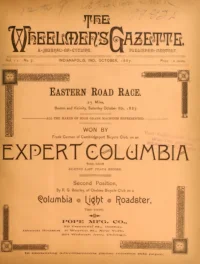
- Frank Carmen of Cambridge port Bicycle Club wins the 25-mile Eastern Road Race on 8 October 1887 on an Expert Columbia in a time of 1:34:29, beating the previous year's record, with second place also taken by a Columbia rider.
- Springfield Bicycle Mfg. Co. of Boston advertises The Springfield Roadster, built on the Yost & McCune patent crank-wheel clutch, claiming safe coasting and hill-climbing without headers, priced at $75 with enamel finish, nickel trimmings and a Fish adjustable saddle; John P. Lovell's Sons of Boston are named as sole New England agents.
- The King Wheel Company publishes October prices with hollow-rim anti-friction bearing models starting at $95 for the rear wheel only, and $105 for both wheels, plus a clergy discount of 10%.
- The New York Bicycle Co. promotes fair exchange prices on second-hand machines traded for new New Rapid and Sparkbrook bicycles, with their agent stock also including Quadrant Tricycles.
- H. B. Smith Machine Co. reports Star bicycle victories in the Eastern meet and cites accepted world road records from 150 to 305 miles and safety records from 1 to 20 miles on the track.
- C. H. Townsend of Newark offers printed Wheelmen's visiting cards for club members across twelve U.S. divisions, printed on heavy board with tinted ground at $1.00 per 100 cards.
- The Gazette offers a combined subscription package for clubs covering seven cycling and general periodicals — including the Gazette, Bicycling World, Outing, and Ten Thousand Miles on a Bicycle — for $6.25.
- M. A. Woodbury of Bradford, Pennsylvania advertises the Eureka home trainer at $3.50, described as a practical machine for developing muscles and maintaining fitness during the off-season.
- Karl Kron's 908-page touring narrative is advertised at $2 from Springfield Printing Co., featuring 41 chapters, 675,000 words, and 75 pages of indexes with over 22,000 references.
- A state-by-state roundup of September-October 1887 cycling news: L.A.W. membership reaches 11,537, a planned Rowe-England and Howell-America exchange and the Boston-to-Chicago road race both fall through, and division notes cover new clubs, races and appointed representatives from Arkansas to Wisconsin.
- Signed 'T. W. Eck' (OCR garbles the byline as 'T. W. Bck'), this opinion piece argues cycle racing needs class-based heats and forfeitable entry fees modeled on National Trotting Association rules to stop 'paper entries' and no-shows, naming racers Rowe, Whittaker, Crocker and Neilson and officials Henry Ducker and Abbot Bassett.
- Thomas Stevens, reprinted from Harper's Young People, recounts dangerous encounters while touring by bicycle through Asia Minor — caning a villager who hazed him with a stick, facing down an armed 'guide' near the Dela Baba Pass with a revolver, and startling locals who took his bicycle for a supernatural apparition.
- A reprinted letter exchange from the English paper Wheeling: a touring cyclist stranded and injured near Paris complains that the Cyclists' Touring Club secretary (Mr. Shipton) refused to help beyond directing him to buy the Continental Handbook, and the editors sarcastically reply that the C.T.C. exists to profit from its members.
- A comic poem reprinted from the Irish Cyclist, signed 'E. R. B.', describing a stout, forty-year-old novice and his cousin's disastrous tandem ride from Rathfarnham toward Bray that ends in a runaway descent into Dundrum, killing a hen and wrecking the machine.
- An essay reprinted from 'Bi. News' criticizing parents for mounting children on oversized or dangerously dilapidated tricycles, illustrated by an eight-year-old girl riding a rattling, barely-functional machine.
- Signed 'Stamson', this column favors Rover-pattern Safety bicycles over the high Ordinary for American roads, recounting a stiff 200-mile Liverpool-to-London test ride and arguing that England's celebrated 'sand-papered roads' are a myth no better than average American roads.
- S. T. Clark & Co. of Baltimore, importers and sole agents, advertise a free 60-page catalogue of 12 wheel patterns — Full and Light Roadsters, Rover-pattern Safeties and Quadrant-steering tandem tricycles, all with 'True Tangent Wheels' — billed as the leading 1887 line.
- Overman Wheel Co. of Boston runs a two-page advertisement for the Victor bicycle: one page boasts wins in open, all-comers 100-mile events such as the Eastern Club Race and the Wanderers' Road Race under the banner 'The Victor Fears No Competition,' the facing page touting the model's all-forged-steel, fully interchangeable construction and superior coasting.
- Reprinted from the Irish Cyclist and the Badminton Library cycling volume by Lord Bury and G. Lacy Hillier, this technical piece explains how proper ankle motion — dropping and clawing the foot through each segment of the pedal stroke — can increase a rider's effective power by roughly one-fourth.
- An untitled club-room yarn about 'Afternoon Jacobs,' a secretly professional racer whose training rides the narrator's fictional Kokomo club tried to sabotage with a decoy bicycle dressed as a ghost, only for Jacobs to smash the decoy machine — which turned out to be his own borrowed wheel — in a rage.
- Signed by Karl Kron, this piece stages a dialogue with Thomas Stevens defending 'Ten Thousand Miles on a Bicycle' against hostile notices from the Boston Herald and Pall Mall Gazette, then quotes favorable reviews of the book from eight papers including the Critic, the Nation, the Sun and the Evening Post.
- A first-person comic narrative told by an aging bicycle nicknamed 'Rudgie,' recounting its owner Charley's on-and-off romance, a rival's canoe taking Charley's attention away from it, and its eventual sale for seventy-five dollars.
- The Gazette debuts a puzzle column, 'Malleable Iron Nuts, Hard to Crack,' offering conundrums, enigmas, a diamond word-puzzle, a chess problem and a cut-up picture puzzle, with prizes including a Kangaroo bicycle and an imitation L.A.W. badge.
- A novella by George S. Darrow (the Gazette's editorial-department head) follows bank clerk Louis Spofford, mistakenly reported killed in a train wreck en route to inspect an inherited Indiana farm, who poses as 'Lord Winterford' during a natural-gas land boom in Bloomfield before confessing his true identity to Doctor Harper's daughter Clara.
- Signed 'Kay Bee,' a comic reminiscence about a bicycle ridden to visit an uncle's farm — beating Uncle Ned's horse Prince in a race home — before the machine is lost for good while the narrator uses it to herd a cow named Buttercup, who carries it off on her horns into the woods.
- Correspondent 'Eagle Rock' of Newark, N.J. covers the Karl Kron-versus-'Tommy' controversy, the New Jersey Cycling and Athletic Association's scramble to raise $500 in back rent to save its track, and a Jack Keen anecdote about winning a Wolverhampton match race on a borrowed Rudge bicycle after his own Eclipse buckled.
- Gormully & Jeffery Mfg. Co. of Chicago advertises its line of bicycle sundries and repair tools alongside a reminder that Frank Dingley's 100-mile record of 5:38:44.5, set at Lynn on Sept. 22 on their Ordinary Light Champion, still stands unbeaten.
- Saml. T. Clark & Co. of Baltimore advertises the Maryland Bicycle Club team's win in the Ten Mile Road Race around Druid Lake over the Baltimore Cycle Club and Rambler Cycle Club, naming Maryland placers Richard Whittingham, Walter Luscom, J. Kemp Bartlett, E. F. LeCato and S. H. Shriver, all but one riding Rapid bicycles.
- A full-page advertisement for Outing magazine's November number promotes its cycling, hunting, yachting and travel features — quoting Thomas Stevens' 'Around the World on a Bicycle' — for twenty-five cents an issue or three dollars a year, from its office at 140 Nassau Street, New York.