The Wheelmen's Gazette, Vol 2, No 9
Articles in this issue
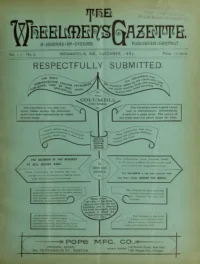
- Pope Manufacturing Co. closes the 1887 season with a brief dignified year-end statement inviting prospective buyers to assess Columbia machines at their principal office in Boston or at branch houses in New York and Chicago.
- The Springfield Bicycle Mfg. Co. advertises the $75 Springfield Roadster (Yost & McCune patent) with its improved clutch lever, Fish adjustable saddle and tool bag, claiming safety against headers and easy hill-climbing, with John P. Lovell's Sons of Boston named sole New England agents.
- The King Wheel Company's final price list for 1887 offers parallel-bearing crescent-rim models from $75 and hollow-rim anti-friction bearing models from $95, with standard clergy and county-first discounts.
- The Gazette again publishes its comprehensive combined subscription rate table for dozens of American periodicals, showing prices when bundled with the Gazette, the Record, or both.
- The December masthead notes that Darrow Bros. of Indianapolis are the proprietors, with G. S. Darrow handling editorial and P. C. Darrow the art department, priced at 50 cents per year.
- A state-by-state roundup of cycling news headed by the death of editor George S. Darrow on November 20 after a lingering attack of typhoid fever, plus Frank Dingley's new indoor records from 100 up to 350-plus miles, T. W. Eck's 50-mile safety record, and Kluge's win of the New Jersey road race.
- The Gazette's monthly patent digest, compiled by patent attorney O. E. Duffy for U.S. grants (including Harry M. Pope's and John Knous's velocipede patents assigned to the Pope Mfg. Co.) and by Hughes, Hughes & Hughes of London for British patents such as John Boultbee Brooks's brake-securing apparatus for velocipedes.
- A notice promoting the young people's monthly Wide Awake for 1888, offering combined subscriptions with the Gazette for $2.50 or with both the Record and Gazette for $3.45.
- A comic verse reprinted from the Omaha Chronicle about a showy bicycle rider undone when a small dog gets tangled in his spokes and pitches him to his knees in front of a laughing lady.
- A tongue-in-cheek Gazette feature suggesting Christmas gifts improvised from bicycle parts — a wheel-spoke ribbon placque, a tool-bag wall pocket, and a tricycle-tire baby jumper — as an economical alternative to store-bought bric-a-brac.
- M. A. Woodbury of Bradford, Pa. advertises the Eureka Home Trainer and Bicycle Stand, adjustable to different cycles and rider strengths, urging professional racers, scorchers and amateurs to keep in condition over the winter.
- The 908-page cycling book by Karl Kron is again advertised for $2, described as the most comprehensive touring narrative published, with 75 pages of indexes and over 22,000 references.
- H. B. Smith Machine Co. cites the Star's accepted world road records and its performance in hill-climbing contests throughout the 1887 season, inviting catalogue requests for the coming year.
- George W. Rouse and Son of Peoria concludes the season advertising easy payment plans for new cycles and a finely illustrated catalogue of second-hand machines available on request.
- Harry Corey recounts his latest English cycling trip, visiting Humber & Co., Rudge & Co. and the Coventry Machinists' Company in London, handling a 23-pound Cripper racing tricycle, and predicting the Rover-type rear-driving safety will soon hold all the speed records, citing G. P. Mills's new 24-hour distance mark on that type.
- A New York Tribune reprint describes women and girls increasingly taking up tricycling in Central Park, riding tandem with a male escort at a genteel seven or eight miles an hour, with the trend also noted in Boston, Philadelphia, Washington and Brooklyn.
- The Overman Wheel Co. of Boston advertises the all-forged-steel, fully interchangeable Victor bicycle, quoting its own catalogue's boast that the Victor has been 'found at the front' wherever hills are climbed or road records set.
- Chapters III to V of Chris Wheeler's serialized cycling romance follow Florence Saxton and her brother Jack, a champion Cambridge student and bicyclist, as his friendship with fellow cyclist Ed Carrington develops before the pair set off touring Scotland by wheel.
- The Gazette surveys the season's trade with the leading manufacturers — the Pope Mfg. Co.'s Columbia, the Overman Wheel Co.'s Victor (moving into a new Chicopee Falls factory), Gormully & Jeffery's Champion, William Read & Sons' New Mail, the H. B. Smith Machine Co.'s Star, the King Wheel Co., the Springfield Bicycle Co., Rudge & Co., W. B. Everett & Co.'s Singer cycles, and Samuel T. Clark & Co.'s New Rapid — each reporting strong 1887 sales and an optimistic outlook for 1888.
- An editorial questions whether the expense of salaried professional racing teams — one manufacturer reportedly spending $8,000 in a season — is better advertising than putting the same money into general publicity, road improvement, or lower prices for wheelmen.
- Reprinted from the Lynn Item: Charles E. Whitten of Merrill & Whitten unveils his own 53-inch, 37-pound roadster combining Star-style front steering with a crank-and-lever motion, timed at a third of a mile in 58 seconds on the Lynn track.
- A cycling club captain recounts, fireside, how a lost bicycle ride to inspect timberland once led him to a remote woodsman's cabin where he rescued a young woman, Kittie Clarke, from his own estranged step-brother — an encounter that ended in the captain's eventual marriage to her.
- The Gazette announces it is the American agent for the Irish Cyclist and Athlete's illustrated Christmas number, 'He-haw-watha' (text by Mr. French, illustrations by Orpen), selling at 15 cents and ready for delivery about December 20.
- The Boston Herald describes Frederick White of Worcester's new 75-pound tricycle, the White Flyer, whose cable-and-clutch driving mechanism (developed from his earlier 'Cyclone' tricycle) is claimed to deliver power steadily over sand, mud or obstacles without a balance gear.
- Club captain Scotty leads a Christmas Eve bicycle and tricycle run that turns into a secret mission when his party finds a boy, Pete, tending his sick father alone in a riverside cabin, prompting the wheelmen to sneak into town and arrange a Christmas turkey and gifts delivered via 'Uncle Billy.'
- A Civil War veteran's fireside anecdote about swapping goods across picket lines with a Confederate trader, and pitting the camp bulldog 'Mack' against a rival regiment's dog only to discover it stuffed with carpet-tacks.
- A full-page illustrated memorial — a moonlit road winding past a hooded figure and a burial urn — pairs the poem 'A Farewell' with a monogram reading 'P.C.D.', evidently art-department head P. C. Darrow's tribute to his brother and co-editor George S. Darrow, whose death on November 20 is reported elsewhere in this issue's Monthly Summary.
- Outing magazine advertises its January 1888 issue, highlighting Thomas Stevens's 'The Bicycly in India' alongside features on American wolves, aerial messenger pigeons and tarpon fishing, priced at 25 cents a copy or $3 for twelve numbers.
- Gormully & Jeffery Mfg. Co. announces that Stillman G. Whittaker of its Champion team lowered the world's 24-hour road record to 323 miles in 23 hours, 58 minutes and 35 seconds near Crawfordsville, riding an ordinary Light Champion Roadster rather than a specially built machine.
- A decorative advertisement for D. Rudge & Co.'s Coventry-made bicycles and tricycles names Stoddard, Lovering & Co. of Boston as sole U.S. agents for the 1887 line and invites readers to send for the catalogue.