The Wheelmen's Gazette, Vol 3, No 1
Articles in this issue
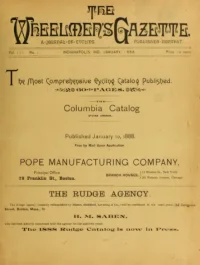
- Pope Manufacturing Co. announces the Columbia Catalogue published January 10, 1888 with free distribution by mail, covering the full season's range of machines.
- Following Stoddard, Lovering and Co. relinquishing the Rudge agency, a new operator announces they will continue the agency at the same Boston address, drawing on two years of active experience.
- The Springfield Bicycle Mfg. Co. announces two 1888 Roadster models — a $75 plain-bearing version and a $100 ball-bearing model with cow-horn handle-bars — both with identical mechanical construction.
- The King Wheel Company continues its lever-bicycle advertisements from the previous season, offering anti-friction bearing models from $95 and parallel-bearing models from $75.
- H. B. Smith Machine Co. promotes the Star's accepted world road records from 150 to 305 miles and its safety track records from 1 to 20 miles, inviting catalogue requests.
- Scovill Manufacturing Co. advertises the Concealed Camera at $15, a compact detective-style camera designed for cyclists and tourist photographers, with free catalogues available.
- Louisville jewellers advertise unique designs in racing medals for bicycle meets, L.A.W. pins, and monograms, serving as general agents for Gormully and Jeffery cycles in Kentucky.
- A satirical piece offering a mock program for bicycle club benefit entertainments: a bombastic president's welcome speech, a three-heat quartette race-song, the comic poem "Saved" about a Star-riding messenger who reaches the gallows in time, and a full parody bicycle melodrama, "Was It Fate?", complete with villain, heroine, and rescuing wheelman Cyrus Clometer.
- A satirical letter from a fictional circus promoter, "Tinhorn Joblots," proposing a traveling exhibition of bicycle racers with a mock program of joke events lampooning real riders like Whittaker, Hollingsworth, Rowe, and Howell.
- The editors announce the Gazette's absorption of the defunct Wheelmen's Record's subscriber list, promise a distinctively literary, non-partisan monthly free of the amateur-rule debate, and set a fifteenth-of-the-month publication schedule for 1888.
- An editorial argues the L.A.W. should decentralize by keeping most dues within state divisions rather than national headquarters, and firmly opposes admitting professional racers to League membership as a corrupting, self-interested element.
- A state-by-state and foreign roundup of cycling news from December 15 to January 15, 1888, covering club elections, the Wheelman's Record's closure, W. J. Morgan's 728 miles in 48 hours at Indianapolis, and English racing and life-boat fundraising news.
- A comic sketch in which a young poetess visits the Gazette office hoping to see her sentimental poem published, only for the editor to "improve" it verse by verse into an absurd, commercially-minded parody about tobogganing and tricycles.
- The monthly list of U.S. and English patents granted for cycling devices, compiled by O. E. Duffy and Hughes, Eli & Hughes respectively, followed by notes on the Irish Cyclist's Christmas parody "Hee-Haw-Watha" and the Overman Wheel Co.'s new boy's bicycle, the Victor Junior.
- C. W. Edgerton's detailed instructional article on handling, mounting, dismounting, coasting, hill-climbing, and machine care for ordinary-bicycle riders, including formulas for ideal crank and handle-bar length and testimony from veteran rider Henry W. Williams on avoiding falls.
- Chris Wheeler's serialized novel continues into Chapter V, with Florence and Jack discussing the tardy young Mr. Carrington and his uncle's wish that he try road-making and bridge-building in a British colonial dependency.
- A New Year's poem comparing the arrival of 1888 to a wheelman racing against Father Time down the track.