The Wheelmen's Gazette, Vol 3, No 4
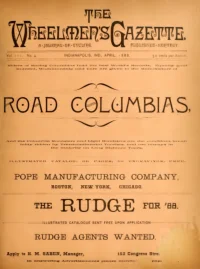
Articles in this issue
- Pope Manufacturing Co. promotes Road Columbia machines as holders of the best world records, with the majority of long-distance tourers riding them, backed by a free illustrated catalogue.
- The Rudge Agency at 152 Congress Street, Boston, announces the 1888 Rudge catalogue is ready and seeks new agents in unoccupied territory throughout America.
- The Springfield Bicycle Mfg. Co. confirms their 1888 Roadster distribution through five regional wholesalers covering New York, Chicago, St. Louis, San Francisco, and Boston, with retail from 147 Washington Street.
- C. H. Lamson of Portland, Maine, provides fitting instructions for his detachable luggage carrier — patented Feb. 7, 1882 and used by Thomas Stevens on his round-the-world bicycle tour — and quotes Karl Kron's endorsement of it as the best luggage carrier ever devised.
- Clark Cycle Co. announces their agency for Lucas Son's King of the Road lamps and publishes a new 1888 catalogue covering New Rapid and Quadrant cycles with a complete lamp price list.
- A classified section carries private advertisements for second-hand cycles including a Facile, Expert, Victor, Columbia Light Roadster, and American Light Champion, with exchange offers for violins and typewriters.
- A brief advertisement promotes a 25-cent guide to cycling touring in England and Wales, covering the practical details from start to finish that tourists most want to know.
- The Gazette publishes an expanded list of dealers and newsstands nationwide carrying the paper, from Hart Cycle Co. in Philadelphia to Osborn & Alexander in Los Angeles and San Francisco and S. B. Wright in Denver.
- Clark Cycle Co., successor to Sam'l T. Clark & Co., claims credit for introducing true tangent spoke construction to America and argues its New Rapid cycles and Quadrant tricycles remain unmatched for the 1888 season.
- The Overman Wheel Co. of Boston offers its free 1888 catalogue covering the Victor Light Roadster, Victor Safety, Victor Tricycle and Victor Jr. Bicycle line.
- A club-room storyteller reads a letter from "Hoosier Holler" describing a rural church debate over whether the bicycle or natural gas is the greater force for civilization, judged by a jury of church stewards who compromise that true progress awaits a bicycle that runs on natural gas.
- A list of U.S. patents granted January-March 1888 for cycling inventions, including Emmitt G. Latta's several velocipede saddle and fork patents assigned to the Pope Mfg. Co. and George W. Rodecap's two-small-wheel tricycle.
- A roster of British patents filed January-March 1888 for cycling improvements, including Dan Albone's "improved velocipede," Stephen John Rose's new dwarf safety bicycle, and Reginald George Fletcher's velocipede adapted to military purposes.
- A contributor signed "Namdets" recounts a February club run of twelve Covington, Kentucky wheelmen to Independence, including a rider's collision with an oyster peddler, a climb of Independence Hill, and a rain-soaked return home packed onto a bus.
- An editorial criticizes the joint editors of the Bicycling World and L.A.W. Bulletin, Bassett and Fourdrinier, for airing petty contradictions in the League's official organ instead of presenting a unified voice to members.
- Forty wheelmen sat down to an elaborate French-menu banquet served by Mr. McKinnie of the Wayne Hotel, with toasts including P. C. Darrow's "The Road Hog—We Despise Him" and Leroy Hartzler's "A Bicycle Ballad."
- A state-by-state roundup of L.A.W. division and club news from mid-March to mid-April 1888, covering officer elections nationwide, the League's semi-annual convention moving officer elections to July, and the Philadelphia 24-hour race won by H. G. Crocker with 405.25 miles.
- H. W. Burmester and J. J. Bliss's century run around San Francisco Bay on March 25 turns comic when a hungry Burmester asks a passing minister for directions to the Fredericksburg brewery and is told to seek a church instead.
- Correspondent "Gies" reports H. D. Corey and Art Taylor touring Chicago-area trade, including a visit to the Joliet penitentiary where 1,346 convicts work under Captain Chas. Gross, and previews Bob Garden's planned Pullman road race.
- Correspondent "Red Eye" reports the reorganized Minneapolis Bicycle Club under President Wm. Pauly, new 1888 Victor stock at F. A. Lealand's, and local road times including Colie Bell's 2:57 mile.
- The Atlanta Wheelmen list the silver and bronze prizes for their April 16-17 race meet, including a $75 silver epergne for the five-mile state championship and a $50 cut-glass wine set for the ten-mile handicap.
- A reprinted Fort Wayne Gazette poem marks the changing season, with sleigh bells falling silent and wheels soon to "hum" on the road again.
- England's National Cyclists' Union will consider an amendment disqualifying any amateur who enters an open or advertised road race for a year, with permanent disqualification for a second offense.
- Miss F. K. Erskine, writing in The Queen of London, instructs lady tricyclists on proper dress, posture and pedaling technique, insisting on a plain tailor-made walking gown and quiet, dignified riding rather than the "crouching" style of novices.
- The Vicomte De La Tour-Pin-Verclause's practical steam tricycle, fueled by coke needing replenishment only every 45 minutes, is reported to reach 26 miles an hour on good roads with a loaded road cart attached.
- Correspondent "Looker-On" recounts a rumored hippodrome race between Surbridge and Roe, R. D. Garden's $2,500 single-day sales record at the Pope Co.'s Chicago branch, and T. W. Eck securing Gormully & Jeffery's permission for Whittaker to race in England.
- Correspondent "A.S." reports the newly formed Crescent Wheelmen elected J. White president, the Kentons awaiting delivery of their first tandem, and the Avondales' new gymnasium and billiard room.
- Three postal cards from Joe Bowers, Billy Griggs and Jim Rose each claim a different, escalating mileage — 20, 45 and 100 miles — for the same club ride, leaving the editor to ask "who is the Annanias?"
- The fifth annual Indiana Wheelmen's tour is being planned to run from Indianapolis through Cumberland, Knightstown, Richmond, Dayton and Hamilton to Cincinnati and Kentucky, finishing at Mammoth Cave.
- Writing as "Stamson," a touring cyclist recalls an English summer tour through dry, dusty lanes to the Blue Boar Inn and the sleepy village of Old Woring, noting the huge Norman draft horses, straw-thatched cottages, and the region's driest summer in years.
- A comic recitation program frames a run of verses as after-dinner boarding-house banter, including "The Landlady's Story" on Dr. Tanner's forty-day fast and a closing "1788"/"1888" poem contrasting a horseback suitor with a modern wheelman's courting call.
- A narrative poem recounts Billy Rowe's celebrated hour record — 44-plus laps of a half-mile Springfield track in October 1886 — paced by Hendee and Woodside to scatter records left and right.
- A. W. Gump & Co. of Dayton, Ohio, offers new 1887-pattern wheels bought wholesale from the factory at cut prices, from a 44-inch machine reduced from $40 to $27 up to a 52-inch reduced from $60 to $40, plus over 250 second-hand bicycles.
- Gormully & Jeffery declares it will not claim false or superseded records, but guarantees its wares as represented and stands by a wheel capable of every world's road and long-distance record.