The Wheelmen's Gazette, Vol 3, No 6
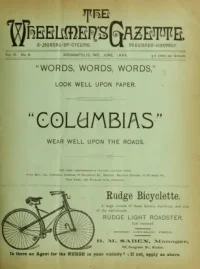
Articles in this issue
- Pope Manufacturing Co. contrasts empty advertising claims with Columbia's proven road record, arguing that words look well on paper but Columbias wear well on the roads, with the free comprehensive catalogue available.
- The Rudge Agency at 152 Congress Street, Boston announces a large invoice of Rudge Bicyclette safety machines and Rudge Light Roadsters just received, inviting inquiries from anyone without a local agent.
- H. B. Smith Machine Co. announces the 1888 Star as the best road bicycle and best hill climber, with free catalogues now ready for distribution.
- Outing magazine promotes its June issue including a leading article on cycling around the world, offering annual subscribers a free bound back volume worth two dollars.
- The Indiana Bicycle Company of Indianapolis advertises spade handles for any bicycle at $2.50 and machine steel cow-horn handle-bars, plus nickel-plating services, accepting second-hand bicycles in trade.
- Clark Cycle Co. of Baltimore promotes the New Rapid Roadster at 40 pounds and the New Rapid Light Roadster at 33 pounds, highlighting true tangent spokes, thickened hollow rims, and hollow detachable handle-bars as reasons why they rarely appear on second-hand lists.
- The King Wheel Company promotes the 1888 King Bicycle as a greatly improved roadster with lever drive and constant power application, suitable for muddy, sandy, or hilly roads.
- H. T. Hearsey of 147 North Delaware Street, Indianapolis advertises new and second-hand bicycles, with second-hand machines taken in trade for new ones.
- Simonds Rolling Machine Co. of Fitchburg, Massachusetts again advertises hardened, ground, and burnished cast steel balls from 3/16 to 3 inches in diameter for bicycle anti-friction bearings.
- A humorous retrospective of League of American Wheelmen annual meets from the first at Newport in 1880 through Boston in 1887, poking fun at attendance figures, parade mishaps, and the League's growth toward the upcoming Baltimore meet.
- Concluding installment: a second detective, Silas G. Stevenson, joins the absurd hunt for the narrator's missing borrowed Star, sending increasingly wild telegrams chasing decoys across Illinois and Wisconsin, until the machine's owner is discovered riding it himself — he had simply reclaimed his own bicycle from the club house.
- Describes the Pullman road race from Chicago's Leland Hotel on Decoration Day, with eighty-seven entries competing for twenty prizes; Lumsden of the Fort Dearborn Club finished first despite an eleven-minute handicap, and Winship won the gold medal for fastest time.
- Full results of the May 30 Terre Haute race meet's twelve events, with Crawfordsville riders winning three races and Terre Haute riders taking the rest.
- Outlines the Indiana Division's fifth annual tour beginning July 8 at Indianapolis, running through Morristown, Rushville, Connersville and Brookville to Cincinnati, then by boat to Maysville, Ky. and on through Kentucky to Louisville by July 15.
- A state-by-state and foreign roundup of club news, races and elections from May 15 to June 15, 1888, a list of coming events, and a note on Karl Kron's continued avoidance of League meets and public appearances.
- By "Carlos": a detailed preview of the June 18–20 Baltimore League meet program, covering the reception committee, the parade route to Druid Hill Park, races at Arlington, the smoker at Concordia Opera House, and the closing steamer excursion to Annapolis and Bay Ridge.
- Reports that champion racer W. A. Rowe broke his collar-bone and suffered serious internal injuries in a header immediately after defeating W. Wood at Jarrow, England, with a friend doubting he will race again.
- A first-person fiction piece recounting how an eccentric acquaintance named Smith, after taking up tricycling, was found to have long premeditated riding his machine off a coastal cliff called High Rock Cove, with the narrator's frantic chase to intercept him arriving just too late.
- An essay comparing the ordinary bicycle, tricycle, and rear-driving safety on speed, safety, hill-climbing, luggage capacity and suitability for different riders, concluding each type suits a different kind of road and rider.
- Profiles the two English-born founders of the Gormully & Jeffery Mfg. Co., covering Gormully's rise from an 1868 immigrant to company president and Jeffery's pioneering bicycle manufacturing in Chicago dating to 1878, including his early conflict with the Pope Mfg. Co. over patents.
- By Joseph J. Bliss, the second installment covers the ride from Gilroy over the Gavilan mountains to Natividad and Salinas, and a tense crossing of the flooded Salinas River with the help of a passing teamster.
- A correspondent reports on Australian cycling: the January amateur championship at Adelaide won by Davis, the collapse of the Victoria Wheelmen's Association, Fred Wood's return to England, a scandal over an English visitor competing without Union permission, and upcoming Melbourne race meetings.
- Describes the Eagle Bicycle's design, which directs the rider's weight downward onto the pedals and the larger wheel for easier hill-climbing and obstacle-crossing, patented by J. B. Taylor of Stamford, Conn.
- A comic verse story in twelve chapters about a touring wheelman who runs up a hotel bill he cannot pay, then tricks the innkeeper with a demonstration ride before speeding off down the pike without settling his debt.