The Wheelmen's Gazette, Vol 3, No 9
Articles in this issue
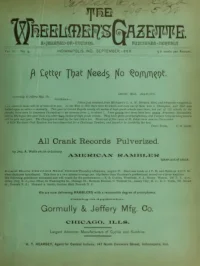
- A letter from C. H. Smith of Detroit describes the meteoric rise of the American Champion: at the 1887 Michigan division meet there was only one Champion in attendance, but at Grand Rapids in 1888 there were 34 out of 112 wheels in the parade.
- Gormully and Jeffery announce that after months of delays driven by demand, they are now shipping American Rambler safety bicycles with a reasonable degree of promptness.
- Gormully and Jeffery report that John A. Wells climbed Eagle Rock Hill on an ordinary bicycle taken straight from stock at a pace two minutes per trip faster than Shurman's professional lever-machine record, naming six witnesses who vouch for the timed performance.
- Clark Cycle Co. invites cyclists to trade second-hand machines in part payment for New Rapid Roadsters, New Rapid Light Roadsters, Quadrant Tricycles, or Quadrant Tandems, asking for a full description of condition and their estimate of value.
- Springfield Bicycle Mfg. Co. again publicises J. Harry Shurman's Eagle Rock hill achievement and the three L.A.W. Baltimore race victories, adding a letter from a Medina, New York club where 16 of 20 members ride Roadsters.
- The classified section lists a Victor tricycle for sale, a Columbia bicycle at $65, and a 1888 pattern American Champion used only a few times, seeking $85 for a machine that cost $105.
- Kingston Knitting Co. of 27 Kingston Street, Boston, advertise jerseys, coats, sweaters, knee tights, knickerbockers, and full body tights in fine worsted, endorsed by hundreds of clubs.
- A private advertiser in Indianapolis offers a Victor Light Roadster ladies' tricycle in first-class condition with ball bearings throughout at $50, having been ridden for about six months.
- Clark Cycle Co. promotes the Quadrant Tricycle No. 8, winner of the one-mile L.A.W. tricycle championship at Baltimore, and the Quadrant Tandem No. 15, alongside a ladies' model, No. 14.
- The King Wheel Co. of New York explains that its lever drive provides constant power application, that placing the treadles behind the hub prevents headers, and that the wheel glides through mud, sand and hills without tiring the rider.
- A detailed maintenance guide covering cleaning nickel-plating and chains, flushing and oiling ball bearings with coal oil, clearing choked hind wheels and pedals, and the correct oiling intervals for cone versus ball bearings.
- Step-by-step instructions for a beginner to learn the ordinary bicycle — starting on a low machine or boneshaker, mastering the step mount, pedalling, and several methods of dismounting including the pedal dismount and throwing the legs over the handles.
- "Violet Lorne" gives encouraging advice to women learning the safety bicycle after mastering the tricycle, followed by The Cyclist's guidance on how a lady should sit the front seat of a tandem, with correct saddle height and minimal pedalling effort.
- Practical roadside and workshop repair advice covering truing a buckled wheel, re-heading stretched spokes, cementing a loose tire, straightening a strained backbone or bent handlebar, and splinting a broken spring.
- A detailed review of the first Buffalo World's Tournament, covering the rough track surface, the Rowe–Temple rivalry, English visitors Allard, Lee and one-legged rider West, Windle's dominant amateur record, and complaints about the officiating.
- Describes a New England mechanic's coin-slot device for renting tricycles, which locks the sprocket wheel an hour after a half-dollar is dropped in, with a planned improvement to bring the machine to a gradual rather than sudden stop.
- Full results of all four days of racing at the September 1888 Buffalo World's Tournament, including Windle's amateur sweep, Rowe's disqualification-tainted and later clean wins over Temple, and the closing $1,000 professional world championship heat.
- A miscellany of tournament sidelights: 1,153 wheels in the parade, the Zig Zag Club's ram's-horn bars, a one-legged English racer, a Star-bicycle-drawn fire engine, a ladies' reception at the Buffalo Bicycle Club, and historic machines on exhibit including Thomas Stevens' round-the-world wheel.
- An account of a dozen Fresno Wheelmen touring the Fresno, Eisen and other vineyards, swimming at Fancher Creek, and a comic mishap borrowing a knife from a vineyard cook named Jake.
- Results of the Erie-to-Buffalo road race run over heavy, rain-soaked roads, with F. M. Dampman finishing first and Frank McDaniel second, both riding Victor Light Roadsters.
- A comic monologue by a Niagara Falls hack-driver lamenting how a hundred wheelmen bicycled past his cab in a body, costing him a fare he had been counting on.
- Reports that S. G. Whittaker of Chicago covered 21 miles 126 yards in one hour at Bordeaux on a Rover Safety, breaking the world's record, with the full authenticated lap times printed.
- By J. J. Bliss: reports Mrs. Emmons' 41-mile tricycle trip from Alameda to San Jose, the election of Edwin Mohrig as California Division Chief Consul, and the Bay City Wheelmen's fourth anniversary smoker.
- By "L. B.": describes a disappointing Labor Day parade turnout in Denver due to working hours, a new eighth-mile training track built by John Rutherford, and praise for Knapp and Eastwood's showing at Buffalo.
- Announces the newly elected Indiana Division officers: J. Fred Probst as Chief Consul, W. H. Pontious as Vice Consul, Josh Zimmerman as Representative, and A. N. Smith as Secretary-Treasurer.
- A state-by-state and foreign roundup of club news, races and tours from August 15 to September 25, 1888, including Whittaker's Bordeaux record and a note defending the Ideal child's tricycle against Dr. Richardson's criticism of heavy children's machines.
- By Joseph J. Bliss, continuing the third day: paying a ten-cent toll for a bicycle at a bridge near Castroville, a rough ride through Watsonville and Aptos, a spill in a boggy creek crossing, and a late arrival by moonlight at Santa Cruz's Pacific Ocean House.
- Reprints a long letter from a Danish-born librarian in Stawell, Victoria, describing his recovery from a paralytic stroke through tricycling, his praise for Karl Kron's book, and observations on the undeveloped state of Australian touring and cycling literature.
- A comic short story of two touring wheelmen, the narrator and Sam, who are lured off the road by young ladies from a country boarding-house, fall asleep in hammocks, and are discovered decorated with hats and a milk pail before joining a country picnic.
- A historical survey of early cycling machines from Ozanam's 1693 pedal carriage through Niepse's wooden bicycle, the 1819 English "Pedestrian Hobbyhorse," and period caricatures by Cruikshank, tracing the idea's revival around 1870.
- George W. Rouse and Co. of Peoria, Illinois advertise second-hand wheels bought, sold, and exchanged, plus new cycles including Victor, Springfield Roadster, Star, and Otto on easy payments at eight percent interest.